
The 9 best basement conversion companies in London for 2026, and how to choose

If you want a straight answer: the best basement conversion company in London for 2026, on our own list, is Beams. We would say that, because we are Beams, so treat the ranking as a starting point and the rest of this page as the useful part.
There is no independent league table for London basement conversion companies. Nobody audits this category. Every "best of" list you will find, including this one, is written by someone with an interest, and the ones that do not admit it are the ones to be most careful with.
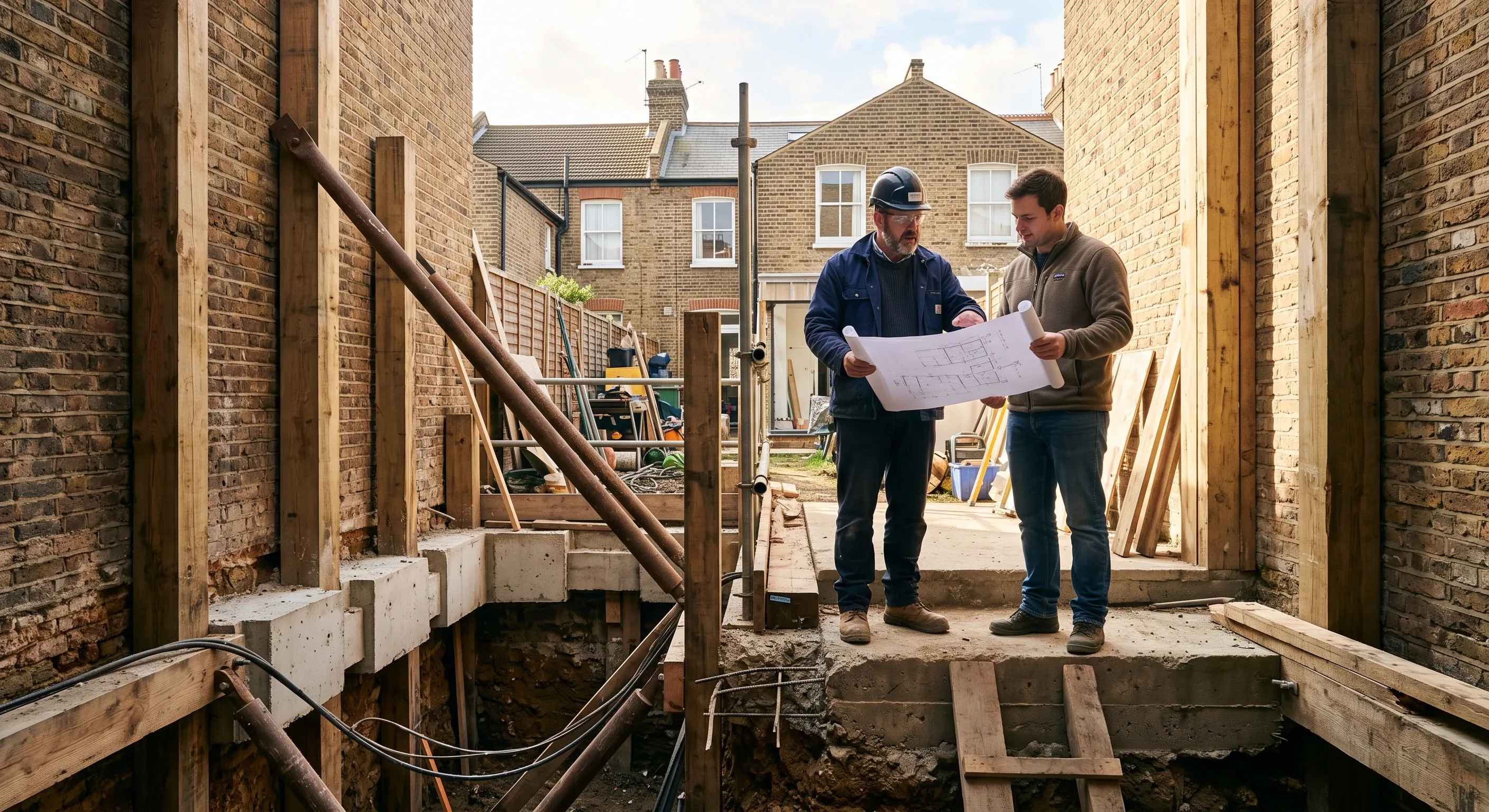
How we built this list
We started from the companies that appear repeatedly in London basement conversion searches and industry coverage, then read each one's own website in September 2026 and recorded only what they publish about themselves: how long they have traded, where they work, what they specialise in and how they describe their own service.
We have deliberately not scored the other companies against our five criteria. Their contract terms, vetting and warranty cover are not consistently published, they change, and we are not a neutral party. Publishing a grade we cannot stand behind would be worse than publishing nothing. So the criteria below are yours to apply, to us as much as to anyone else.
Why basements carry more structural risk than any other renovation
A loft conversion works inside a roof that is already holding itself up. A basement conversion takes the ground out from underneath a wall that is holding up the whole house, which is a different order of risk. Most London terraces and semis sit on foundations only 600mm to 900mm deep, nowhere near enough for a habitable basement, so the existing foundation has to be extended downward in short numbered sections called underpinning, with no more than a fifth of any wall left unsupported at once. Bays typically run 1.0 to 1.2 metres long and up to 2.5 metres deep, and depths beyond about 3 metres usually call for piling instead. Building control is engaged under Approved Document A whether or not planning permission is needed, and a company that cannot name the structural engineer signing off the design has not thought about this stage at all. Our guide to underpinning versus digging down explains how the sequence actually works.
Waterproofing is a separate discipline from structure, and BS 8102:2022 is the standard the industry and every insurer measures against, even though it is guidance rather than law. It sets out three types of protection, a barrier system, a structurally integral concrete box, or a drained cavity membrane that lets water in and pumps it out, and four performance grades depending on what the room is used for. Most retrofit basements cannot use the structurally integral option, since that suits new-build construction, so a barrier and a cavity drain system are typically combined instead. The specialist appointed to design this should hold a CSSW qualification and be a different person from your structural engineer, however good that engineer is. Our guide to basement tanking and waterproofing sets out what each grade means in practice.
Then there is the neighbours. Excavating within 3 metres of next door's foundations and deeper than them, or within 6 metres if the dig would cut a line drawn at 45 degrees from the bottom of theirs, triggers the Party Wall Act 1996, and a basement dig in a typical London terrace does this on both sides at once rather than one. That can mean two or three sets of neighbours, two or three surveyors, and a published London rate of £1,800 to £2,500 or more per neighbour for a basement, the highest category on any surveyor's price list we have found. Serve notice on both sides on the same day, because staggering them staggers your own start date. Our guide to party walls in London terraces covers what this means house by house.
The five checks that predict whether a basement conversion goes well
What to check | What to ask | A good answer sounds like | Why it matters |
|---|---|---|---|
Who is doing the work | How did you check the builder who will actually be on my job, and what did you find? | We met them in person, took references on recent jobs, inspected work they finished this year, and here is their public liability certificate. | A company that subcontracts to whoever is free that month has checked nothing on your behalf. |
Whether the price is fixed | Is this a fixed price or an estimate, and what happens if the ground conditions or an existing foundation turn out to be a problem once you dig? | Fixed, in writing, before excavation starts, and anything found once the ground is open is priced and approved before it is done. | Once the ground is open, structural surprises surface. A fixed price decides whose problem that is. |
Where your money sits | When do I pay, and who holds the money between my payment and the work being done? | Staged payments tied to work you have signed off, held securely and released only on your approval. | Pay ahead of the work and you are an unsecured creditor of your builder. |
What happens if it fails | What is covered if the waterproofing or the finish fails six months after handover, and who pays if the builder is no longer trading? | Twelve months on workmanship, in writing, with cover that still stands if that builder has gone. | A warranty is only worth as much as whoever is still standing behind it. |
Who owns the structural and waterproofing risk | Who is responsible for the structural engineering sign-off and the waterproofing and tanking system, and who manages the party wall agreements with the neighbours on both sides? | One named structural engineer, one named waterproofing specialist working to a specified BS 8102 grade, and party wall agreements in place with all affected neighbours before excavation starts. | Basement conversions carry the highest structural risk of any renovation type. Getting this wrong can affect neighbouring foundations, and it is the largest single source of disputes, delays and remedial cost. |
What a London basement conversion actually costs
Converting a cellar you already have costs £1,080 to £1,680 per square metre including VAT nationally, or £37,500 to £58,500 for a 30 square metre cellar in London. Lowering that same cellar to gain proper headroom, which means underpinning the existing walls, costs £2,100 to £2,800 per square metre including VAT in London. Digging an entirely new basement under a London house is a different order of project again: £7,200 to £12,000 per square metre including VAT, commonly £288,000 to £480,000 for a 40 square metre basement, with £360,000 a realistic central figure.
Project | Typical cost including VAT |
|---|---|
Converting an existing cellar (30m²) | £37,500 to £58,500 in London (£1,080 to £1,680/m² nationally) |
Lowering an existing cellar for headroom (30m²) | £63,000 to £84,000 in London (£2,100 to £2,800/m²) |
Digging a new basement under the house (40m²) | £288,000 to £480,000 in London (£7,200 to £12,000/m², £360,000 typical) |
Our full basement conversion cost guide breaks down where that sevenfold gap between the cheapest and most expensive route actually comes from, and the figures above are taken directly from it.
None of those figures include professional fees, typically 12 to 18 per cent of construction cost for the architect, structural engineer and cost consultant combined. Building control adds its own charge on a cost-recovery basis that varies by borough, for example Camden currently charges £1,875.55 including VAT for a basement up to 60 square metres plus a further £1,640.94 for the first 10 metres of underpinning. Then there is the party wall surveyor, and our guide to party wall notice and agreement costs shows a basement is the single most expensive category on any published list, at £1,800 to £2,500 or more per neighbour.
The companies
1. Beams
Beams is not a builder, and that is the whole design of it. It sits between you and the trade, and you can take as much or as little of it as your project needs. Some people want the lot: a design produced in house, then a vetted builder matched to deliver it. Others arrive with drawings already done and want only the builder and the protections. Both are normal.
What stays constant is the structure around a managed basement conversion. Builders in the network have been met in person, had references taken and recent work inspected, and each carries at least £6m of public liability cover. Your build is priced and delivered on a fixed-price contract signed before anyone starts, and the builder runs it day to day rather than Beams. Your money moves in stages, held securely, released when you sign off the stage it belongs to. Workmanship is warranted for 12 months, and if that builder leaves the network inside the year, Beams puts up to £10,000 behind putting it right.
Beams is a certified B Corp and has delivered hundreds of London renovations across kitchens, bathrooms, extensions and whole houses. On Beams' own figures, once a design and scope are agreed, projects run an average of 1.8 per cent over budget and finish around 2 per cent ahead of schedule.
2. LCCL Construction
LCCL Construction is an award-winning design and build company trading for over 20 years, registered as House Extension Company London Limited. It works from Finchley across all of London and into Hertfordshire, naming Barnet, Hampstead, Highgate, Islington, Camden, Enfield, Putney, Chelsea, Fulham, Ealing, St Albans and Watford, and reports more than 350 completed projects. Loft conversions and extensions are the core, with basements and new builds alongside, and it offers architecture, planning and party wall services separately. It is an NFB member and an LABC Registered Partner, and won an LABC regional award in 2024.
3. NU Projects
Trading since 2010 and describing itself as a premium design and build service, NU Projects brings architecture, interior design, project management and construction under one roof, with mechanical and electrical work and bespoke joinery in house too. It works across Prime Central London and the south west, naming Fulham, Battersea, Wimbledon, Barnes, Chiswick, Richmond, Chelsea and South Kensington, and takes on renovations, extensions, basements, lofts and new builds. It displays NICEIC and Gas Safe registration.
4. houseUP
houseUP is a London construction company specialising in high-end residential and commercial work, offering design and build while partnering with architecture practices on the design side. It has offices in Covent Garden and Hackney, with projects named in Belgravia, Chelsea, Highgate, South Kensington, Shoreditch, Hammersmith, Chiswick and Greenwich. Alongside renovations, extensions, lofts and basements it lists conservation architecture, structural glass, soundproofing and sash window work, and says it has handled basements in listed buildings and conservation areas.
5. Simply Basement
Simply Basement is part of the Simply Construction Group, alongside Simply Loft and Simply Extend, and works across the majority of London. It offers a fully bespoke design and build service for basement conversions, from cinemas and gyms to home offices and playrooms, with specialist modifications such as skylights, sun pipes and lightwells built in. Projects are quoted at a fixed price with a dedicated site foreman managing the work, and every basement comes with a 10 year guarantee.
6. Abtech Basements
Abtech Basements, trading as Abtech (UK) Ltd, is a specialist basement construction and waterproofing company whose directors, David Hilton and David Greentree, bring over 50 years of combined experience in ground engineering. It works throughout London and the wider south of England, with clients from Coventry down to the Channel Islands, and employs its own directly trained workforce rather than subcontracting. Alongside full basement conversions it offers a standalone waterproofing service for existing basements with damp issues.
7. Proficiency Design & Build
Proficiency has been designing and converting basements across Greater London for over 14 years from its base in West Hampstead. It is Federation of Master Builders verified and a Considerate Constructors Scheme member, carries £5m of public and employers' liability cover alongside £10m of contractor's all risk and indemnity cover, and puts a dedicated project manager and structural engineer on every job. Waterproofing is handled with Delta Membrane Systems cavity drain installations, and the company covers North London, Fulham, Putney, Chiswick, Chelsea, Kensington, Wandsworth, Battersea, Clapham and Ealing.
8. Alstruct Ltd
Alstruct was founded in October 2023 by brothers Altin and Dino Hallaci, with Altin working as a civil engineer on projects up to £160m before starting the company on a single residential extension in Highgate. It has since grown to a team of twenty running five to six simultaneous projects and around £1.7m in annual turnover, and holds CHAS Elite and Constructionline Gold accreditation alongside Federation of Master Builders membership. Basement work is quoted at a fixed price on a JCT contract with a 10 year workmanship warranty, backed by £10m of public liability cover, and covers cellar conversions, full dig-down excavations, lightwells and underpinning across areas including Hampstead, Kensington, Chelsea, Islington and Wimbledon.
9. Michael Brady Ltd
Michael Brady Ltd, known as MBL, has traded since 1992 and specialises in high-end residential and commercial refurbishment across London, with 38 professional employees and 23 renovations completed in the past 12 months. It holds Constructionline Gold and CHAS accreditation alongside SSIP and ISO certification, and its basement work spans conversions, extensions and new-build basements, including a basement swimming pool built beneath an existing four storey building in the Royal Borough of Kensington and Chelsea. MBL describes working proactively with party wall surveyors and local councils to manage the disruption basement construction causes to neighbours.
Every profile above is drawn from what the company publishes about itself, checked on 24th September 2026. None of it tells you how they contract, how they hold your money or what they warrant, because that is generally not published. Which is exactly why the five questions above are worth asking out loud.
When Beams is not the right choice for you
Worth saying, since we put ourselves first.
Beams is built for basements with real structural scope: underpinning, a full excavation or a genuine dig-down with an engineer and a waterproofing specialist involved from the start. If all you want is to tidy up and insulate a dry cellar that already has headroom, with no excavation and no structural work, a smaller local contractor working on volume will likely be faster and cheaper, and the structure around a Beams project is overhead you do not need.
It is a London and surrounding area service. Outside that, we are the wrong call.
And if you actively enjoy running a build yourself, holding your own contracts with the structural engineer, the waterproofing specialist and each trade, and carrying the risk directly including the party wall correspondence with neighbours on both sides, you will find the fixed price and the staged sign-offs constraining rather than reassuring. Some people genuinely prefer to project manage a basement dig themselves. That is a legitimate way to renovate and it is not what we sell.
How to choose between them
Start with what kind of basement job this actually is. A partial dig that lowers an existing cellar, a full new-dig basement under the footprint of the house, and a basement that extends out under the garden are different jobs, with different engineering, different party wall exposure and very different price points. Get this right before you get quotes, not after.
Then decide how much you want handled. Design and builder together, with the structural engineer and waterproofing specialist coordinated for you, or just the builder because the rest is already sorted.
If the basement is one part of a bigger project, we have run the same exercise for whole-house work in our list of the best renovation companies in London for 2026.
Then put the five questions to everyone on your shortlist, including us. Ask to see an actual fixed-price contract rather than being told the price is fixed, and ask who is named as responsible for the structural sign-off and the party wall agreements before you sign anything. The answers will separate the shortlist faster than any portfolio.
FAQs
Is this an independent ranking?
No. Beams wrote this page and put itself first. There is no independent audit of London basement conversion companies, so any list you find is written by someone with a position. We have set out our criteria, dated our research and left the other companies ungraded rather than marking our own homework twice.
What's the typical order of work on a London basement conversion?
Site investigation and trial pits come first, followed by structural design and the waterproofing strategy together, then party wall notices served as early as possible so they never sit on the critical path. Excavation and underpinning follow, then the new slab and structure, waterproofing and drainage, the full fit-out, and finally building control sign-off. Our guide to how long a basement conversion takes in the UK sets out realistic timings for each stage.
Do I need planning permission for a basement conversion in London?
Often not for a straightforward conversion of an existing cellar that leaves the outside of the house unchanged, which can fall within permitted development. A full excavation, a new lightwell or any change to the external appearance will usually need planning permission, and several London boroughs run their own basement policies on top of national rules. Our guide to planning permission for a basement conversion covers what triggers an application in your borough.
What should a basement conversion contract include?
A fixed price in writing before excavation starts, one named structural engineer and one named waterproofing specialist, staged payments released against work you have signed off, and a workmanship warranty that still stands if the builder stops trading. This is what a Beams fixed price commits to on every project, basement or otherwise.
How do I check a basement conversion company is legitimate before hiring them?
Ask for public liability cover of several million pounds given the risk involved, and check any accreditation, FMB, CHAS or Constructionline, directly on the accrediting body's own site rather than taking a logo at face value. Ask specifically for references from a completed basement, not just any renovation, since the structural and waterproofing skills involved are different from general building work. Then put the five questions above to them directly.
Find out what your project will cost
Tell us about your basement and we will get you up to three comparable quotes from vetted London builders, with the structural engineering and waterproofing priced in rather than assumed.