
9 things to know before moving to Kingston upon Thames

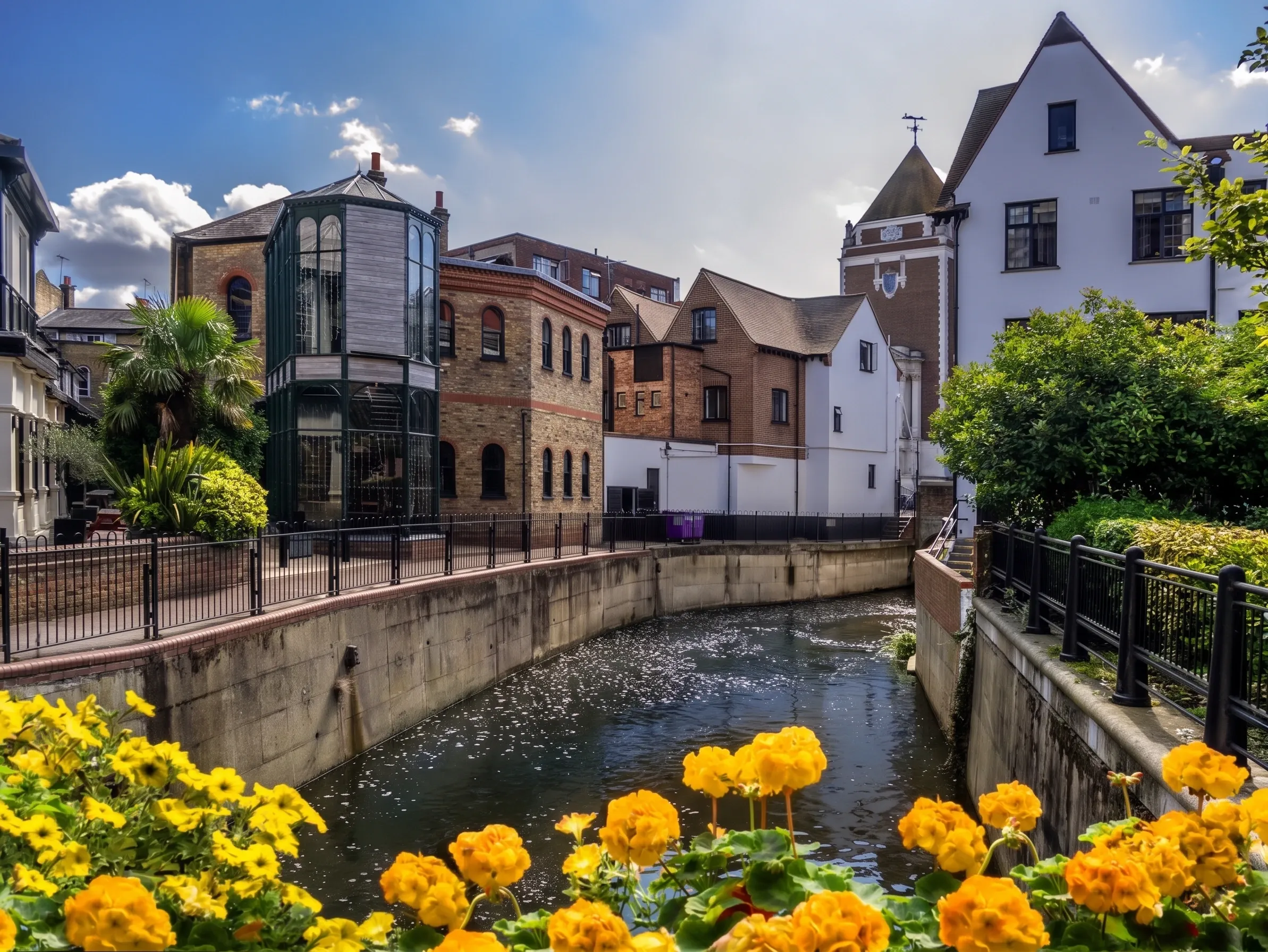
Kingston upon Thames suits families who want the river, Richmond Park and two of London's hardest grammar schools on their doorstep. It costs them. Band D council tax is £2,608.12 in 2026/27, and the station is National Rail only, sitting on a slow loop. It does not suit anyone who needs a quick, reliable commute. Everything below was checked on 20 August 2026.
1. The council tax is the number nobody puts in the area guide
For 2026/27, the Royal Borough of Kingston upon Thames charges a Band D household £2,608.12 in total. That splits into £2,097.61 for the council including adult social care, up 4.99%, and £510.51 for the Greater London Authority precept, up 4.1%. Band A is £1,738.75 and Band H is £5,216.24. Those figures come from the council's own bands and charges page for 2026 to 2027.
The GLA precept is identical across every London borough. So the part that makes Kingston expensive is the £2,097.61 the borough sets itself.
One local quirk catches people out. Properties within three quarters of a mile of Wimbledon Common pay a levy passed to the Wimbledon and Putney Commons Conservators. At Band D that adds £41.38, taking the bill to £2,649.50.
Budget for it before you fall in love with a house.
2. Tiffin drives the property market, and the admissions rules are not what people assume
Two selective state schools sit inside KT2. Both publish detailed admissions policies, and almost no area guide reads them.
Tiffin School, the boys' grammar on Queen Elizabeth Road, has a published admission number of 180 for September 2027 entry and a two-stage test. Stage One, a computer-marked English and maths sift, is on Friday 2 October 2026. Stage Two, written papers, follows in mid November 2026. The combined score is 50% English and 50% maths, though the maths half combines the Stage One and Stage Two marks in a 2:3 ratio while the English half comes from Stage Two only.
Here is the part that matters. Tiffin School operates a Priority Area covering everyone living less than 10km from the school, measured in a straight line. Its determined policy for 2027 entry, adopted on 25 February 2026, states plainly: "Since September 2019, when a 10 km Priority Area was introduced, places have only been offered to those who live within 10 km of Tiffin School." Ties for the 180th place are settled by distance to the Queen Elizabeth Road pedestrian gate, and if distances tie too, by independently supervised random draw.
The Tiffin Girls' School on Richmond Road works differently again. It also has a published admission number of 180 for 2027 entry. It has an Inner Area of 13 electoral wards, including Canbury Gardens, Kingston Town, Norbiton, Kingston Gate, Tudor, Coombe Hill and Coombe Vale, and a wider Designated Area of 44 postal districts across KT, TW, SW, W, SM and CR. Up to 60 initial places go to girls whose combined mark is at or above the 350th ranked mark, with priority inside that 60 going first to Pupil Premium girls living in the Inner or Designated Area and then to Inner Area girls. Its combined mark is weighted 60% English and 40% maths, so it is not the same test profile as the boys' school.
The school's summary guidance for parents for 2027 entry states that since the Designated Area was introduced in September 2014, all Year 7 places have been offered to girls living within it.
So a KT1 or KT2 address puts you comfortably inside both catchments. It does not buy a place. Your child still has to pass. And because the Designated Area stretches across 44 postcode districts, the genuinely scarce address is an Inner Area ward, not simply a Kingston postcode.
3. Kingston station is National Rail only, and it sits on a loop
Kingston station, Wood Street, KT1 1UJ, is managed by South Western Railway. There is no Underground interchange. National Rail lists bus and taxi as the onward links, and nothing else. When we checked on 20 August 2026 the station was step-free category A with lifts and no live outage, and the ticket office opened 06:40 to 20:30 Monday to Saturday and 08:30 to 18:00 on Sundays.
Kingston sits on a loop, with Hampton Wick one stop west and Norbiton one stop east. Trains reach Waterloo travelling in either direction: one way runs via Wimbledon and New Malden, the other via Twickenham and Richmond. That means two things. You can usually get a train. You are rarely on the quickest one.
Surbiton, just over a mile south, sits on the South West Main Line where fast services call, and plenty of Kingston residents walk or bus there rather than use their own station. On a January 2026 Mumsnet thread about relocating here, one long-term resident put it this way: "The slow train to Waterloo is a pain, but for me countered by the ease of getting around locally."
If your job demands a predictable half-hour door to door, buy nearer Surbiton or buy elsewhere.
4. Check the date on any Ofsted rating you are shown
Ofsted stopped issuing single overall grades for state schools on 2 September 2024, and inspections carried out from 10 November 2025 report against a new report card format. Ofsted says the old and new grades cannot be compared. The practical effect is that "Outstanding" and "Good" labels floating around property listings are increasingly historic.
Kingston makes the point neatly. Tiffin School's Ofsted provider page still carries the outcome of its inspection on 24 May 2022, published that September: Good overall, with Behaviour and attitudes, Personal development and Sixth form provision all Outstanding. The Tiffin Girls' School was inspected on 6 January 2026, its report was published on 2 March 2026, and when we looked on 20 August 2026 its provider page carried no overall grade and no report card grades at all.
Both schools run over capacity. Ofsted records Tiffin School with 1,478 pupils against a capacity of 1,400, and Tiffin Girls' with 1,267 against 1,001. Those rolls are recorded at the point of inspection, so the boys' figure dates from May 2022 and the girls' from January 2026.
Read the report. Ignore the badge.
5. Crime in Kingston is a town centre story, not a residential one
Use Met Police ward figures and the picture is clear. In Kingston Town ward, the Met recorded 364 offences in June 2026, and 4,561 across the twelve months to that date. The top four categories for the month were violence and sexual offences (92), anti-social behaviour (81), shoplifting (72) and other theft (27).
Now take Canbury Gardens, the residential ward immediately north along the river. It recorded 38 offences in June 2026, and 541 over the same twelve months. Its top categories were anti-social behaviour (11), violence and sexual offences (9), public order (4) and bicycle theft (3).
Shoplifting alone in Kingston Town during June 2026 was nearly double every recorded offence in Canbury Gardens. That is what a regional shopping centre and a night-time economy do to a ward's count. The Met's rolling twelve-month window moves every month, so those totals are the position as at June 2026, checked on 20 August 2026. These counts also include anti-social behaviour, which is not a recorded crime.
Residents describe the same split. The complaint on local forums is the centre after dark and the traffic snarling around it, not the streets people actually live on.
6. The green space is the genuine reason to move here
Richmond Park covers 2,500 acres and is London's largest Site of Special Scientific Interest as well as a National Nature Reserve. The Royal Parks says its 600-strong herds of red and fallow deer have roamed it since 1637. Kingston Gate sits on the borough's eastern edge, and the Tamsin Trail runs just over seven miles around the perimeter. Pedestrian gates are open 24 hours a day. Vehicle gates were open 7am to 8.15pm when we checked, and those times change with the season.
Bushy Park lies across the river. Closer in, Canbury Gardens has a better story than most municipal parks. After the railway arrived in 1863 the site became a tar factory and rubbish dump. It was then laid out as a public garden to plans by Borough Surveyor Henry Macaulay, opening on 8 November 1890.
You can walk from Kingston Bridge upstream to Teddington along the towpath. That, plus the park, is what people mean when they say Kingston earns its council tax.
7. The flood risk here is fluvial, not tidal
Kingston's Level 1 Strategic Flood Risk Assessment, the 2021 version of a document the council describes as living, is unambiguous on one point: "There is currently no tidal flood risk within Kingston." Of the Thames it says: "It is a non-tidal river throughout Kingston, but poses fluvial flood risk to the properties in its hydrological catchment." Kingston sits upstream of the tidal limit at Teddington Lock, which is the geographical reason, though the assessment itself does not spell that out.
Three other Environment Agency main rivers matter more than buyers expect. The Hogsmill runs through the middle of the borough from east to north-west as a Thames tributary, with the Surbiton Stream as its own tributary to the south-west, and the Beverley Brook runs along the north-eastern boundary. The assessment describes all three as "flashier systems that have a faster response to heavy or prolonged periods of rainfall" than the Thames, which means shorter lead times for flood warnings and alerts.
It also records that no part of the borough sits in the Environment Agency's areas benefiting from flood defences, and explains why. That layer only counts protection up to the 1-in-100-year event, and there are defences along those rivers.
Kingston has defined its own Flood Zone 3a for surface water, assessed by the council rather than the Environment Agency, covering land within modelled surface water extents up to and including the 1-in-100-year event. That local designation does not itself change permitted development rights.
The assessment also reproduces Thames Water's historic sewer flooding records for 1988 to 2021 at four-digit postcode level. The Kingston entries are KT2 6 with 229 incidents, KT2 7 with 160 and KT1 3 with 126. They are not the borough's highest: Surbiton's KT5 9 records 409.
If you are planning a basement, a lower ground floor or anything that alters drainage near the river or the Hogsmill, expect a site-specific flood risk assessment and build the time into your programme. Our complete guide to planning permission covers where those assessments sit in the application process.
8. There are 26 conservation areas, and Article 4 does not do what you think
Kingston has 26 conservation areas protected under the Planning (Listed Buildings and Conservation Areas) Act 1990, covering about 9.4% of the borough and around 10,000 postal addresses. Kingston Old Town was designated in March 1971 and covers 13.4 hectares and 334 properties, its medieval street pattern around All Saints Church and the Market Place described by the council as "the best preserved of its type in outer London". Riverside North followed in November 2004 across 27 hectares. Grove Crescent was designated in July 1985 and extended in September 1989.
Inside a conservation area, Kingston requires approval for work that would normally be permitted: demolishing a main building, garage, outbuilding or wall, external alterations and extensions, putting up a sign or advertisement, new outbuildings to the front or side, and fixtures on roofs or walls facing a public highway. Our guide to renovating in a conservation area covers how to design within those constraints rather than against them.
Now the correction. Kingston has exactly three Article 4 Directions in force: Seething Wells Filter Beds, a borough-wide direction on commercial, business and service use changing to residential use, and one covering North Lodge and South Lodge. None of them removes householder extension or alteration rights. The North Lodge and South Lodge direction does remove the right to demolish buildings on those two plots, so it is not quite nothing. The council's own pages for Kingston Old Town, Riverside North and Grove Crescent each record "Article 4 Directions: None".
So the rights that survive in most Kingston conservation areas are wider than agents imply. Directions can be made at any time, so check the council's register against your own address, and read what permitted development rights actually cover before you assume either way.
9. The housing is mostly mid to late Victorian, and the town centre is mid-transformation
Kingston railway station opened in 1863 and the town built outwards from it. Grove Crescent was laid out around 1863, and Knights Park was developed between 1861 and 1871. The council's conservation area page for Grove Crescent describes larger houses and neat villas on Springfield Road and Denmark Road, tighter knit cottages on Portland Road, a strong Victorian Gothic style through the centre, smaller artisan dwellings to the east and grander Italianate buildings to the west. Riverside North adds large Victorian and Edwardian houses on Lower Ham Road.
Which means most buyers here take on a Victorian terrace or villa with the usual list attached: solid walls, original sash windows, a single-skin rear addition and drainage of uncertain vintage. The common problems and costs in a Victorian terrace apply directly. Where plot widths are tight, as they are across much of Grove and Fairfield, a loft conversion often beats a side extension on both cost and planning risk.
The town centre itself is changing. Kingston's community-led vision document, Your Vision Our Future, was endorsed by the council's Place Committee on 20 June 2023, after a Citizens' Panel process that began in March 2022 and a draft shaped by more than 600 public comments. The council's stated reason for the vision is that "Kingston town centre area is currently experiencing significant levels of change", and it names the Unilever HQ site, council-led development and the offering at Kingston University and Kingston College as opportunities to respond to. That is the council's position as endorsed in June 2023, not a statement about August 2026.
Expect construction, expect the retail mix to shift, and expect the riverside to get more attention than the shopping streets.
Common questions about living in Kingston
Is Kingston upon Thames in London or Surrey?
Both, in different senses. It is the Royal Borough of Kingston upon Thames, a London borough and the local authority for schools and planning. Postal addresses still carry Surrey, which is why Ofsted lists Tiffin School as "Kingston upon Thames, Surrey, KT2 6RL".
Do I need to live in Kingston to get my child into Tiffin?
No, but you need to live close. Tiffin School's determined policy for 2027 entry, adopted on 25 February 2026, states that since a 10km Priority Area was introduced in September 2019, places have only been offered to those living within it. Tiffin Girls' summary guidance for 2027 entry states that since the Designated Area was introduced in September 2014, all Year 7 places have been offered to girls living within it. A KT1 or KT2 address qualifies for both, and guarantees nothing, because both schools select on test performance first.
Does Kingston have an Underground station?
No. Kingston station is National Rail, run by South Western Railway, and National Rail lists only bus and taxi as onward transport links. Norbiton and Hampton Wick are the neighbouring loop stations. Surbiton, on the South West Main Line, has the faster services.
Does Kingston flood?
Parts of it carry fluvial risk, from the Thames, Hogsmill, Surbiton Stream and Beverley Brook. The council's 2021 Level 1 Strategic Flood Risk Assessment states there is no tidal flood risk in the borough, because the Thames is non-tidal throughout Kingston. Surface water is a separate and locally significant issue, and the council maintains its own surface water Flood Zone 3a.
Sources and verification notes
Checked on 20 August 2026.
Primary sources
- Council tax 2026/27: Royal Borough of Kingston upon Thames bands and charges page. Band D £2,608.12 (£2,097.61 council, £510.51 GLA), Band A £1,738.75, Band H £5,216.24, Wimbledon and Putney Commons levy £41.38 at Band D taking the bill to £2,649.50.
- Tiffin School: Determined Admissions Policy 2027-28, adopted 25 February 2026, for the 180 place admission number, the Priority Area, the quoted sentence on offers since 2019, the 50/50 weighting and the tie-break rules. Stage One and Stage Two dates from the school's published key dates, updated 8 July 2026.
- The Tiffin Girls' School: Determined Admissions Arrangements for entry September 2027 for the 180 place admission number, the 13 Inner Area wards, the 44 postal districts, the up to 60 places at or above the 350th ranked mark and the 60/40 weighting. The sentence about Designated Area offers since 2014 is footnote 2 of the school's Summary Guidance for primary and junior school parents for 2027 entry.
- Ofsted: provider pages for Tiffin School (inspection 24 May 2022, report published 21 September 2022) and The Tiffin Girls' School (inspection 6 January 2026, report published 2 March 2026, no grades shown on 20 August 2026), including both roll and capacity figures.
- Removal of single headline grades: gov.uk, 2 September 2024. Report cards apply to inspections from 10 November 2025.
- Kingston station: National Rail station page for step-free category A, lifts, onward transport links and ticket office hours, checked 20 August 2026.
- Crime: Metropolitan Police ward pages for Kingston Town and Canbury Gardens, June 2026 and the twelve months to June 2026.
- Richmond Park: The Royal Parks park page for the acreage, SSSI and National Nature Reserve status, the deer, the Tamsin Trail and the gate times.
- Canbury Gardens history: Kingston Council's Riverside North conservation area page.
- Flood risk: Royal Borough of Kingston upon Thames Level 1 Strategic Flood Risk Assessment, 2021 version, prepared by Metis Consultants. Sections 5.2.2, 5.3.2, 5.8.2, 5.9 and 5.10.
- Conservation areas: Kingston Council conservation areas index and list (26 areas, about 9.4% of the borough, around 10,000 addresses) and the individual pages for Kingston Old Town, Riverside North and Grove Crescent, including designation dates, hectares, property counts and the "Article 4 Directions: None" entries.
- Article 4: Kingston Council's Article 4 directions page listing the three directions in force, with the North Lodge and South Lodge direction confirmed by Place Committee on 8 February 2024.
- Housing history and architecture: Kingston Council's Grove Crescent and Riverside North conservation area pages.
- Town centre vision: Kingston Council's "A vision for Kingston town centre" page for the 20 June 2023 Place Committee endorsement, the Citizens' Panel process from March 2022, the 600 plus comments and the quoted sentence.
Where sources disagree
- The Kingston Loop, the two Waterloo routings and Surbiton's place on the South West Main Line. National Rail's Kingston page does not name the line or list adjacent stations, so this rests on the station's onward travel poster rather than a primary line diagram. The distance to Surbiton is roughly 1.3 miles in a straight line.
- The claim, common in other guides, that Kingston's borough element is among the highest in London. We could not source a like-for-like comparison, so it is not in the article.
- That Kingston's position above Teddington Lock is the reason for the absence of tidal risk. The flood risk assessment states the absence but gives no reason.
- The Mumsnet comment is one resident's account, quoted as such.
- The Strategic Flood Risk Assessment describes itself as a living document with mapping reviewed regularly, and there is a separate addendum whose date we did not establish. Check the council's current version before relying on it for an application.
What we could not confirm
- Named catchment distances in metres for either Tiffin school. Both allocate on test rank first, and neither publishes a distance catchment for ordinary offers.
- Any crime rate per 1,000 residents. The only available figures come from unofficial aggregators and they contradict each other.
- The figure of 186 Year 7 places that appears in Tiffin School's admissions FAQs. The determined policy gives the admission number as 180.
Renovating in Kingston?
- Kitchen renovation in Kingston
- Bathroom renovation in Kingston
- House extensions in Kingston
- Loft conversions in Kingston
- Basement conversions in Kingston
- Home renovation in Kingston
- Interior design in Kingston
- Builders in Kingston
If you are still choosing between boroughs, we have set out the planning position across twenty London areas in one place.
Find out what your project will cost
Kingston jobs usually mean a Victorian house inside one of 26 conservation areas, sometimes in a flood zone that triggers a site-specific assessment before anything is consented. Both shape the design and the programme, and both are cheaper to price at the start than to discover at validation.
Wimbledon suits families and commuters who can afford SW19. The schools, the Common levy, the tennis road closures, and who it doesn't suit.

Richmond has more green space than anywhere in London and the highest council tax in the south west. Planes, flooding, schools and 85 conservation areas.
London renovation costs run around a third above UK figures. The gap is labour, access, waste and borough charges rather than materials. The published figures and the reason.
Permitted development rights removed, party walls on both sides, nowhere to put a skip and borough charges that vary fourfold. What actually differs about renovating in London.