
How much does it cost to plaster a house?

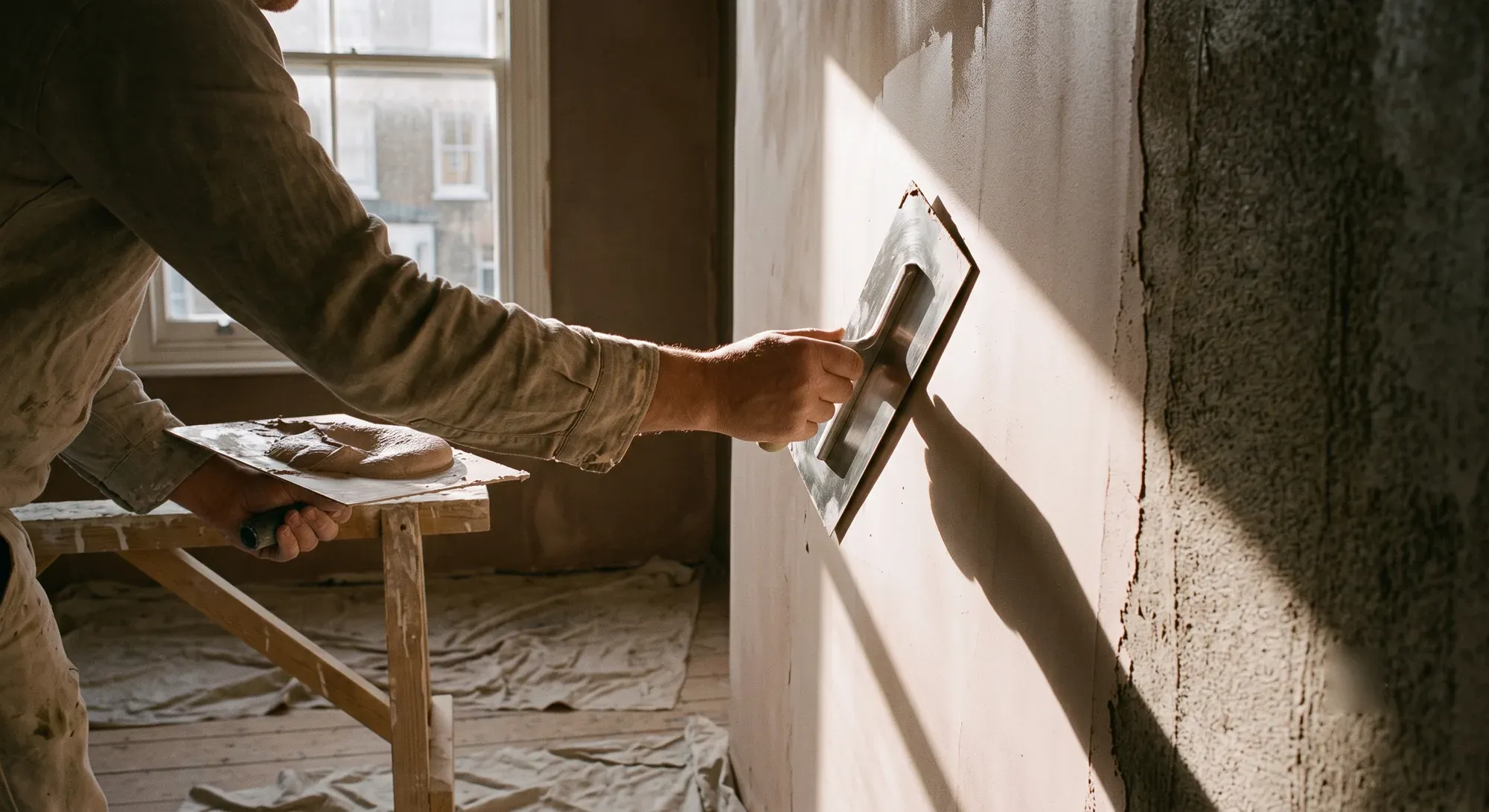
A skim over sound existing plaster runs about £15 to £25 per square metre, while a full re-plaster back to brick is £30 to £40. Those are two different jobs, and confusing them is where most quotes go wrong.
A three-bedroom house skimmed throughout lands somewhere around £3,500 to £7,000. Taken back to brick, it is a different number entirely.
Skimming or re-plastering, and why the difference matters
Skimming is a thin finishing coat, two or three millimetres, applied over plaster that is already sound and flat. The wall stays where it is. You are buying a smooth surface to decorate.
Re-plastering means taking the old plaster off, back to the brick or block, then building the wall up again with a backing coat before the skim. It is two or three times the labour, it generates waste, and it takes considerably longer to dry.
Same room. Same finished appearance. Roughly double the price.
There is a third option that quotes rarely name. Instead of a wet backing coat, the plasterer fixes plasterboard to the wall on dabs of adhesive, then skims over it. Dot-and-dab is faster, it dries in a fraction of the time, and it gives a flat surface on a wall that is anything but. It is how most modern walls are finished. Our guide to dry lining vs plastering sets out which walls suit which method.
The catch is what it leaves behind: a void between the board and the masonry. On a modern cavity wall that is fine. On a solid wall it creates a cold gap where moist air can circulate and condense, and it means fixings need to find the masonry rather than the board. Worth asking which method a quote assumes, because the price and the outcome both change.
This is where published figures fall apart. One of the largest cost sites prices "full plastering" from £18 per square metre, which sits below the top of its own skimming range of £15 to £30, and elsewhere on the same page puts skimming at £6 to £12. Another prices stripping and re-plastering below plain plastering and presents it as the budget option. A third quotes £1,100 for a nine square metre room without saying whether those nine metres are the floor or the walls, which is the difference between £122 per square metre and about £37.
None of them state whether their figures include VAT, and structurally they cannot. Their numbers come from homeowner-submitted quotes, and plenty of plasterers trade below the £90,000 VAT registration threshold, so the same range silently mixes inclusive and exclusive prices.
The practical test is simple. Ask any plasterer quoting you whether the price is a skim or a re-plaster, and whether it includes VAT. Two questions, and most of the confusion disappears.
How plasterers price work
Two models, and which one you get tells you something about the job.
Per square metre is standard for anything measurable: a room, a ceiling, a run of walls. It is the fairer basis for you, because it prices the actual area rather than the plasterer's guess at how long it will take.
A day rate is standard for patching, making good after other trades, or anything awkward enough that nobody can measure it sensibly. Expect a plasterer to prefer a day rate on a job with lots of small areas, cutting in around new sockets, or chasing another trade.
If a whole-house job comes back as a day rate with no measured area, ask for it both ways. A plasterer who has measured the walls will usually quote lower than one who is protecting themselves against the unknown.
Costs move for reasons you can see before anyone starts. Ceilings cost more than walls, because working overhead is slower and harder. Old walls that are uneven need more backing coat to bring flat. Anything above single-storey height needs access equipment. And a house full of furniture takes longer than an empty one, because the protection and the moving are your plasterer's time.
Drying time costs you money
Fresh plaster cannot be decorated until it has dried out properly, and that is a programme cost more than a labour one.
A skim on sound plaster is usually ready to paint within a few days. A full re-plaster with a backing coat takes considerably longer, because the backing coat has to dry before the skim goes on, and then the skim has to dry too. Thick coats on a solid wall in a cold month can hold up decorating for weeks.
That is why plastering sits where it does in the order of works, and why rushing it is expensive twice over: paint applied to damp plaster peels, and the wall has to be made good and redecorated. Our guide to renovating plaster covers the sequencing and what to expect at each stage.
The other thing worth knowing: new plaster needs a mist coat, watered-down emulsion, before its first proper coat. Skip it and the paint sits on the surface instead of bonding, then comes off with the roller.
Lime plaster, and why old houses are different
On a period property with solid walls, the plaster is doing more than providing a flat surface. It is part of how the wall manages moisture.
Solid brick and stone walls have no cavity and no damp-proof course. They get damp and then dry out again, and they rely on being able to breathe. Lime plaster is vapour-permeable, so moisture that gets into the wall can evaporate back out through the surface.
Gypsum plaster and cement render do not work that way. The Society for the Protection of Ancient Buildings is blunt about it: cement render is incompatible with the construction of most old buildings and can cause or accelerate serious decay. It restricts evaporation, and because it is more rigid than the wall behind it, hairline cracks open up. Water gets in through the cracks and then cannot get out.
The result is a wall that looks fine for a year or two and then shows damp, blown plaster and salting, usually blamed on rising damp, which is how owners end up finding out how much damp treatment costs when the real cause is the finish.
Lime runs roughly £50 to £120 per square metre, two to four times a gypsum skim. It is slower, it goes on in more coats with waiting time between them, and it needs a plasterer who has actually worked with it. The finish also has to be vapour-permeable, so standard vinyl emulsion is the wrong paint and undoes the point of the exercise.
If you are working on a Victorian or Edwardian house, this is the decision that has consequences years later. Our guide to Victorian terrace renovation problems covers the other places where period construction changes the answer.
When plastering becomes building work
Most plastering is decoration and nothing more. There is one case where it stops being decoration.
Under the Building Regulations, an external wall is a thermal element, and that includes its internal plaster. Regulation 2 defines renovating a thermal element as replacing one of its layers, and regulation 23 brings that within the regulations once the work covers more than half the surface area of the element. Regulation 3 then makes it building work.
So hacking an external wall back to brick across a whole room can trigger Part L, which means the wall is expected to be upgraded to current thermal standards, usually with insulated plasterboard rather than a straight re-plaster. There is an exemption where upgrading is not economically feasible, and enforcement varies between authorities.
Two things follow. If you are stripping external walls back on any scale, ask building control before you start rather than after. And a re-plaster that turns into an insulation job costs meaningfully more, so it belongs in the budget as a possibility rather than a surprise.
Internal walls and ceilings are unaffected. A skim over existing plaster is not a replacement of a layer, so it is outside all of this.
What plastering costs inside a bigger project
Most plastering is not a standalone job. It is the making-good stage of a kitchen, a bathroom or a full refurbishment, so it gets priced inside a wider scope rather than measured on its own. On a kitchen it might be making good after the units and services are in. On a full refurbishment it is several rooms and often ceilings too.
Plastering is also one of the trades most likely to expose something else. Old lath and plaster ceilings that were only just holding on, walls with no plaster behind the old wallpaper, and previous repairs done in the wrong material all turn up once the surface comes off. For how that sits against the rest of a budget, see what a renovation costs in the UK, with a calculator.
How Beams helps
Plastering quotes are hard to compare because the same words describe different jobs. One plasterer prices a skim, the next prices a strip-out and re-plaster, and unless the scope is written down you are comparing two numbers that were never measuring the same work.
So we define it first: which walls, skim or re-plaster, gypsum or lime, ceilings in or out. Then your builder prices it inside the fixed price, with the plastering sequenced properly against first fix and decoration so nothing gets painted too early.
That is what Beams protections and warranties cover: one agreed price, payments released against milestones, and 12 months on the workmanship.
Common questions about plastering costs
Can I just skim over old plaster?
Often, yes, and it is much the cheaper option. The test is whether the existing plaster is sound and well bonded. Tap it: a hollow drummy sound means it has blown away from the wall behind and skimming over it will fail. Blown patches can be cut out and made good, but if most of a wall sounds hollow it needs taking off.
How long before I can paint new plaster?
A skim is usually ready in a few days once it has gone from dark to a uniform pale pink. A full re-plaster takes longer because the backing coat dries first, and thick coats in winter can take several weeks. Paint too early and it peels. Start with a mist coat of watered-down emulsion so the first proper coat bonds.
Is lime plaster worth the extra on an old house?
On solid walls with no cavity and no damp-proof course, yes. Lime lets the wall dry out through the surface, which is how those walls were built to work. Gypsum and cement trap moisture and the damp reappears somewhere else, usually blamed on rising damp. On a modern cavity wall it makes no difference and gypsum is fine.
Does plastering need building regulations approval?
Not normally. Skimming and internal replastering are outside the regulations. The exception is stripping an external wall back to brick across more than half its area, which counts as renovating a thermal element and brings Part L into play. Ask building control first if you are doing that.
Should I plaster before or after new windows and electrics?
After. Plastering is a making-good trade, so it follows first fix electrics and plumbing, and it follows window replacement, because both leave holes and chases that need filling. Plaster first and you will be paying someone to repair it.
Where these figures come from
The figures on this page are market rates compiled from published UK trade cost data rather than from any single plasterer's price list. Our projects are in London and the surrounding area.
Thermal elements and renovation thresholds: The Building Regulations 2010, regulations 2, 3 and 23
Lime, breathability and cement render on historic buildings: Society for the Protection of Ancient Buildings
Per square metre market rates and day rates: published UK trade cost data, 2026. No public body publishes plastering rates, so these are market figures rather than an official statistic
VAT registration threshold: HM Revenue and Customs, £90,000 taxable turnover
Every wall prices differently once its condition, its construction and the finish are known. These figures are a starting point for a conversation rather than a quote.
Find out what your project will cost
We define the scope first, skim or re-plaster, which walls, ceilings in or out. Then up to three vetted London builders quote against the same specification.