
How much does it cost to paint a room in the UK?

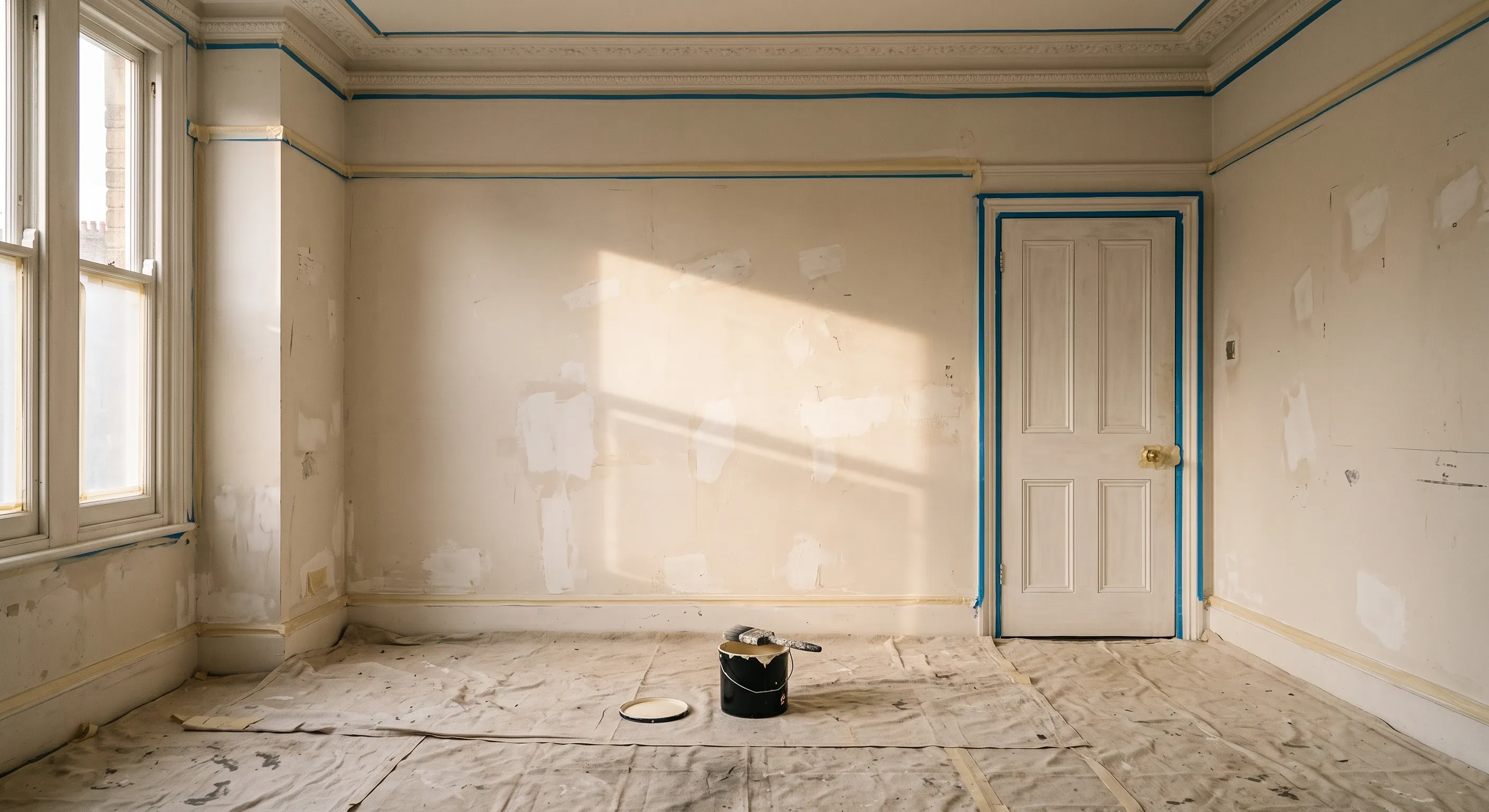
A standard bedroom costs £260 to £400 for walls and ceiling, or £350 to £660 for a large one with woodwork included. Checkatrade puts a medium 18m² room at £450. Across the three biggest guides the published per-room range runs from £150 to £1,330, and not one of them states its VAT basis.
That spread is not regional variation. It is three organisations pricing three different jobs and calling them all "a room". One includes the paint, one treats woodwork as an extra, and one quotes a flat average with no range at all. Put their numbers next to each other and the disagreement becomes the most useful thing on the page.
What do the published guides actually say per room?
Here are the three most visible UK sources, with their own figures, their own room definitions and their own publication dates. Nothing has been averaged or smoothed.
Room | MyBuilder (updated 21/08/2026) | MyJobQuote (updated 20/07/2026) | Checkatrade (updated June 2026) |
|---|---|---|---|
Small room or box room | £180 to £300 (walls and ceiling) | £175 to £300 (box room, 7 to 9m²) | £350 (small room, 8m²) |
Bathroom | grouped with small room | £150 to £300 (6 to 9m²) | not priced separately |
Standard bedroom | £260 to £400 (walls and ceiling) | £250 to £400 (small bedroom, 10 to 12m²) | £450 (medium room, 18m²) |
Large bedroom | £350 to £500 | £350 to £660 (14 to 20m²) | not priced separately |
Living room | £400 to £700 | £300 to £530 small, £500 to £990 large | £1,000 (large room, 30m²) |
Kitchen | £300 to £600 | £250 to £500 (10 to 15m²) | not priced separately |
Hall, stairs and landing | not priced | £875 to £1,330+ (35 to 40m²) | £1,600 |
Look at the small room row. Checkatrade's figure for the smallest room it prices, £350, sits above MyBuilder's entire range for a standard bedroom and above the top of MyJobQuote's box room range. On the published numbers, the smallest room in one guide costs more than a bedroom in another.
Why do the three sources disagree so badly?
Because they are not measuring the same thing, and two of the three do not say so clearly. MyBuilder's table is explicitly walls and ceiling only, with woodwork priced separately at £50 to £100 per room on top. MyJobQuote's figures cover a room painted "including all woodwork and coving", which is a materially bigger job. Checkatrade prices by floor area in square metres and states that its room prices include standard trade paint.
Then there is the internal contradiction. Checkatrade's own guide gives a painter and decorator day rate of £325 "plus the cost of paint", and in the FAQ on the same page states that labour, materials, prep work and clean-up are normally all included in a decorator's quote. Those two positions cannot both hold. If you are using a published figure to sanity-check a real quote, that single ambiguity is worth more than the number itself.
Do the published prices include VAT?
No source says. Checkatrade, MyBuilder and MyJobQuote all publish per-room figures without stating whether they are inclusive or exclusive of VAT, which on a £450 room is a £75 question either way.
The mechanics matter here more than they do on a larger job. A sole trader decorator whose taxable turnover sits below the £90,000 VAT registration threshold charges no VAT at all, and that threshold has applied since 1st April 2024 (GOV.UK, VAT thresholds). A VAT-registered decorating firm adds 20%. Two genuinely comparable decorators can therefore hand you quotes 20% apart for identical work, purely on registration status. MyJobQuote's own guide tells readers to check whether a quote includes VAT before comparing, which is sound advice it does not apply to its own numbers.
Ask for the VAT position in writing on every quote you collect. It is the single cheapest thing you can do to make three prices comparable.
What does each surface add to the price?
Pricing per room hides the thing that actually drives the bill, which is how many surfaces you have asked for. Published per-item figures are far more useful when you are trying to work out why your quote came in where it did.
Item | Published figure | Source |
|---|---|---|
Woodwork per room (skirting, architrave, frames) | £50 to £100 on top of walls and ceiling | MyBuilder |
Painting a door, both sides | £90 average | Checkatrade |
Woodwork | £15 per m² (range £10 to £20) | Checkatrade |
Ceilings | £15 per m² (range £10 to £20) | Checkatrade |
Interior walls | £15 per m² of wall area (range £10 to £20) | Checkatrade |
Radiator | £15 each (range £10 to £20) | Checkatrade |
Mist coat on new plaster | £80 to £150 per room | MyBuilder |
Crack filling and preparation | £50 to £150 per room | MyBuilder |
Wallpaper removal | £250 to £350 | MyJobQuote |
Painting skirting boards | around £200, one day | MyJobQuote |
Moving furniture | £20 to £50 per room | MyBuilder |
Note that Checkatrade prices interior walls per square metre of wall area, not floor area, while pricing whole rooms by floor area. In a room with ordinary ceilings the two broadly track each other. In a period room they come apart completely, which is the next problem.
Why does a London period room break the published figures?
Because every cost guide prices a plain rectangular box with a 2.4m ceiling, and almost no London period room is one. Take a 4m by 3m bedroom. At a 2.4m ceiling that is 33.6m² of wall. At a 3.2m ceiling, common in a Victorian or Georgian first floor, the same floor plan gives you 44.8m² of wall. A third more paintable surface, for a room that a floor-area calculator scores identically.
Then add the detail. Cornice and ceiling roses have to be cut in by hand, and where they have been painted over for a century they need cleaning back before they read as plasterwork again. Picture rails and dado rails each add a full run of brushed linear metres to every wall. Panelled doors take several times as long as flush doors because every panel, bead and edge is brushed separately, and Checkatrade's £90 per door is quoted without a range, so it tells you nothing about which kind of door it means. Sash windows are the slowest item in the house: glazing bars, meeting rails and beads, with the sashes needing to slide afterwards rather than be painted shut.
MyBuilder acknowledges the direction of travel without quantifying it, noting that decorators work at around 40m² of wall surface per day, that 3m-plus ceilings need more time per coat, and that London and South East day rates run 20 to 35% above the national average. MyJobQuote's calculator goes further and offers ceiling height bands up to "over 3m", which is a quiet admission that its headline £400 does not cover a period room. If you are budgeting for a whole house of these rooms rather than one, the costs that come with a Victorian terrace are worth reading before you set a number.
How much of the quote is preparation, and what gets cut?
Most of it, and preparation is exactly what disappears from a cheap quote. MyBuilder states that preparation accounts for 40 to 60% of total labour on older properties. MyJobQuote puts paint and supplies at as little as 10 to 15% of the total on a standard job using budget or mid-range paint.
Run those two together. If materials are roughly an eighth of the bill and preparation is roughly half of the remaining labour, then filling, sanding, caulking, washing down and mist coating is something like 35 to 55% of everything you are paying. It is invisible once the room is finished, and it is the only line a decorator can quietly delete to come in 30% under everyone else. A quote that is dramatically cheaper is usually a different scope, not a better price.
New plaster is where this bites hardest. It needs a mist coat, a watered-down emulsion, and it needs to be properly dry first. Seal damp plaster with ordinary emulsion and it flakes within weeks. If your room is being skimmed before it is painted, it is worth knowing what replastering a room actually costs so you can tell whether the decorator has priced for making good or assumed someone else has.
Why do two quotes for the same room differ so much?
Scope, almost every time. Two decorators standing in the same bedroom will quote against different assumptions about coats, cutting in, filling, woodwork, who supplies the paint and who moves the furniture, and neither quote will usually say which assumptions it made.
The fix is boring and it works: give every decorator the same written list of questions and make them answer it before pricing. Beams scopes painting and decorating work this way, settling the two items that most often separate quotes, cutting in and preparation, along with paint supply, mist coating, and whether stairs and landings are in or out. Quotes written against a fixed scope can be compared. Quotes written against an imagined one cannot.
Day rates are the other half of this, and they belong with whole-house scoping rather than with a single room, so they sit on that same page.
Does the paint you choose change the price much?
Less than most people expect, until it doesn't. MyBuilder puts budget trade emulsion at £5 to £10 per litre, mid-range trade at £10 to £18, and premium emulsions at £40 to £70. On a standard bedroom that is roughly £20 to £50 of trade paint against £80 to £200 of premium, so switching brand adds £100 to £300 to a room, which MyBuilder states directly.
Colour is the sleeper cost. MyBuilder notes that deep blues, greens and charcoals often need three coats regardless of brand, adding 15 to 25% to total labour time. That is a labour increase, not a materials one, so it lands on the expensive side of the bill. Rooms with moisture to deal with have their own constraints on top of that, and which paint to use in a bathroom is a different question from which paint you like the look of.
Is it cheaper to do it yourself?
Yes, by a margin the guides agree on for once. MyBuilder costs a DIY bedroom at £65 to £135 all in: £20 to £50 for two 2.5L tins of emulsion, £15 to £25 for gloss or satin, £20 to £40 for brushes, roller, tray and tape, and £10 to £20 for filler and sandpaper. Checkatrade puts DIY at £50 to £100 assuming you already own the tools, against around £450 for the same room done professionally.
The saving is real. So is the reason people pay it: cutting in neatly around cornice, skirting and window frames is a skill, and a poor cut line is the first thing visible once the furniture goes back. In a plain room, previously painted, going on a similar colour, DIY holds up well. In a period room needing filling, stripping and a mist coat, it usually doesn't.
Frequently asked questions
How much does it cost to paint a small bedroom?
MyBuilder publishes £180 to £300 for a small room covering walls and ceiling, MyJobQuote £175 to £300 for a 7 to 9m² box room, and Checkatrade £350 for an 8m² room including standard trade paint. None states a VAT basis, so confirm that separately.
How long does it take to paint a bedroom?
One to two days for a standard bedroom in reasonable condition, on all three sources. MyJobQuote adds a day for wallpaper removal and three to four days in total if furniture is being moved out and back.
Does the price include the paint?
Checkatrade says its room prices include regular trade paint, MyJobQuote adds around £50 of paint to its labour figure to reach its £400 average, and MyBuilder itemises paint separately. Because Checkatrade also quotes its day rate as excluding paint, always get paint supply confirmed in the written quote.
Is a decorator cheaper if I do several rooms at once?
Usually. Both Checkatrade and MyBuilder note that decorators price more keenly across multiple rooms in one visit, because setting up, sheeting out and travelling is done once rather than repeatedly.
Does painting the outside work the same way?
No. Exterior work brings access costs and, on older or protected houses, a planning dimension that interior work never has. Painting the outside of a house in a conservation area is governed by permitted development rules, Article 4 directions and, on listed buildings, a separate consent regime.
Find out what your project will cost
Three decorators can price the same bedroom hundreds of pounds apart simply because none of them was told what to include. Get up to three comparable quotes from vetted London builders, all priced from the same written scope, so the differences you see are real ones.
Exterior painting is permitted development under Class C of the GPDO. An Article 4 direction removes that, and listed building consent is stricter still.
A proper diagnosis for blown plaster: the tap test read correctly, skim versus backing coat failure, and what crack width and shape really mean.

How to decide between repairing, overboarding or removing a lath and plaster ceiling, including testing the key, the asbestos question and the mess.