
Blown plaster: how to tell if your walls need replastering

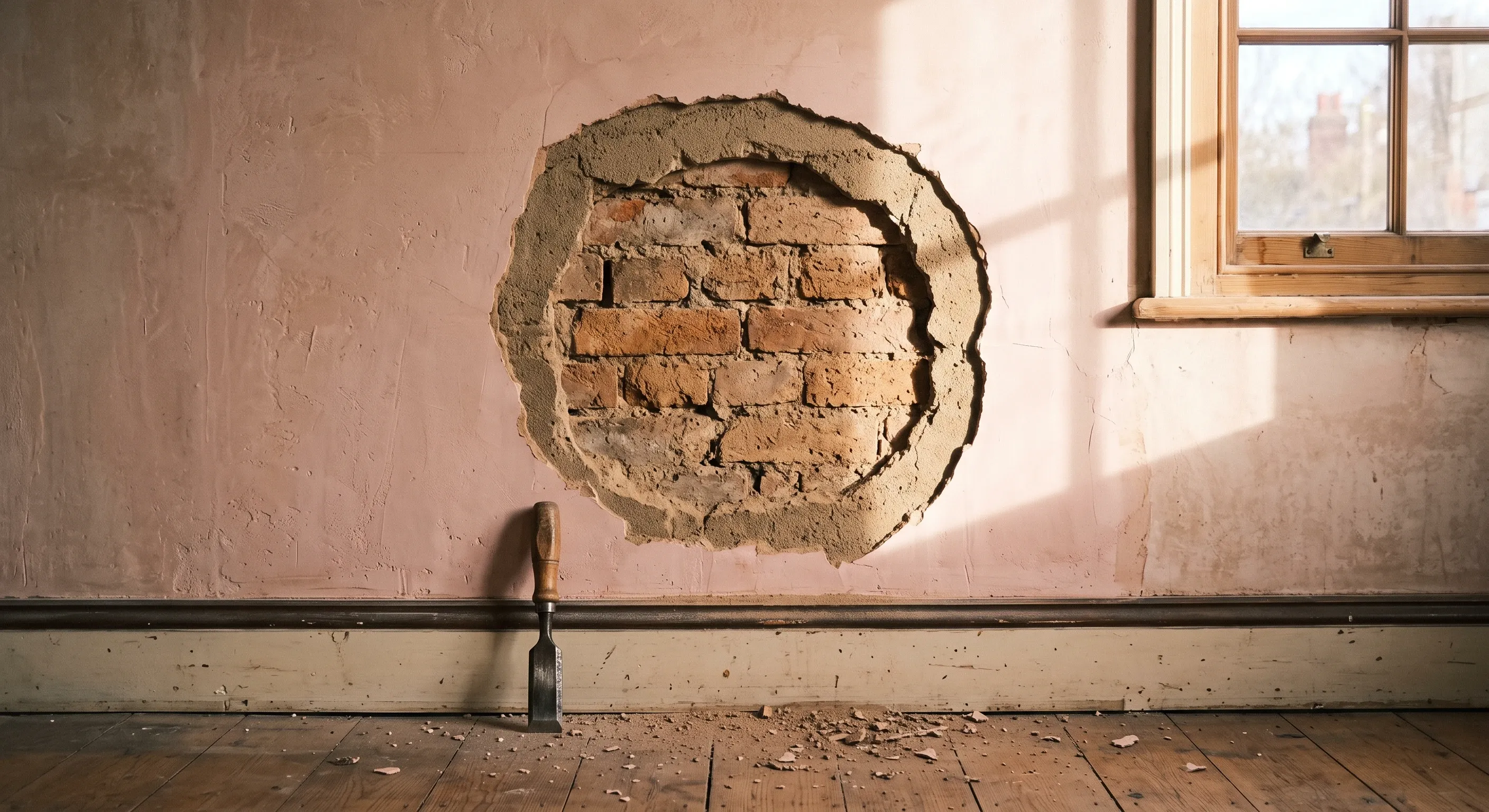
Plaster has blown when it has lost its bond with what is behind it, even though the surface still looks flat. Tap it with a knuckle: sound plaster gives a dull, dead thud, blown plaster rings hollow. Add a gentle press, a look at crack width and shape, and a check for damp, and you can map exactly how much of a wall has actually failed.
Every plastering page on the internet gives you that first sentence and stops. The problem is that a hollow sound has at least four different causes, only one of which is blown plaster, and the ones people misread cost them a wall they did not need to lose. Diagnosing this properly takes about twenty minutes with a coin, a torch and a pencil.
What has actually failed when plaster blows?
A modern plastered wall is two separate layers doing two different jobs, and either can let go independently. Against the masonry sits a backing coat, usually browning on porous brick or hardwall on dense brick and blockwork, laid around 11mm thick. Over that goes a 2 to 3mm finishing coat of multi-finish. Bonding is used where the substrate is smooth or mixed, and PVA or a bonding agent is often used to control how fast the brick sucks water out of the mix.
Blowing is a failure of adhesion at one of those interfaces. Either the backing coat has parted company with the brick, which is the serious version, or the skim has delaminated from the backing coat, which is a surface problem with a surface fix. On a pre-1920 solid wall there may be no gypsum at all: lime scratch, float and set coats over brick, or lime over timber laths, which fails differently again and is worth understanding alongside the problems that come with a Victorian terrace.
How do you do the tap test properly?
Work in a grid, not at random. Tap with a knuckle or the edge of a coin every 300mm or so, moving methodically across the wall and listening for the moment the sound changes rather than trying to judge any single tap in isolation. Solid, well-bonded plaster answers with a short, dull, dead knock. Blown plaster answers with a drumming, hollow, slightly musical note, because there is an air gap behind it.
Mark the boundary as you go. A soft pencil line or chalk where the sound changes, following it round until you have closed a shape, turns a vague worry into a measured area you can point at. Pay particular attention to the first 600mm above skirting level, around and under window reveals, the sides and breast of a chimney, and anywhere pipework has been chased in, because those are where blown areas start.
The misreading to avoid: a plasterboard wall sounds hollow everywhere, because there is a cavity behind the board by design. Dry lining, stud partitions and boarded-out chimney breasts all drum. That is not blown plaster. Before you panic at a hollow sound, work out whether you are tapping masonry or board, which a 100mm test hole in an inconspicuous corner or a magnet run over the surface looking for screw heads will tell you in seconds. Ceilings need their own version of this, since whether a lath and plaster ceiling gets repaired, overboarded or taken down turns on a different mechanism entirely.
Is it the skim or the backing coat?
This is the question that decides everything, and almost nobody asks it. Find a loose edge inside the area you have marked, or make one at a corner, and lift a piece off with a scraper. Then look at what came away and what is left.
If a thin flake 2 to 3mm thick lifts off cleanly and leaves a flat, sound, pink or grey surface behind, the skim has delaminated and the backing coat is fine. That happens when multi-finish was applied over gloss paint, over old wallpaper paste, over a dusty surface, or over PVA that was left to go fully dry instead of being skimmed onto while tacky. If the piece comes away thick, 11 to 13mm or more, with sand and brick dust on the back and bare masonry underneath, the backing coat has lost the wall.
Measure it rather than eyeballing it. Push a thin blade through the plaster until it stops and read the depth. Two or three millimetres means a finish coat problem. Anything over about ten means the backing has gone. The distinction matters because the two failures have nothing in common: one is a bond failure between two coats, the other usually points at moisture, salts or movement in the wall itself.
What crack width and shape are telling you
Width tells you how much to worry. Shape tells you what caused it. Take both.
Crack | What it usually means |
|---|---|
Fine map or craze cracking over a patch | Shrinkage in the finish coat, cosmetic |
Hairline under 1mm, stable, no lipping | Normal movement, fill and decorate |
Straight line following a plasterboard joint | Scrim tape failure or board movement, not blown plaster |
Straight line along a ceiling or skirting junction | Differential movement between materials, cosmetic |
Diagonal from the corner of a window or door | Structural movement, needs assessment before any plastering |
Stepped, following mortar joints, showing through | Movement in the masonry behind the plaster |
Any crack where one side sits proud of the other | The plaster is lifting off the wall, blown |
BRE Digest 251, the standard UK reference for classifying cracking in low-rise buildings, bands damage by width: hairline up to 0.1mm, fine cracks up to 1mm, then up to 5mm, then 5 to 15mm and upwards. It was written for masonry rather than plaster finishes, but the thresholds are the ones surveyors use, and they are a better guide than the arbitrary numbers that float around online.
The test worth more than width, though, is whether a crack moves. Press either side of it with your thumbs. A crack that rocks, where one lip drops as you press, is telling you the plaster is no longer attached, and a 1mm crack that rocks is a worse sign than a 4mm crack that sits still. Grit and sandy dust falling out of a crack means the same thing.
What changes when there is damp staining?
Everything about the sequence, and nothing about the diagnosis. Damp staining does not make a hollow sound any more or less hollow. What it does is tell you that replastering is now the second job rather than the first, because plaster applied over a wall that is still taking on water will blow again, usually within two winters.
Learn to read what the staining looks like. A horizontal tide mark 600mm to 1m up an external wall, with a yellowish-brown edge, points at rising damp or a bridged damp-proof course. Patches that darken in wet weather and dry out afterwards point at penetrating damp through failed pointing, a leaking gutter or a cracked render. Brown or yellow staining on a chimney breast that comes back through paint and stays slightly damp in muggy weather is usually hygroscopic salts, nitrates and chlorides drawn out of old soot, which pull moisture from the air and will keep doing it through any ordinary plaster you put over them. Black speckled mould in corners and behind furniture is condensation, which is a ventilation problem rather than a plaster one.
In every one of those cases the order is the same: find the source, fix the source, let the wall dry, then plaster. There is a separate specification for what goes back on a wall that has been damp, including where salt-retardant or lime systems earn their place, and how plaster is put right after damp covers that ground properly.
Five things that look like blown plaster and are not
Nail pops and screw heads. Small circular cracks or bulges in a line, caused by fixings working loose in timber that has moved. Refix and fill.
Scrim tape cracks. A straight crack exactly on a plasterboard joint means the scrim was skipped, or paper tape was used dry, or the board moved. It reads as a serious crack and is a half-hour repair.
Efflorescence. A white, fluffy or crystalline bloom pushing through paint. Salts coming out of the masonry as it dries, common in a newly plastered or recently wet wall. Brush it off dry, do not wash it in.
Paint failure. Emulsion peeling in sheets off plaster that is still hard underneath usually means it went onto new plaster without a mist coat, or onto a wall that was damp, or onto distemper or limewash that nothing will stick to. The plaster is fine, the paint is not.
Blown render outside. An external wall drumming on the outside face is render, not internal plaster, and it is a different repair with different consequences if it is ignored.
So how much of the wall has actually failed?
Measure your chalk lines. Add up the blown area, express it as a proportion of the wall, and write it down wall by wall rather than as a whole-house judgement, because one bad chimney breast does not condemn a room. You now have the only information anybody needs to scope the work: which walls, how much of each, whether the failure is in the skim or the backing coat, and whether the wall is wet.
What you do with that is a separate decision, and it has three possible answers rather than one. Diagnosis tells you which walls have failed and how deep the failure goes. It does not tell you which of those answers each wall gets, which is a scoping judgement and belongs in writing before anybody quotes: skim, overboard or hack off, decided wall by wall. That decision is the reason two quotes for the same house can land thousands apart.
Cost follows the scope rather than the other way round, so it is worth seeing published plastering rates per square metre only after you know which of the three jobs each wall actually needs. Diagnose first. Price second.
Common questions
Can you paint over blown plaster?
You can, and it will look acceptable for a while, but paint has no structural function and the hollow area carries on separating behind it. The one thing worse than painting over it is papering over it, because lining paper holds a failing surface in place until it lets go in a sheet.
Does blown plaster always mean damp?
No. Plenty of blown plaster is nothing more than a poor bond: skimmed onto paint, onto dust, onto a substrate that sucked the water out of the mix too fast, or onto masonry that was frozen when it went on. Damp is the most common cause on a solid wall and the least common on a 1980s block wall. Check for moisture before assuming either way.
Can you patch just the blown area?
Yes. Cut back to sound plaster with a straight edge, dub out in a matching backing coat, and skim the patch with a feathered join. It works well on small areas of a wall that is otherwise fine. The reason it stops working on larger areas is that patching is priced per patch while hacking off is priced per square metre, and past a certain point the patching bill overtakes the wholesale one.
Find out what your project will cost
You have found the hollow patches. What you probably have not found is why one plasterer wants to skim the room and another wants to take it back to brick. Get up to three quotes from vetted London builders, all priced against the same written scope, so you can see exactly what each of them has allowed for.
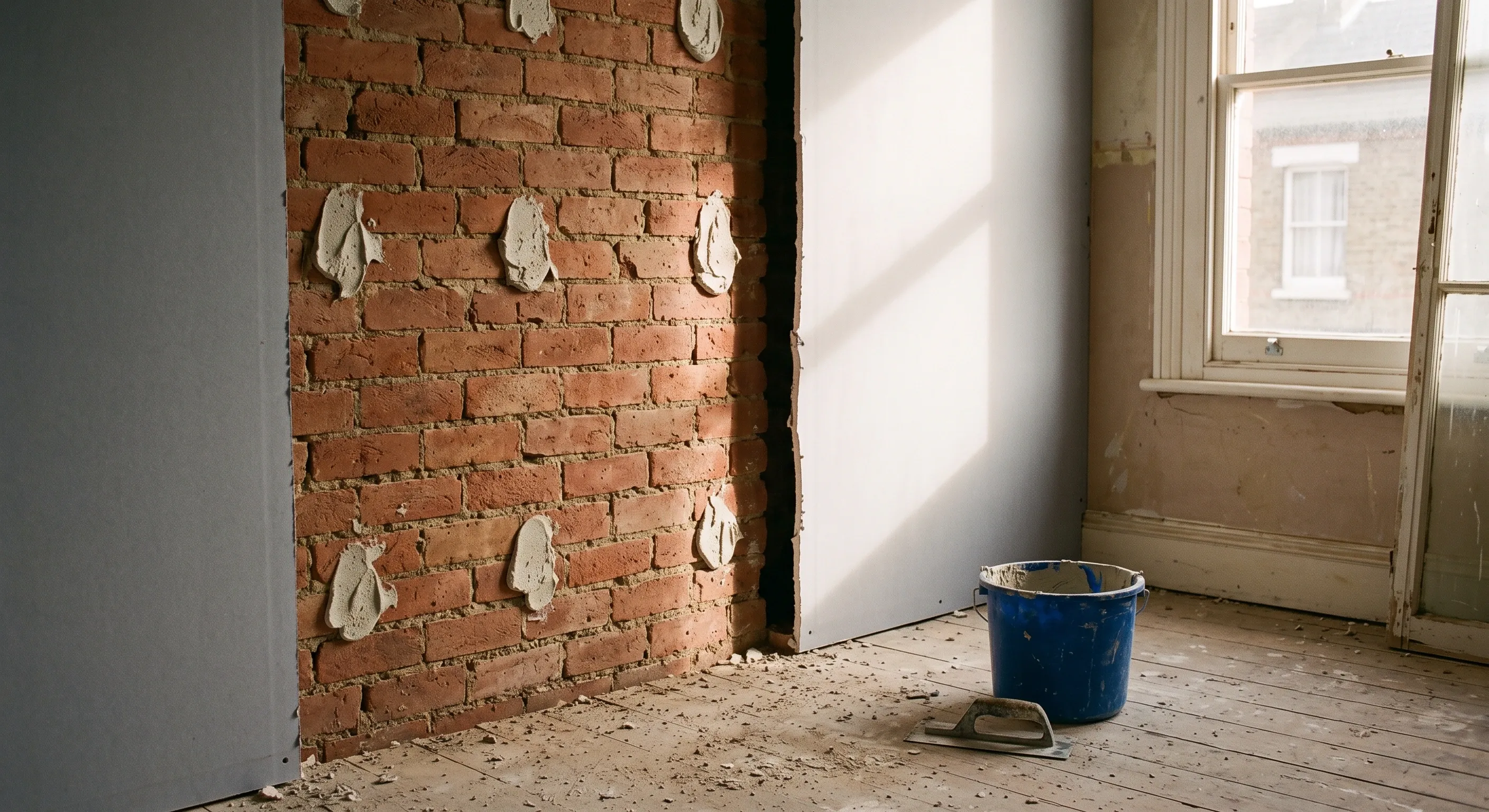
Dry lining isn't automatically faster or cheaper. The right method depends on whether your wall is solid brick, cavity, new blockwork or lath and plaster.

How to decide between repairing, overboarding or removing a lath and plaster ceiling, including testing the key, the asbestos question and the mess.
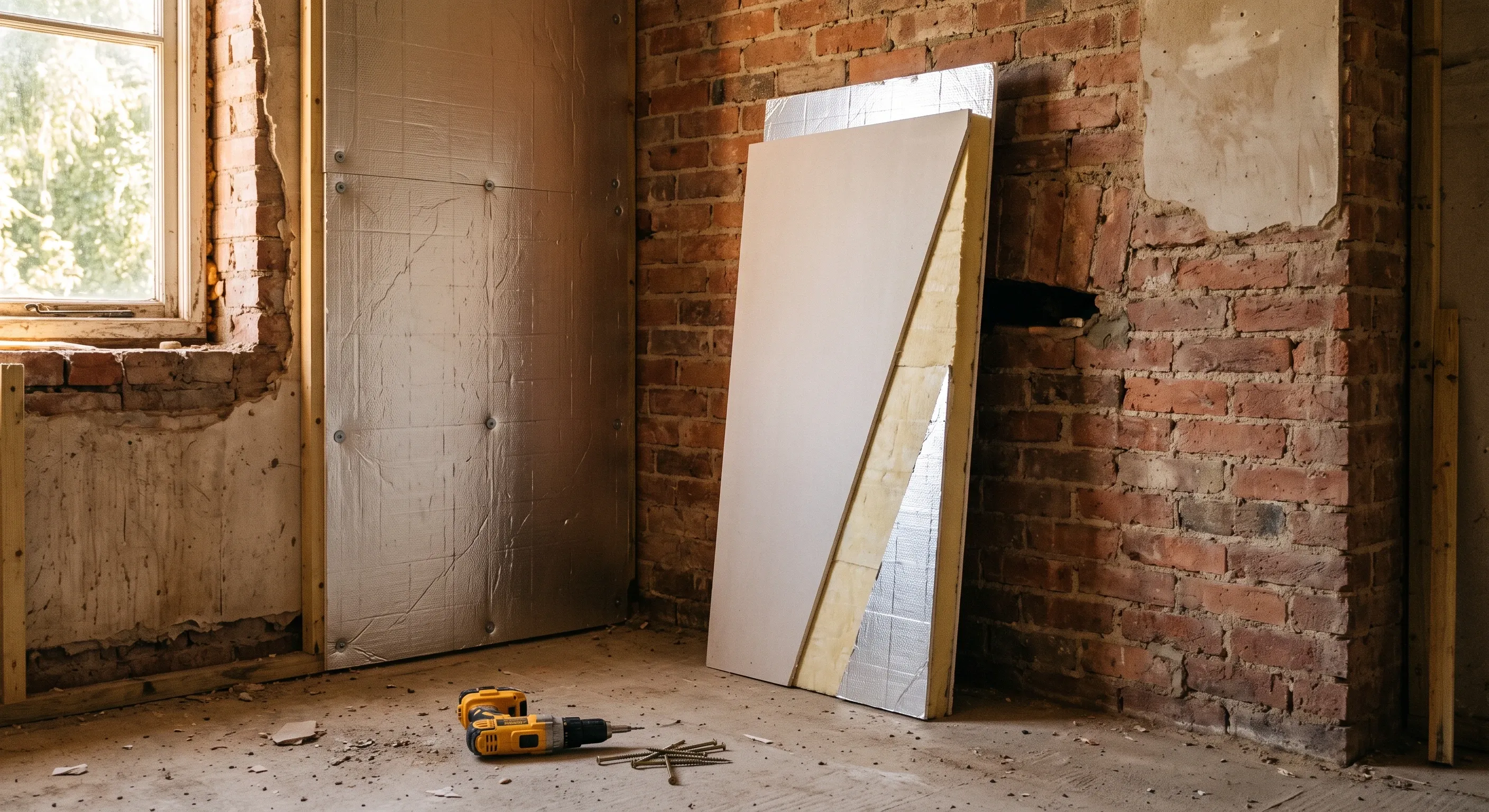
Internal wall insulation on solid brick: the Part L trigger, the 0.30 W/m2K target, why the dew point matters, room depth lost, and where it goes wrong.