
Do loft conversions add value?

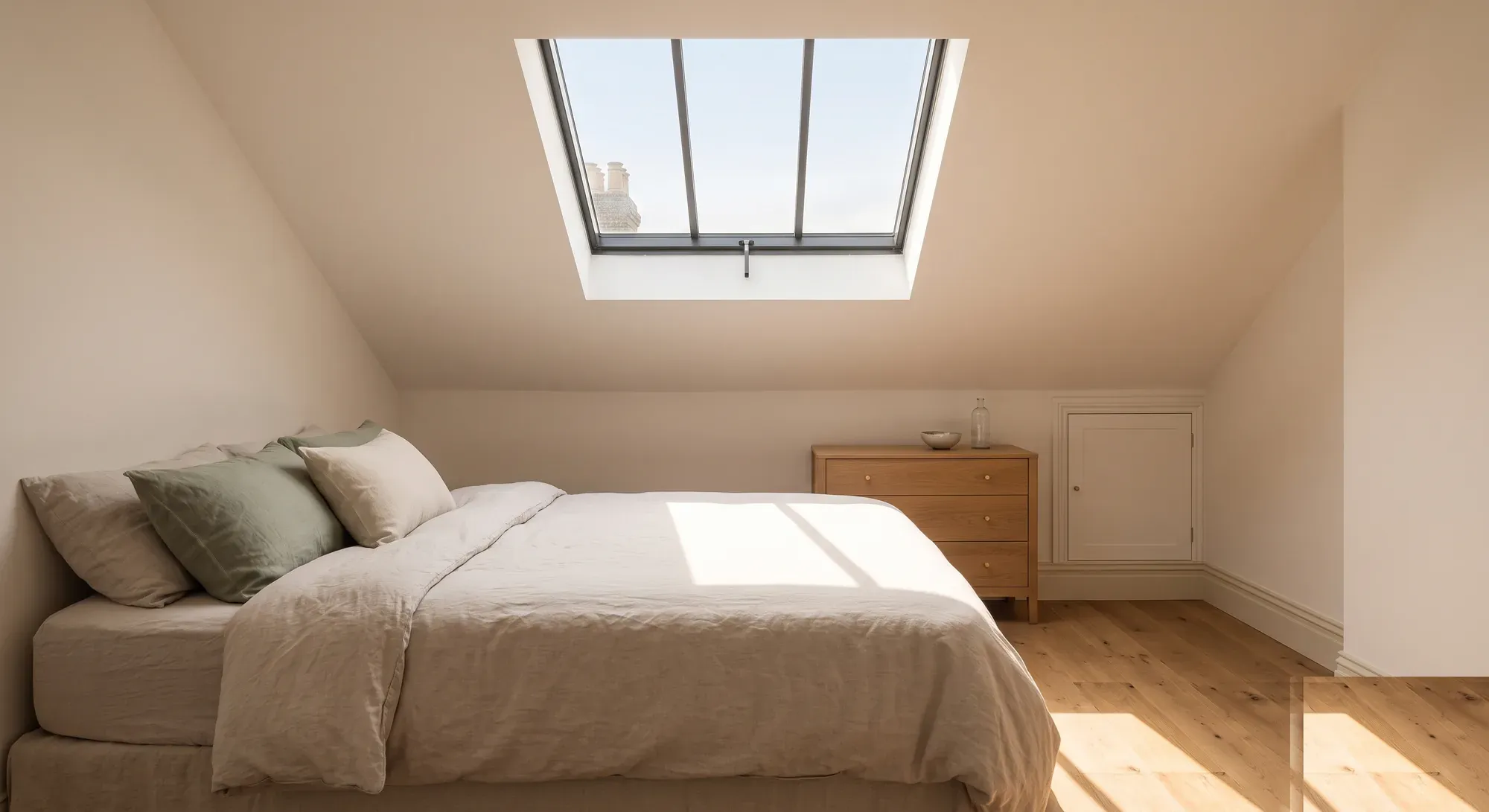
Yes, and the most useful published research says the gain comes from what the space is called rather than how much of it there is. Nationwide's house price research, based on hedonic regression across its own mortgage lending, found that a 10% increase in floor area adds about 5% to price, that going from two bedrooms to three adds around 13%, and that adding a bedroom and a bathroom together adds up to 24%.
That last figure is the one worth designing around, because a loft conversion is one of the few projects that can deliver both.
What the research actually says
Most claims about renovation adding value have no source behind them. This one does.
Nationwide's analysis uses hedonic regression across its own mortgage lending, which means it is isolating the effect of individual property characteristics on price across a large real sample rather than surveying opinions.
Change | Effect on price |
|---|---|
10% increase in floor area | About 5% |
Two bedrooms to three | Around 13% |
Three bedrooms to four | Around 10% |
Adding a bedroom and a bathroom | Up to 24% |
Read those rows together and the pattern is clear. Floor area alone moves the price modestly. Changing the number of bedrooms moves it much more, because it changes which buyers can consider the house at all. And the bedroom plus bathroom combination outperforms either on its own.
Why a loft conversion does well on this
A loft conversion is unusually well suited to the thing the research says pays.
It adds floor area, which gets you the 5% per 10%. But more importantly it almost always adds a bedroom, and it very often has room for an ensuite, which is exactly the combination that reaches up towards 24%.
Compare that with a single-storey rear extension, which usually adds kitchen and living space. That improves how the house lives without changing how it is described. A three-bedroom house with a bigger kitchen is still a three-bedroom house.
The other advantage is that a loft conversion adds nothing to the footprint. You are not losing garden, which in London is itself worth something and is a real cost of extending outwards.
The caveats that matter more than the percentages
Three, and they are the reason to be careful with a headline number.
The ceiling price on your street. Every street has a level above which buyers stop paying, regardless of what you have built. If three-bedroom houses on your road sell at a certain figure and four-bedroom houses barely exceed it, the 13% is theoretical. Local evidence from an agent beats national research on this specific question.
The figures are national averages from mortgage lending, not London specifics. The research covers Great Britain. London's price base is higher, its floor areas smaller and its buyer behaviour different, so treat the percentages as direction rather than as a calculation you can apply to your own house.
Losing a bedroom to a staircase. A loft conversion has to take its stair from somewhere, and on a small landing that sometimes means eating into an existing bedroom. Converting a two-bedroom house into a three-bedroom one only to make the second bedroom unusable as a double is a real outcome, and it undoes the thing you were paying for.
What actually drives the number
Four things, and only one of them is size.
Whether it counts as a bedroom. A room described as a loft room and a room described as a bedroom sell differently. That is partly about head height, partly about the stair, and partly about whether it has been signed off. Our guide to what head height you need for a loft conversion covers where the real constraints sit, and the widely repeated minimum that does not exist.
Whether there is a bathroom. The 24% figure attaches to bedroom plus bathroom, not bedroom alone. If the space and the plumbing allow an ensuite, the research says it is worth doing.
Whether the stair works. A conforming staircase in a sensible position reads as a proper floor of the house. An alternating tread stair squeezed into a corner reads as a room in the roof, whatever the particulars say.
Whether it has a completion certificate. This is the one people forget. A conversion with no building control sign-off is a problem at sale: a buyer's solicitor asks, a surveyor recommends a specialist report, a lender may make it a condition. See our guide to loft conversion building regulations: stairs, fire and insulation, which sets out what approval involves and what you should hold at the end.
The honest way to think about it
Value is one reason to convert a loft and usually not the main one.
If you need a fourth bedroom and the alternative is moving, the comparison is not the uplift against the build cost. It is what a loft conversion costs in the UK against stamp duty, agents' fees, legal costs and the disruption of a move, and on that comparison converting usually wins comfortably.
If you are converting purely as an investment, the research gives you a plausible direction but the ceiling price on your street decides the outcome, and that is a local question.
And if the loft is genuinely marginal on head height or roof type, the cost of making it work can climb quickly enough that the arithmetic stops being attractive. We have hip to gable loft conversions explained in a separate guide, which covers one of the more involved routes to making a difficult roof usable.
How Beams helps
The value of a loft conversion is decided by design choices made early: whether the stair position preserves the bedroom below, whether an ensuite fits, and whether the head height supports a room that reads as a proper bedroom.
So on our managed loft conversions we work those questions through before the design is fixed rather than discovering them on site, and make sure the building control sign-off exists at the end, because that is what a buyer's solicitor asks for.
That is part of what a Beams project commits to: one agreed price, payments released against milestones, and 12 months on the workmanship.
Common questions
How much value does a loft conversion add?
Published research from Nationwide indicates about 5% for a 10% increase in floor area, around 13% for going from two bedrooms to three, and up to 24% for adding a bedroom and a bathroom together. Those are national figures, not London-specific.
Is a loft conversion better value than an extension?
For value specifically, a loft conversion has an advantage where it adds a bedroom, because the research shows bedroom count moves price more than floor area alone. A rear extension usually adds living space without changing how the house is described. It also does not cost you garden.
Does it need to be a bedroom to add value?
The largest published effects attach to bedroom count and to bedroom plus bathroom. A loft used as an office or a playroom adds floor area, which the research associates with a smaller uplift.
Will it add value without building regulations approval?
It will create a problem instead. A conversion with no completion certificate is a routine cause of delay at sale, and lenders and surveyors ask about it.
What is a ceiling price?
The level above which buyers on your street stop paying regardless of what the house offers. It is the single biggest limit on any value calculation, and a local agent will know it better than any national research.
Where this information comes from
Effect of floor area and bedroom count on price, including approximately 5% for a 10% increase in floor space, around 13% for two bedrooms to three, around 10% for three to four, and up to 24% for a bedroom plus bathroom: Nationwide house price research, reported October 2025, based on hedonic regression across Nationwide's own mortgage lending
Head height and stair requirements: The Building Regulations 2010, Approved Document K, paragraphs 1.11, 1.13 and 1.29
Completion certificates, in all cases and within eight weeks: regulation 17(1) and 17(2), as currently in force in England
We have not published an absolute pound figure for the uplift, because we could only reach secondary reporting of the underlying research rather than the primary release. The percentages above are consistently reported and are used here as direction rather than as a calculation for any individual property. Ceiling prices are local and no national research substitutes for local evidence.
Whether it adds value comes down to whether the work is built and certified properly, which is what a managed loft conversion with Beams is for.
Find out what your project will cost
Tell us about your loft and we will get you up to three comparable quotes from vetted London builders, designed so the new floor reads as a proper bedroom.