
Combi, system or regular boiler: which one does your house need?

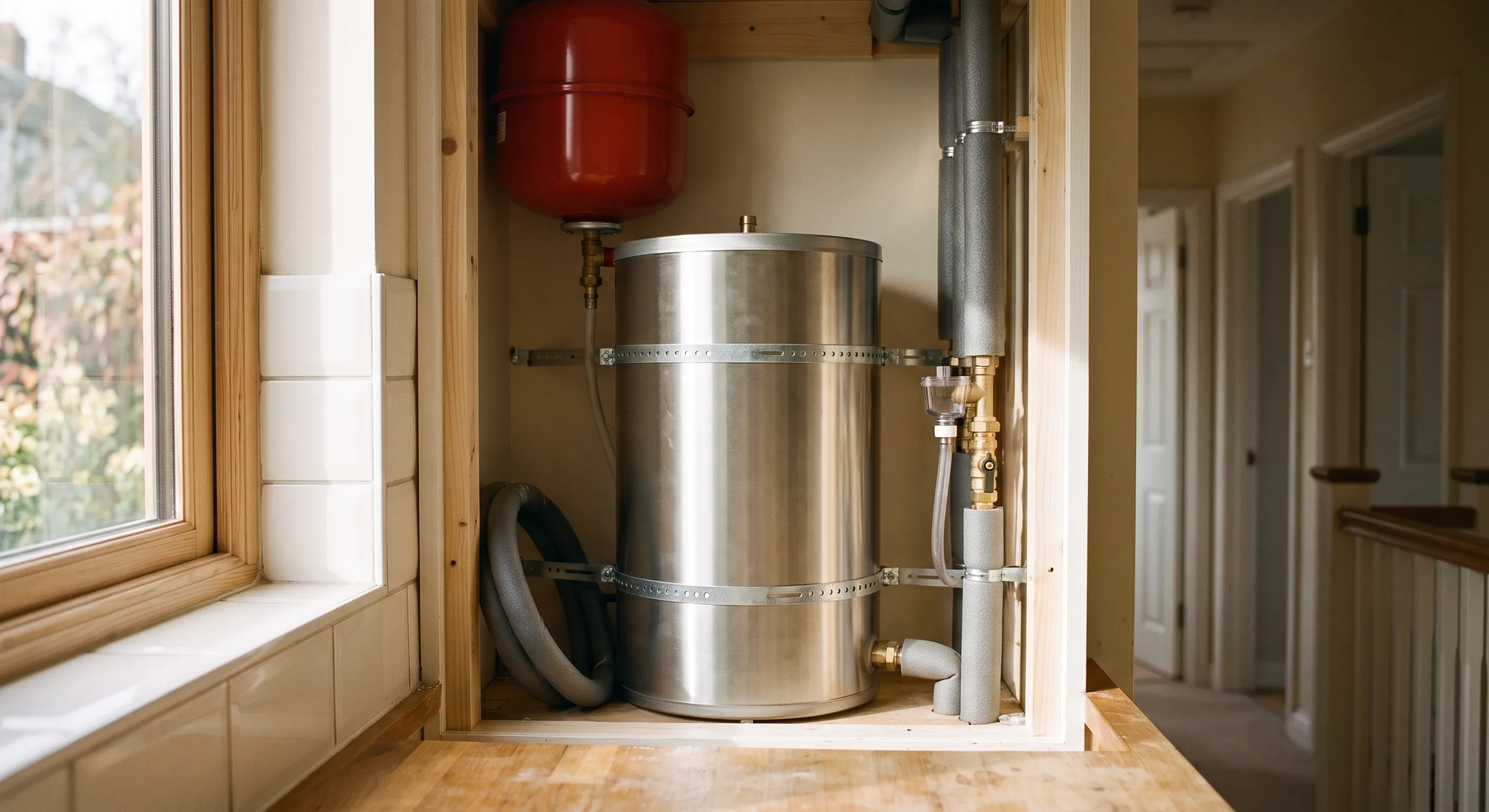
Three things decide it, and bedroom count is not one of them: your incoming mains flow rate in litres per minute, how many bathrooms you want running at the same time, and whether you can afford to lose the airing cupboard. Test the flow rate before you speak to anyone. Everything else follows from that number.
Manufacturer selectors ask how many bedrooms you have because it is the only question they can ask without visiting. It is a proxy, and in London it is a bad one. A three-bed terrace in Tooting with 9 litres per minute at the kitchen tap and a two-bed flat in Clerkenwell with 22 need different answers, and the bedrooms are telling you nothing about either.
What actually separates a combi, a system and a regular boiler?
A combi heats water on demand straight from the mains and stores nothing. A system boiler heats a cylinder, usually in an airing cupboard, and pushes both heating and hot water round a sealed system. A regular boiler, which Viessmann calls a conventional or heat-only boiler, needs a hot water cylinder and a cold feed tank, normally in the loft.
The practical consequence is stored capacity. A combi's hot water output is capped at whatever the mains can deliver at that instant, and it is shared between every outlet that is open. A cylinder holds a fixed volume at full flow and then runs out, and takes time to reheat. That is the entire trade-off, and it is why the question is really about flow rate and simultaneity rather than house size.
Combi | System | Regular | |
|---|---|---|---|
Hot water source | Mains, on demand | Cylinder, pressurised | Cylinder, gravity or pumped |
Cylinder needed | No | Yes | Yes |
Loft tank needed | No | No | Yes |
Limited by mains flow rate | Yes, directly | Only while reheating | No |
Two showers at once | Halves the flow at each | Yes, within cylinder volume | Yes, often needs a pump |
Runs out of hot water | No | Yes, then reheats | Yes, then reheats |
Space cost | None beyond the unit | Airing cupboard | Airing cupboard and loft |
How do you test your mains flow rate?
Take a container of known volume, put it under the cold tap that is fed directly off the mains, which in almost every UK house is the kitchen tap, and open it fully. Two methods work.
The bucket method: fill a 10-litre bucket and time it. Ten litres in 30 seconds is 20 litres per minute, ten litres in 60 seconds is 10 l/min. The jug method is faster and just as good: run the tap flat out into a measuring jug for exactly six seconds, then multiply the litres collected by ten. Nine hundred millilitres in six seconds is 9 l/min.
Three things ruin this test, so avoid all of them. Do not use a bathroom tap, because in a house with a loft tank it may be gravity fed and will read low for the wrong reason. Do not test at eleven in the morning, because mains pressure in London falls in the evening peak and on summer mornings when everyone is showering. And do the test twice: once on its own, and once with a second cold tap running, so you can see how much the supply sags when something else opens. That second number is the one that predicts how a combi will behave in real life.
What flow rate does a combi actually need?
Work backwards from the outlets, not the appliance. Worcester Bosch's technical bulletin TB 0123 A cites NHBC guidance limiting hot water outlets to 6 litres per minute at a basin, sink or shower, and 9 litres per minute at a bath. So a household that wants a bath filling while someone showers needs around 15 l/min arriving at the house before the boiler is even part of the conversation.
Measure 20 l/min or better and a combi will do almost anything you ask of it. Between 12 and 20 you have a usable combi for a house with one bathroom and an occasional second outlet. Below about 12 l/min a combi will disappoint you every winter morning regardless of its kW rating, because kW governs how fast the boiler can raise the temperature, not how much water the street can give you. Worcester Bosch notes that all its combi boilers carry a flow restrictor to guarantee a 40°C temperature rise, so on a cold January mains a combi limits flow deliberately to keep the water hot. Low flow rate and cold incoming water compound each other, which is exactly why combis feel worse in February than in June. The same bulletin puts the flow needed to fire the boiler at all at 2 to 3 l/min, which is why a slightly open tap sometimes runs cold.
Measured mains flow | Realistic options |
|---|---|
Under 10 l/min | System or regular boiler, or upgrade the incoming supply first |
10 to 15 l/min | Combi for one bathroom only, and expect a noticeable drop when a second tap opens |
15 to 20 l/min | Combi works well for one bathroom plus an occasional second outlet |
Over 20 l/min | Combi, system or a storage combi all viable; choose on storage and space |
How many bathrooms can each type run at once?
One, in the case of a combi, properly. Open a second outlet and the available flow is split between them, which is why two showers off a single combi feel like two disappointing showers rather than one good one. A system boiler with a decently sized unvented cylinder runs two showers simultaneously at full pressure until the cylinder is empty, which is the behaviour most families actually want.
Viessmann's own guidance lands in the same place from the other direction: it recommends 24 to 30 kW for most households with a single bath and shower, 30 to 35 kW where there is an additional en-suite, and says outright that where multiple bathrooms are likely to be in use at the same time, a system boiler storing hot water in a cylinder is more suitable. If you are adding an en-suite as part of the works, decide the boiler type then, not afterwards.
The shower itself is a separate cost and a separate decision. We have priced running a shower off a combi in detail elsewhere, including the pump question, which is where most people get caught: a combi delivers at mains pressure, so a pump on the hot side is not an option.
What do you actually give up to keep a cylinder?
An airing cupboard, and in a London flat that is often the only storage on the floor. A modern unvented cylinder for a family house is typically 150 to 250 litres and roughly 1.5 to 1.8 metres tall, so it wants a cupboard a metre square, not a shelf.
It also brings regulation. An unvented hot water storage system is notifiable work under Part G3 of the Building Regulations, has to be installed by someone holding the relevant competent person qualification, and needs a safe discharge route for the temperature and pressure relief valve, which is why it is usually sited on an external wall. That discharge is the detail that kills cylinder plans in internal flat cupboards. Ask where the tundish discharges before anyone orders a cylinder, because if the answer is a shrug, the cupboard is not going to work.
When is a regular boiler still the right answer?
When the mains is genuinely poor and cannot be improved, or when the property will not take the pipework upheaval. A regular system's cold feed tank in the loft gives you a gravity head that is independent of the street, which is why Viessmann still points to conventional systems for homes with low mains pressure and lots of radiators.
It is also the right answer more often than people think in large period houses, where converting to a combi means the loss of the tanks, the resizing of the primaries, and a house full of open floors. Checkatrade puts a regular-to-combi conversion at around £4,000 for supply and installation and about two days, with a system-to-combi conversion running to three, and neither figure states a VAT basis. Before committing to a conversion, it is worth reading what a new boiler actually costs once the pipework and making good are included, because the conversion price is rarely the whole number.
Does flow temperature change the answer?
It changes the radiators more than the boiler. A condensing boiler only condenses when it returns water below about 55°C, so the direction of travel in every well-designed system is lower flow temperature and larger emitters. That argues for oversizing radiators now rather than replacing them twice.
It also makes wet underfloor heating worth considering in any room where the floor is coming up anyway, because underfloor circuits are designed for low flow temperatures from the start and make the eventual jump to a heat pump far less painful. A combi complicates that story, since a heat pump needs a cylinder and a combi house has nowhere to put one. If you think a heat pump is in your ten-year plan, losing the airing cupboard today is a decision you may pay for twice.
How the choice actually gets settled
Two pieces of evidence, gathered before anyone quotes: a room-by-room heat loss calculation and a measured mains flow rate. The heat loss calculation gives the output the house needs on the coldest day, which sets the kW. The flow rate test tells you whether a combi can ever satisfy the hot water demand, which sets the type. Viessmann's guidance is blunt about the first half of this: do not oversize to compensate for heat loss, because the old habit of specifying 30% bigger than required just wastes gas.
That is step two of the Beams process, and it is why designing the heating system around the house comes before choosing a product rather than after it. An engineer who recommends a boiler type without measuring either number is guessing, politely.
Frequently asked questions
Can I fit a combi if my flow rate is 9 l/min?
You can, and you will regret it. The better route is to find out why the flow is low. If the incoming supply from the street is 15mm lead or old iron, upgrading it to 25mm MDPE can transform the number, and that is a decision to make before choosing a boiler type, not after. Where the supply genuinely cannot be improved, some households end up on an instantaneous electric shower instead, and we have compared an electric shower against a combi-fed one on what each costs to run.
Is a storage combi a real solution or a compromise?
It is a genuine middle option. A storage combi holds a small internal buffer, so it copes with short simultaneous draw-offs without needing a separate cylinder. Viessmann typically suggests one for a three-bed semi with a single bathroom. It will not run two showers at once.
Does a bigger kW combi fix low mains flow?
No. kW is heating capacity, litres per minute is supply. A 35kW combi on a 10 l/min main gives you 10 l/min of hot water, slightly hotter.
Do I need a system boiler if I have three bedrooms?
Not automatically. Three bedrooms and one bathroom with 18 l/min at the mains is a combi house. Three bedrooms, two bathrooms used at the same time every morning is a system house. The bathrooms decide it, not the bedrooms.
What if the cylinder has to go in the loft?
It can, but loft cylinders need boarded access, insulation and pipework protected from freezing, and the pressure at ground floor outlets depends on the type of system. Say it early so it is designed in rather than improvised.
Find out what your project will cost
Not sure whether your mains will support a combi, or what a cylinder does to your storage? Get up to three comparable quotes from vetted London builders, all priced from the same written scope, so the boiler type is settled by evidence rather than by whoever quotes first.
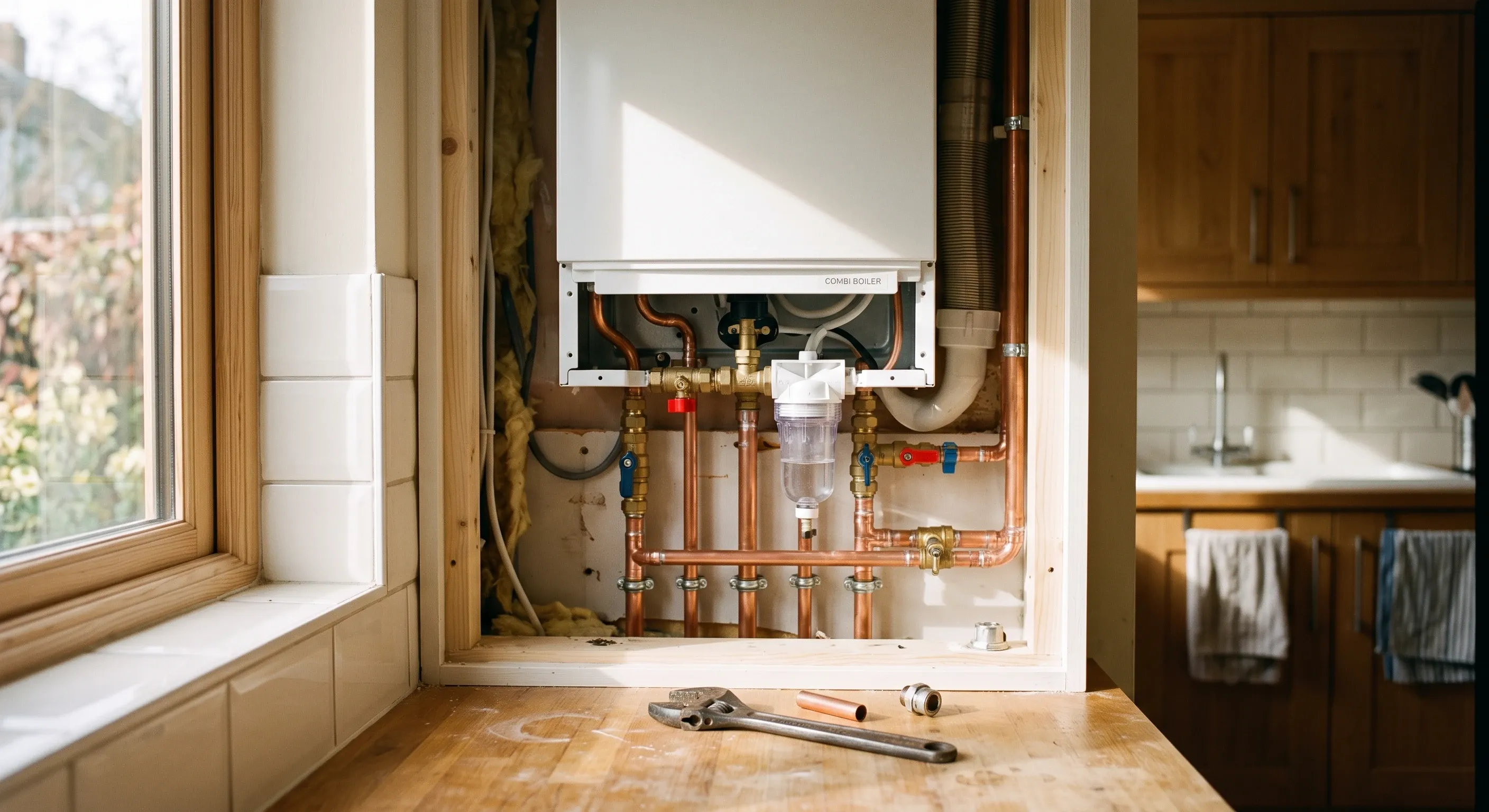
Published UK boiler prices with the VAT basis stated, plus the pipework, radiator and making-good costs that headline quotes quietly leave out.
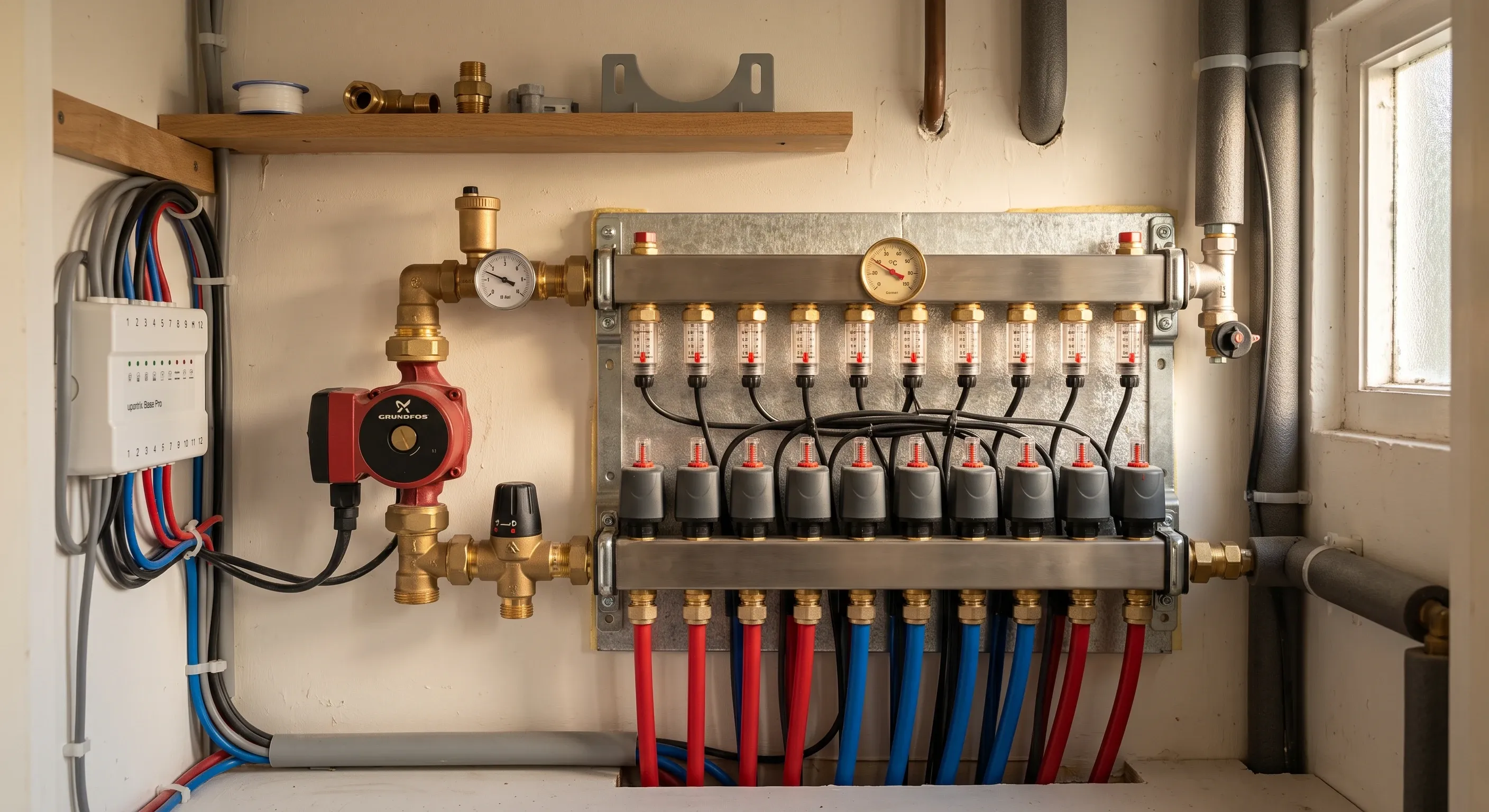
Yes, with a blending valve, manifold and zone valves. The real question is whether your combi modulates low enough to run a low-temperature circuit.
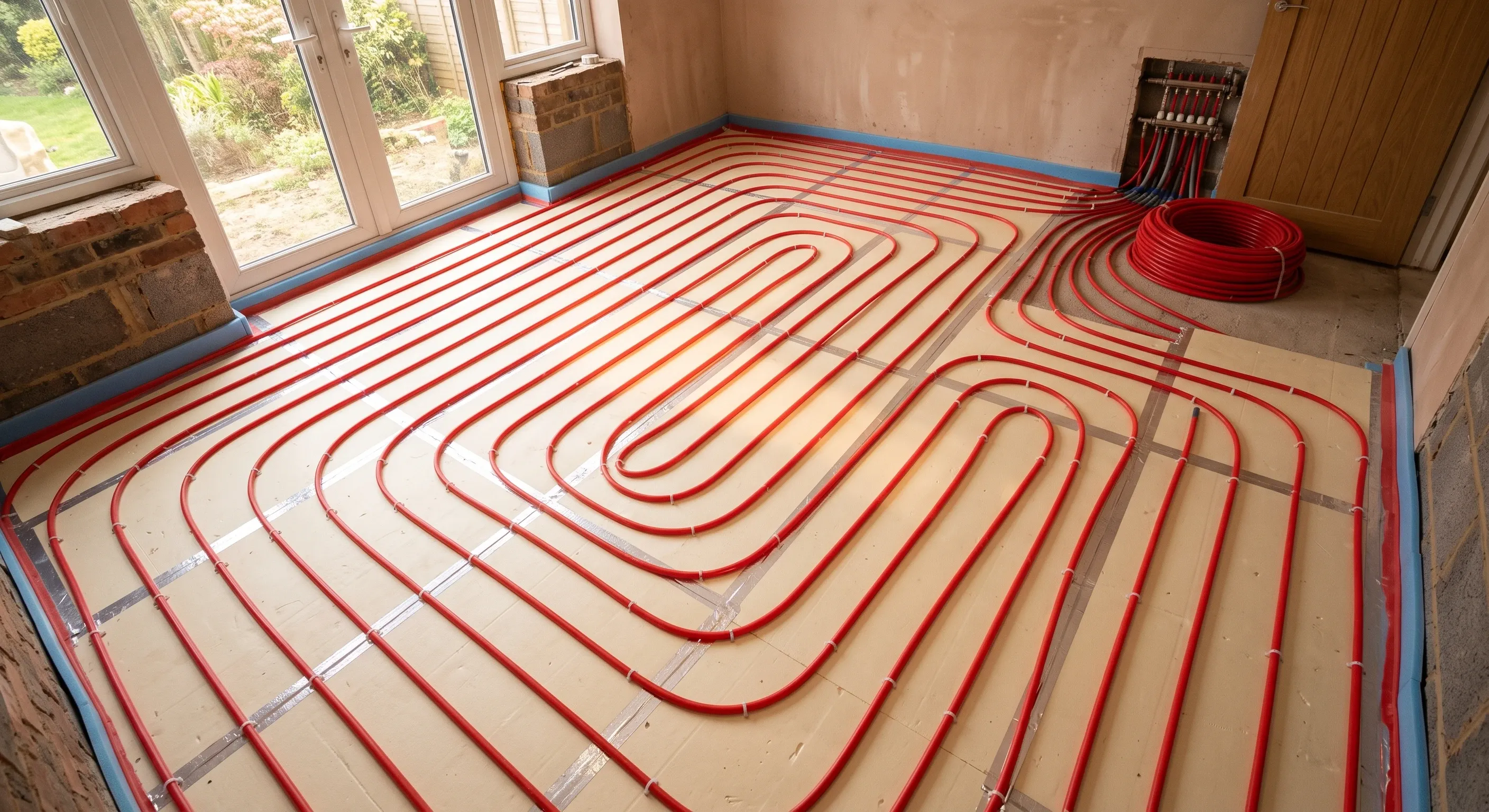
Published figures say 25% cheaper and also say parity. The variable is flow temperature and floor insulation. What that means for a London terrace.