
Signs your house needs rewiring (and which ones are actually urgent)

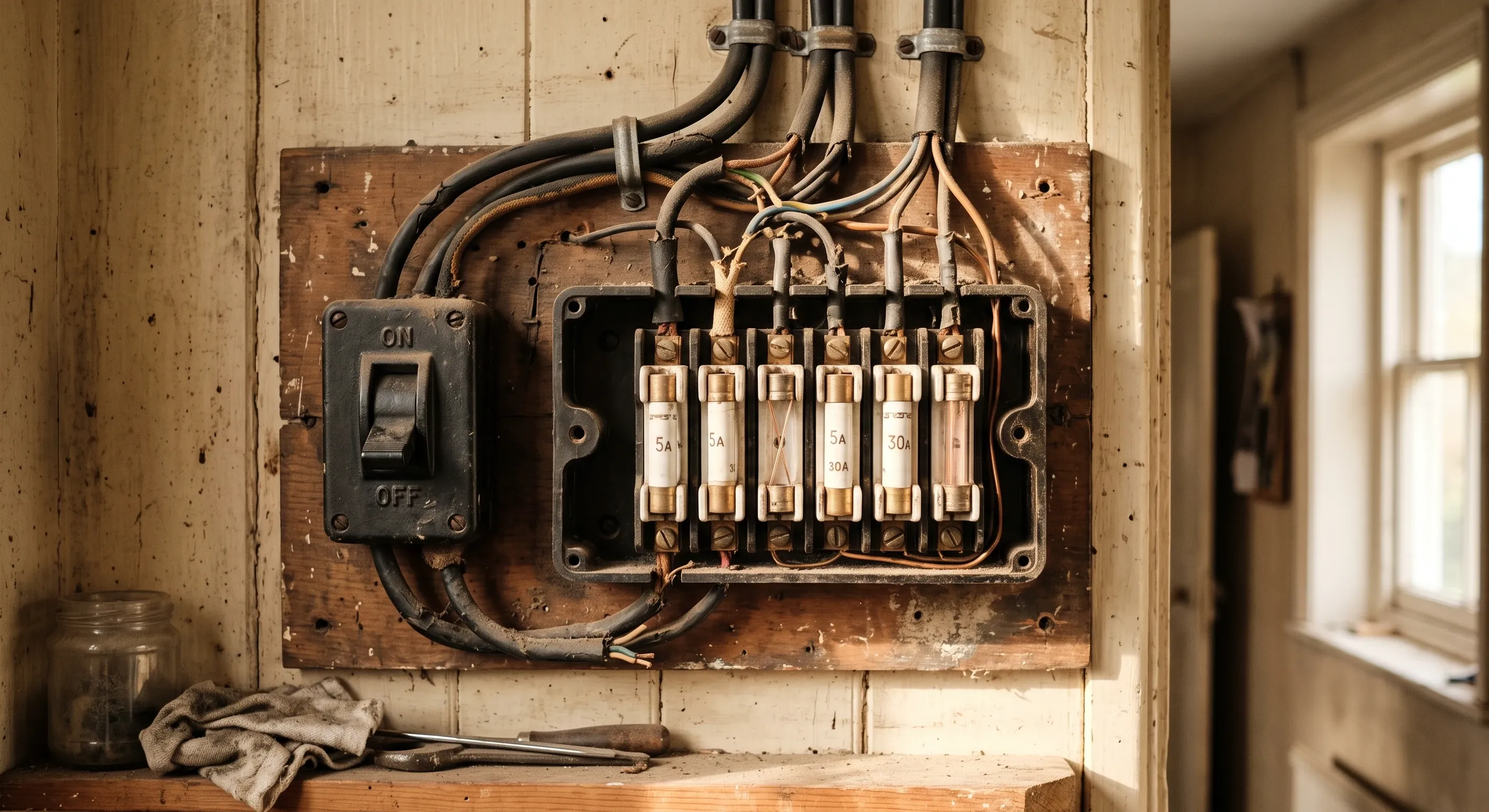
Most houses do not need rewiring. Four signs genuinely mean the cable itself has to come out: rubber, lead or fabric-sheathed cable, lighting circuits with no earth, round-pin sockets on general-purpose circuits, and widespread low insulation resistance readings. A fuse box with rewirable fuses, no RCD protection and nuisance tripping usually mean a new consumer unit, not a rewire.
That distinction is worth thousands of pounds, and almost every article on this subject refuses to make it. They give you a list of symptoms and leave you to guess. So here is the same list of signs, graded: what each one means, whether it is urgent, and what work it actually points to.
Which signs are urgent, and which are not?
Grade every sign you find against what it tells you about the cable, because the cable is what a rewire replaces. Everything at the board can be swapped in a day. Everything buried in the walls cannot.
What you've found | What it usually means | Urgency |
|---|---|---|
Rubber, lead or fabric-sheathed cable | Full rewire | High, arrange an inspection now |
Lighting circuits with no earth | Full or partial rewire | High if you have metal light fittings |
Round-pin sockets on general circuits | Full rewire | Medium |
Black or brown bakelite accessories | Dates the install to pre-1960s, check the cable behind | Medium |
Fuse box with rewirable fuses | Consumer unit replacement | Medium |
No RCD protection | Consumer unit replacement | Medium to high |
Warm, buzzing or scorched socket | Local repair, occasionally a circuit rewire | Immediate, stop using it |
Recurring tripping | Fault finding first, not a rewire | Medium |
Not enough sockets | Extra circuits, not a rewire | Low |
Red and black cable cores | Wired before 2006. Not a fault | None |
A modern consumer unit runs to around £485 supplied and fitted for a populated 10-way RCBO board, according to Checkatrade's 2026 consumer unit cost guide, with terraced houses averaging £350 and large detached homes £750. Those figures exclude VAT. A full rewire sits in a different order of magnitude, and we have set out what a full rewire costs in the UK separately. Knowing which of the two you are actually looking at is the entire point of the exercise.
Does rubber, lead or fabric-sheathed cable mean a full rewire?
Yes. This is the one sign that settles the question on its own. Vulcanised rubber insulation, used in British homes until around 1960, hardens and cracks with age until it flakes off the conductor when disturbed. Fabric-covered and lead-sheathed cable belongs to the same era. Once rubber has gone brittle, there is no repair: pulling a light fitting off the ceiling can shed insulation inside the rose and leave bare copper sitting in a metal enclosure.
Look in three places. Behind the ceiling rose in a room nobody has redecorated, at the back of the consumer unit where the circuit cables enter, and under the floorboards nearest the meter. Modern PVC twin and earth is grey or white, flat, and flexible. If what you find is round, cloth-wrapped, dull grey metal, or if the outer covering crumbles between finger and thumb, the house needs rewiring. Period housing stock is where this turns up most often, alongside the other problems Victorian terraces tend to hide.
Is a fuse box with rewirable fuses a rewire trigger?
No. An old board with ceramic rewirable fuse carriers, a wooden back, or a cast-iron main switch is a consumer unit replacement, not a rewire. Rewirable fuses to BS 3036 are crude protection and they offer no earth fault protection for people at all, which is the real objection to them. But the cable behind them may be perfectly sound PVC from 1985, and swapping the board changes nothing about the cable.
The same applies to no RCD protection. BS 7671 has required RCD protection for general socket outlets and for cables buried in walls at less than 50mm depth since the 17th Edition in 2008, so any board older than that is very likely to fail on this point. A replacement to the current 18th Edition, with RCBOs giving each circuit its own residual current protection rather than one RCD tripping half the house, fixes it. Where people get caught out: your electrician will test the existing circuits before fitting a new board, and if the insulation resistance readings are poor, they are quite right to refuse. A new board on decayed cable is a new board that trips constantly.
What do round-pin sockets and bakelite accessories tell you?
Round-pin sockets on general-purpose circuits date the installation to before the BS 1363 13A square-pin standard took over from 1947, which means the wiring behind them is almost certainly original and almost certainly rubber. Treat them as a full rewire indicator. One exception, and it catches people out: 5A round-pin sockets are still fitted today on switched lamp circuits in new installations, so a single round-pin outlet in a sitting room controlled from the wall switch is a deliberate modern feature, not a relic.
Black or brown bakelite switches and sockets are a dating clue rather than a defect in themselves. They tell you the accessories are pre-1960s and nobody has touched that circuit since. Take the faceplate off, with the circuit isolated or by an electrician, and look at the cable behind it. That is where the actual answer is.
Why should a warm or scorched socket be dealt with today?
Heat at an accessory means a loose or high-resistance connection, and high-resistance connections are what start electrical fires. Brown or black staining around the pin holes, a faint smell of hot plastic, a buzzing or crackling noise, or a faceplate that feels warm when nothing is plugged in: any of these means stop using that socket, switch the circuit off at the board, and get an electrician to it.
This is rarely a whole-house problem. Most scorched sockets are a single failed accessory or one loose terminal, and the fix is an hour's work. What matters is the pattern. One warm socket is a repair. Warm sockets appearing in several rooms, particularly on the same ring final circuit, points to a circuit that has been overloaded or badly extended over decades, and that circuit may well need replacing on its own.
Does recurring tripping mean the wiring has failed?
Usually not. A circuit breaker that trips repeatedly is doing its job, and the honest first step is fault finding, not a rewire quote. The common causes are a faulty appliance, water ingress into an outside socket or a bathroom extractor, a nail or screw through a cable from a shelf someone put up, or an older RCD protecting too many circuits at once so that normal leakage from several appliances adds up and trips it.
That last one is worth naming, because it produces the classic complaint of a board that trips when the washing machine and the immersion heater run together. It is a board design problem, solved by splitting the circuits across RCBOs. Where tripping does point at the cable is when it happens on damp mornings, on one circuit, with no appliance involved. Moisture getting into degraded insulation behaves exactly like that.
What does lighting with no earth mean?
It means the lighting circuit was wired before earthing at every lighting point became standard practice in the mid-1960s, and it is one of the strongest rewire indicators after the cable itself. Take down a ceiling rose and if there is no green and yellow conductor, or no bare copper conductor waiting to be sleeved, there is no circuit protective conductor in that cable.
The practical consequence is that you cannot safely fit any metal light fitting, downlight or track anywhere on that circuit, which rules out most of what people want when they renovate. Plastic fittings marked with the double-square Class II symbol are the only compliant option. Because lighting circuits and socket circuits in a house of that age were almost always installed together, no earth in the lighting normally means the whole installation is of the same vintage. Occasionally it is only the lighting, in which case a partial rewire of the lighting circuits alone is a sensible and much cheaper answer.
How old does wiring have to be before it needs replacing?
There is no expiry date, and the widely repeated line that houses need rewiring every 25 or 30 years is marketing rather than engineering. PVC twin and earth installed in 1975 and left undisturbed in a dry floor void can test perfectly well today. What ages an installation is heat, damp, rodents, and fifty years of people cutting into it.
Dating the wiring is more useful than guessing at the house. Two clues do it quickly. Cable cores in red and black were the standard until the harmonised brown and blue colours arrived in 2004 and became mandatory in 2006, so red and black tells you the circuit predates 2006 and nothing more than that. Earth sleeving in plain green rather than green and yellow puts the work before 1977. Neither is a defect. Both tell you roughly what you are dealing with before anyone opens a wall.
What should you do next?
Book an Electrical Installation Condition Report before you speak to anyone about a rewire. An EICR is a tested inspection of the fixed wiring by a qualified electrician, not a visual once-over, and it produces the evidence that decides the question: insulation resistance readings circuit by circuit, earth continuity, polarity, and a coded list of every defect found. Checkatrade puts a domestic EICR at £100 to £250 excluding VAT, averaging £200. It is worth understanding what the codes on that report mean before the electrician talks you through it, because C1, C2 and C3 are not interchangeable and only some of them oblige you to do anything.
Use the report to scope the work rather than to justify the biggest possible job. If the defects sit at the consumer unit and at individual accessories, you need a board change and some repairs. If low insulation resistance shows up across several circuits, or the cable is rubber, you should scope a full or partial rewire with a proper written specification: which circuits, how many sockets per room, where the board goes, and who makes good the plaster afterwards. Partial rewires are legitimate and underused, and a house where the ground floor was redone in 2005 and the first floor never touched is a normal thing to find.
Whoever does the work must be registered with a competent person scheme such as NICEIC, NAPIT or ELECSA, because a rewire and a consumer unit replacement are both notifiable under Part P of the Building Regulations in England. You should receive an Electrical Installation Certificate and a Building Regulations compliance certificate at the end. No certificate means a problem at your next sale.
If you are in a flat, check your lease before anything is ordered. Rewiring usually counts as an alteration to the demise and often needs a licence to alter from your freeholder, which takes weeks to obtain and costs money in the freeholder's legal and surveyor's fees. Starting the work first and asking afterwards is how leaseholders end up with a breach on file that surfaces years later during a sale.
Frequently asked questions
Can I get a mortgage on a house that needs rewiring?
Usually yes, though a surveyor's valuation report will normally flag old wiring and recommend an electrical report. Some lenders apply a retention, holding back part of the advance until the work is done and certified. Where the survey recommends an EICR, get one before exchange, because it gives you a priced defect list to negotiate with.
Is a house with an unsatisfactory EICR unsafe to live in?
Not necessarily. A C1 defect means danger is present and the electrician should make it safe on the day. A C2 means potentially dangerous and needs remedial work, but the installation is not usually isolated. What makes a house genuinely unsafe is ignoring the report, not receiving one.
Do I need to rewire before a kitchen or bathroom refit?
Not automatically, but it is the cheapest time to do it if the answer turns out to be yes, because the walls and floors are open anyway. Both rooms need new circuits regardless: a dedicated cooker circuit, a kitchen socket circuit, and RCD protection in the bathroom. Ask for the electrical test results before the units are ordered rather than after.
Does a rewire have to include a new consumer unit?
Yes in practice. A rewire terminates every circuit at the board, and the certification covers the whole installation, so a rewire onto an old board would leave the new cable protected by obsolete devices. Treat a rewire quote that excludes the consumer unit as incomplete and ask why.
How disruptive is a partial rewire compared with a full one?
Considerably less, because the chasing and lifting is confined to the circuits being replaced. The trade-off is that you end up with an installation of two ages, and the electrician must be satisfied the old circuits are safe enough to certify alongside the new. Get that confirmed in writing before the work starts.
Find out what your project will cost
You've spotted the signs but you still don't know whether this is a £500 board change or a whole-house strip-out, and every electrician you call will tell you something different. Get up to three comparable quotes from vetted London builders, all priced from the same written scope, so you are comparing the work rather than the sales pitch.
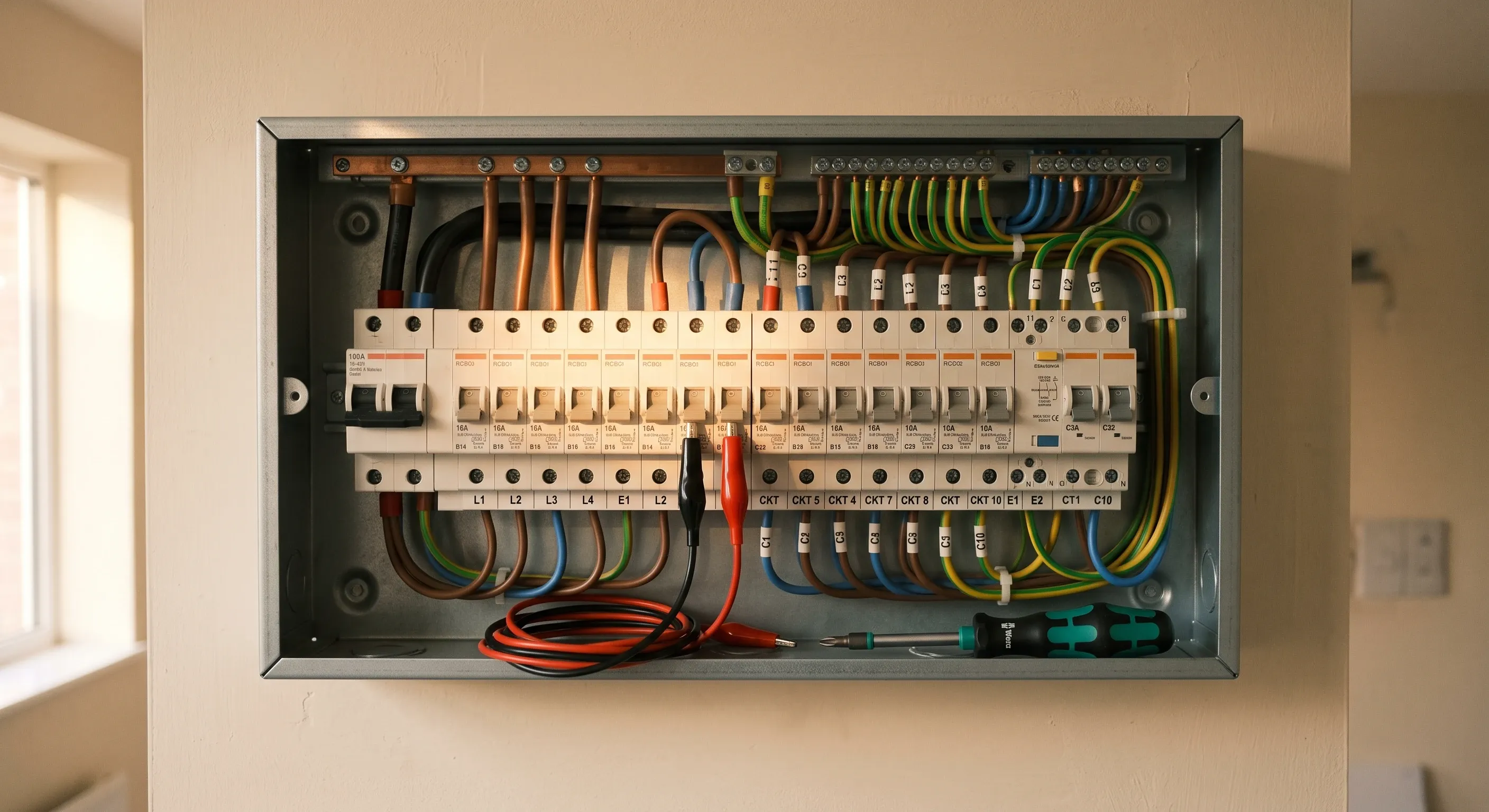
What C1, C2, C3 and FI mean on an EICR, what makes a report unsatisfactory, the 28-day landlord rule, and when coded defects add up to a rewire.

Published UK boiler prices with the VAT basis stated, plus the pipework, radiator and making-good costs that headline quotes quietly leave out.
A proper diagnosis for blown plaster: the tap test read correctly, skim versus backing coat failure, and what crack width and shape really mean.