
EICR codes explained: what C1, C2 and C3 mean and what you have to fix

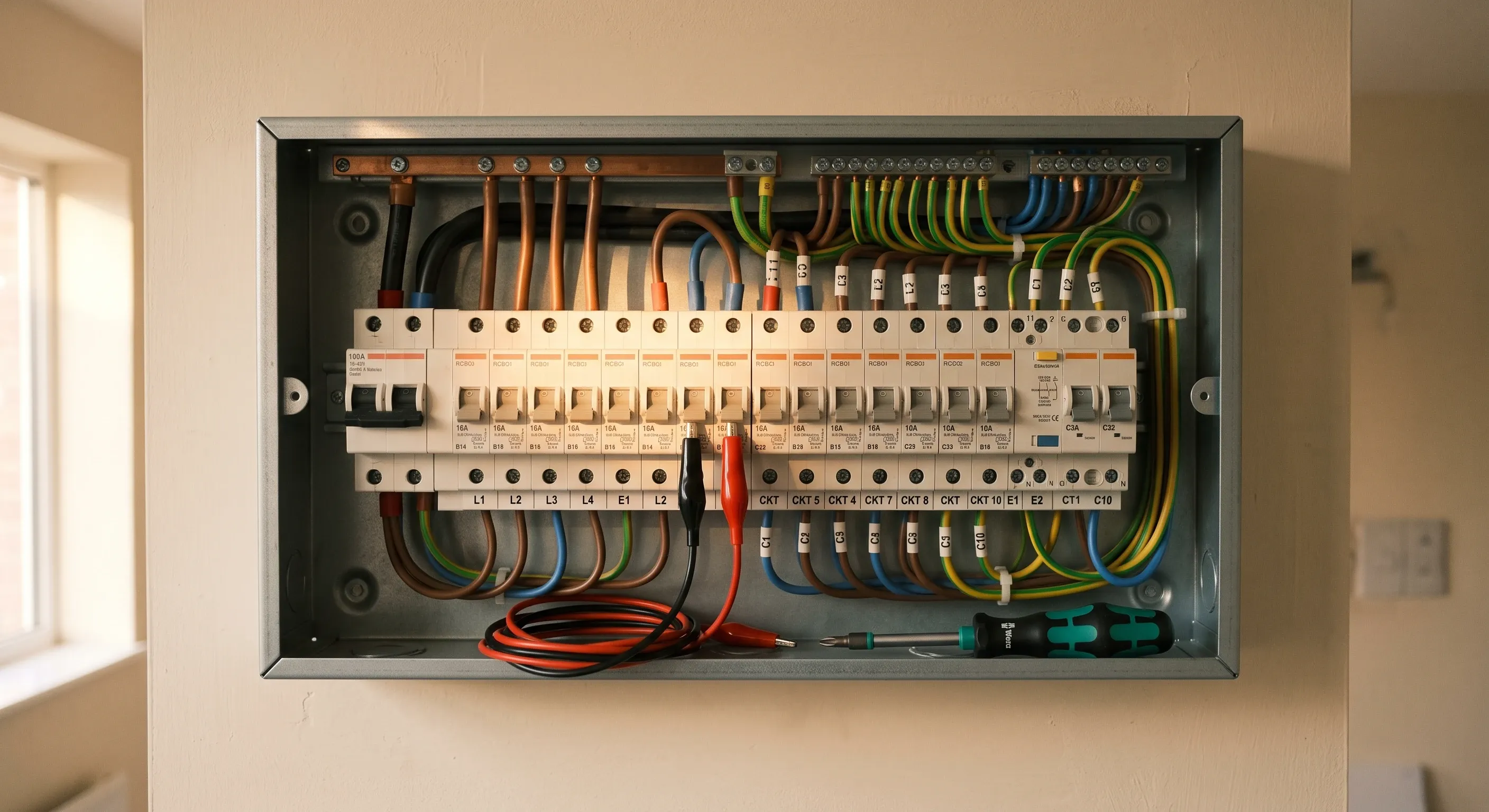
C1 means danger is present and must be made safe immediately. C2 means potentially dangerous and requires remedial work. C3 means improvement recommended, with nothing you are obliged to do. FI means the inspector could not tell and further investigation is needed. Any C1, C2 or FI makes the report unsatisfactory. C3s alone do not.
That is the whole code system in five lines, and it is where most articles stop. The harder questions are the ones you actually have: whether an unsatisfactory report obliges you to do anything if you are not a landlord, why two electricians will code the same fault differently, and at what point a list of C2s stops being a repair job and becomes a rewire.
What do C1, C2, C3 and FI mean?
Every observation on an Electrical Installation Condition Report carries one of four classification codes, applied under the BS 7671 model forms. They describe risk, not cost, and they say nothing about how hard the fix is.
Code | Meaning | What it obliges you to do | Typical example |
|---|---|---|---|
C1 | Danger present, risk of injury | Immediate action. The inspector should make it safe or isolate the circuit before leaving | Exposed live conductor, missing consumer unit blanking plate, broken socket with live parts accessible |
C2 | Potentially dangerous | Remedial work required. Not immediately dangerous, but will become so under a foreseeable fault | No main protective bonding to the gas or water service, borrowed neutral, no earth at a metal light fitting |
C3 | Improvement recommended | Nothing. Advisory only | Plastic consumer unit, no RCD on a lighting circuit, no circuit chart, absence of AFDDs |
FI | Further investigation required | Investigate, then code whatever is found | A circuit that cannot be traced, an unexplained low reading, a junction box nobody can find |
The distinction that matters day to day is between C2 and C3. A C2 says the installation is safe right now but will not stay safe if something else fails, which is why it needs fixing. A C3 says the installation would be built differently today. Regulations in BS 7671 are almost never retrospective, so a house wired correctly to the 16th Edition is not illegal because the 18th Edition asks for more. It just collects C3s.
What makes an EICR unsatisfactory?
One C1, one C2 or one FI. That is the entire test, and there is no partial pass. A report with fourteen C3s and nothing else is satisfactory. A report with one C2 and nothing else is unsatisfactory.
Plenty of published guidance gets this wrong by saying a report fails on C1 or C2 and leaving FI out. It does not. An FI means the inspector found something they could not assess, and until somebody assesses it the condition of the installation is unknown, so the report cannot be declared satisfactory. If your report came back unsatisfactory on an FI alone, the next step is a targeted investigation of that one item, not a quote for remedial work.
Who decides the code, and why do two electricians disagree?
The inspector does, using professional judgement. There is no legally binding list that maps faults to codes, which is why the same installation can come back satisfactory from one firm and unsatisfactory from another, and why homeowners end up convinced somebody is inventing work.
Two industry publications do most of the standardising. Electrical Safety First publishes Best Practice Guide 4, on classification codes for domestic and similar installations, and NAPIT publishes the Codebreakers guide. Both are advisory. Both are widely used. Ask your electrician which one they code to, because the answer tells you whether they are working from a recognised reference or from habit. The classic disputed item is the absence of RCD protection on general socket outlets, which Best Practice Guide 4 treats as C3 in many domestic cases, but which becomes C2 where those sockets could reasonably supply equipment outdoors, or where cables are buried in walls at less than 50mm without RCD protection. Reasonable inspectors land in different places on that.
What do you actually have to fix if you own the home?
Legally, nothing. The Electrical Safety Standards in the Private Rented Sector (England) Regulations 2020 apply to landlords, not to owner-occupiers, and there is no statute requiring a homeowner to act on an unsatisfactory EICR. That is the honest answer, and almost no page ranking for these queries gives it, because almost all of them are written for landlords.
Practically, the position is different in three situations. A C1 gets made safe on the day regardless of who owns the property. Home insurance policies typically require you to keep the property in a safe condition, and an insurer handling a fire claim will ask whether you knew about a coded defect and left it. And an unsatisfactory report follows the house into a conveyancing pack, where a buyer's solicitor will raise it and a buyer will price it. Sitting on a C2 list does not cost you nothing. It just defers the cost to the moment you are least able to argue about it.
Read the limitations box before you read anything else. Every EICR records agreed limitations and the extent of sampling, and a cheap inspection may have tested a fraction of the accessories and none of the fittings behind furniture. A satisfactory report with heavy limitations is worth much less than it looks.
What must a landlord do, and how fast?
Landlords in England must have the fixed wiring inspected at least every five years and supply the report to tenants within 28 days of the inspection, and to the local housing authority within seven days of a request. Where the report requires remedial or further investigative work, that work must be done within 28 days, or sooner if the report specifies a shorter period.
Written confirmation that the work is complete must then go to the tenant and to the local authority within 28 days of completion. An Electrical Installation Certificate or a Minor Electrical Installation Works Certificate is acceptable confirmation, so you do not need a second full EICR. Local authorities can serve a remedial notice, arrange the works themselves with a right of entry, and impose a financial penalty of up to £30,000. The rules differ elsewhere in the UK: Wales runs a five-yearly requirement under the Renting Homes (Wales) Act 2016, Scotland has required five-yearly checks under the repairing standard since December 2015, and Northern Ireland has no directly equivalent duty. One point that catches flat owners out is that being a leaseholder does not make you a landlord, and it does not make your freeholder responsible for the wiring inside your flat either, a split we cover in more detail in our guide to renovating a leasehold flat.
Which defects get coded most often, and what do they cost?
Most unsatisfactory domestic reports are built from the same dozen observations. Recognising yours on this list tells you quickly whether you are looking at an afternoon's work or a project.
Observation | Usual code | Typical remedy |
|---|---|---|
No main protective bonding to gas or water service | C2 | Run 10mm bonding conductor to the service entry |
Damaged accessory, live parts accessible | C1 | Replace the accessory |
No RCD protection for cables buried under 50mm in walls | C2 | Consumer unit replacement with RCBOs |
No earth at lighting points, metal fittings installed | C2 | Replace fittings with Class II, or rewire the lighting circuit |
Borrowed neutral between circuits | C2 | Trace and separate the circuits |
Reversed polarity at an accessory | C2 | Rewire the connection |
Rewirable fuses to BS 3036 | C3 | Consumer unit replacement |
Plastic consumer unit enclosure | C3 | None required |
No circuit chart or labelling | C3 | Label the board |
Insulation resistance below 1 megohm on a circuit | C2 or FI | Trace the circuit, often points to cable replacement |
The remedial column is where the money goes, and the two consumer unit rows carry most of it. Checkatrade's 2026 cost guide puts a populated 10-way RCBO board at around £485 supplied and installed, ranging from £350 for a terraced house to £750 for a large detached property, all excluding VAT. Replacing a consumer unit is notifiable work under Part P of the Building Regulations in England, so it must be done by an electrician registered with NICEIC, NAPIT, ELECSA or another competent person scheme, and it is one of several jobs where certification matters more than most people expect. Our guide to which building regulations apply to renovation work sets out where that applies across a project.
When do coded defects add up to a rewire?
When the defects are in the cable rather than at the ends of it. That is the test, and it is the single question an EICR can answer that a visual inspection cannot, because it is decided by the test results rather than the observation list.
Turn to the schedule of test results, not the observations page. BS 7671 sets a minimum insulation resistance of 1 megohm for a 230V circuit, and IET guidance is that anything reading below 2 megohms should be investigated even though it technically passes. One circuit reading 0.8 megohms is a damaged cable somewhere, usually a screw through it. Six circuits reading between 0.5 and 2 megohms is an installation whose insulation has degraded as a whole, and no amount of replacing sockets will change that. The same logic applies to ring final circuit continuity failures across several circuits, and to any report that identifies rubber, lead or fabric-sheathed cable, which is beyond repair by definition. Those readings are worth reading next to the physical signs that point to old wiring, which you can check yourself before anyone quotes.
Volume alone is not the test, and this is where homeowners get talked into work they do not need. Twelve C2s that all say the same thing, typically no RCD protection on circuit after circuit, is one defect repeated twelve times and one board change fixes all of it. Three C2s spread across three unrelated circuits, with low insulation resistance behind each, is a much shorter list and a much bigger job. Degraded cable across the installation is the finding that turns a remedial list into a whole-house rewire, and it is the only finding that should.
So before you accept a rewire quote off the back of a report, ask the electrician to point at the readings that justify it. If the answer is the length of the observation list rather than a number in the test schedule, get a second opinion. It is a serious piece of work, and how rewiring costs break down is worth understanding before you commit to it.
How do you get the report back to satisfactory?
Have the C1s, C2s and FIs put right by a qualified electrician, then obtain written confirmation. You do not need a whole new EICR. An Electrical Installation Certificate for new circuits or a board change, or a Minor Electrical Installation Works Certificate for smaller repairs, is the evidence that the coded items have been cleared, and it sits with the original report.
Get the remedial quote from someone other than the firm that did the inspection, at least once. The inspector codes the faults and then quotes to fix them, which is a conflict nobody in the trade likes to discuss. Most electricians are straight, but the incentive is real and it costs you nothing to test it. Ask for the remedials priced line by line against the observation numbers on the report, rather than as a single figure, because that is the only way to see whether the price is attached to the work or to your anxiety.
Frequently asked questions
How long is an EICR valid for?
The report states a recommended date for the next inspection, which is normally ten years for an owner-occupied home and five years for a rented one, or at change of occupancy. It is a recommendation rather than an expiry date, except for landlords in England, Wales and Scotland where the five-year interval is a legal requirement.
Can I sell a house with an unsatisfactory EICR?
Yes. There is no legal barrier. Expect the buyer's solicitor to raise it and expect a price adjustment or a retention. Sellers often do better by getting the C1s and C2s cleared and supplying the confirmation certificate, because a priced defect list in a buyer's hands tends to grow.
Is a C3 ever worth acting on?
Sometimes. A plastic consumer unit under a wooden staircase and the absence of RCD protection on a lighting circuit are both C3s that a sensible person fixes when the board is being replaced anyway. The point of a C3 is that it is your call, not that it is trivial.
What happens if a C1 is found while the electrician is there?
They should make it safe before leaving, usually by isolating the circuit and issuing a danger notice, and they need your permission to do it. A C1 left live is the one situation where you should not wait for quotes.
Does an EICR cover my appliances?
No. An EICR covers the fixed installation: the cables, the consumer unit, the accessories and the earthing and bonding. Plug-in appliances are covered by PAT testing, which is a separate exercise and is not a legal requirement in a private home.
Why did my report come back unsatisfactory when nothing has changed since the last one?
Either a fault has developed, the coding standard the inspector works to differs from the last one, or the previous inspection had limitations that hid something. Compare the limitations sections of both reports first. That comparison explains more disputes than anything else.
Find out what your project will cost
An unsatisfactory report is only useful once you know whether it means a board change or a rewire, and the firm that wrote it is rarely the right one to answer that. Get up to three comparable quotes from vetted London builders, all priced from the same written scope, so the remedial list is costed the same way by everyone bidding.
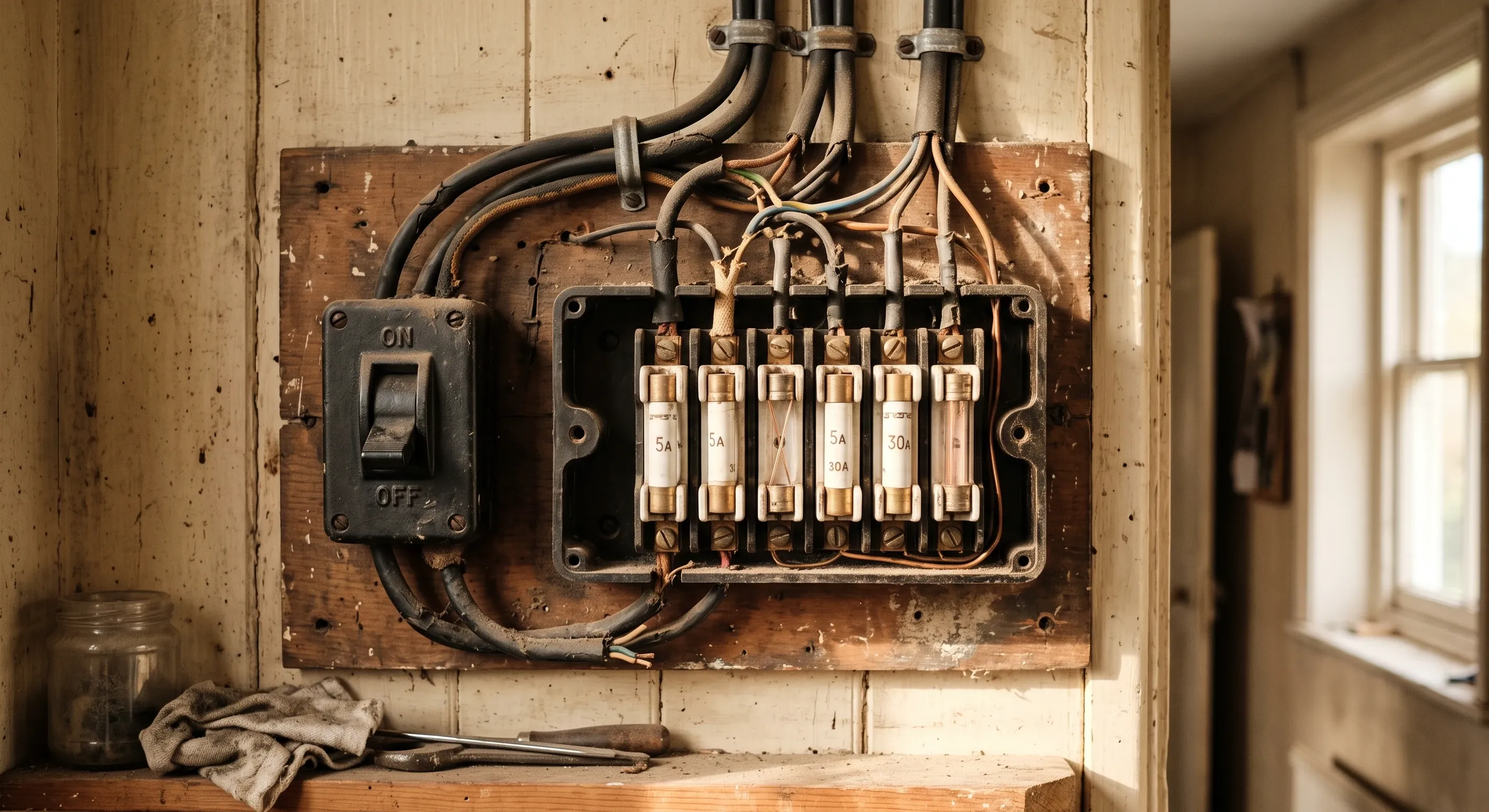
The real signs your house needs rewiring, graded by what each one actually means: full rewire, partial rewire, or just a new consumer unit.

Published UK boiler prices with the VAT basis stated, plus the pipework, radiator and making-good costs that headline quotes quietly leave out.

How to decide between repairing, overboarding or removing a lath and plaster ceiling, including testing the key, the asbestos question and the mess.