
How much does an RSJ or steel beam cost?

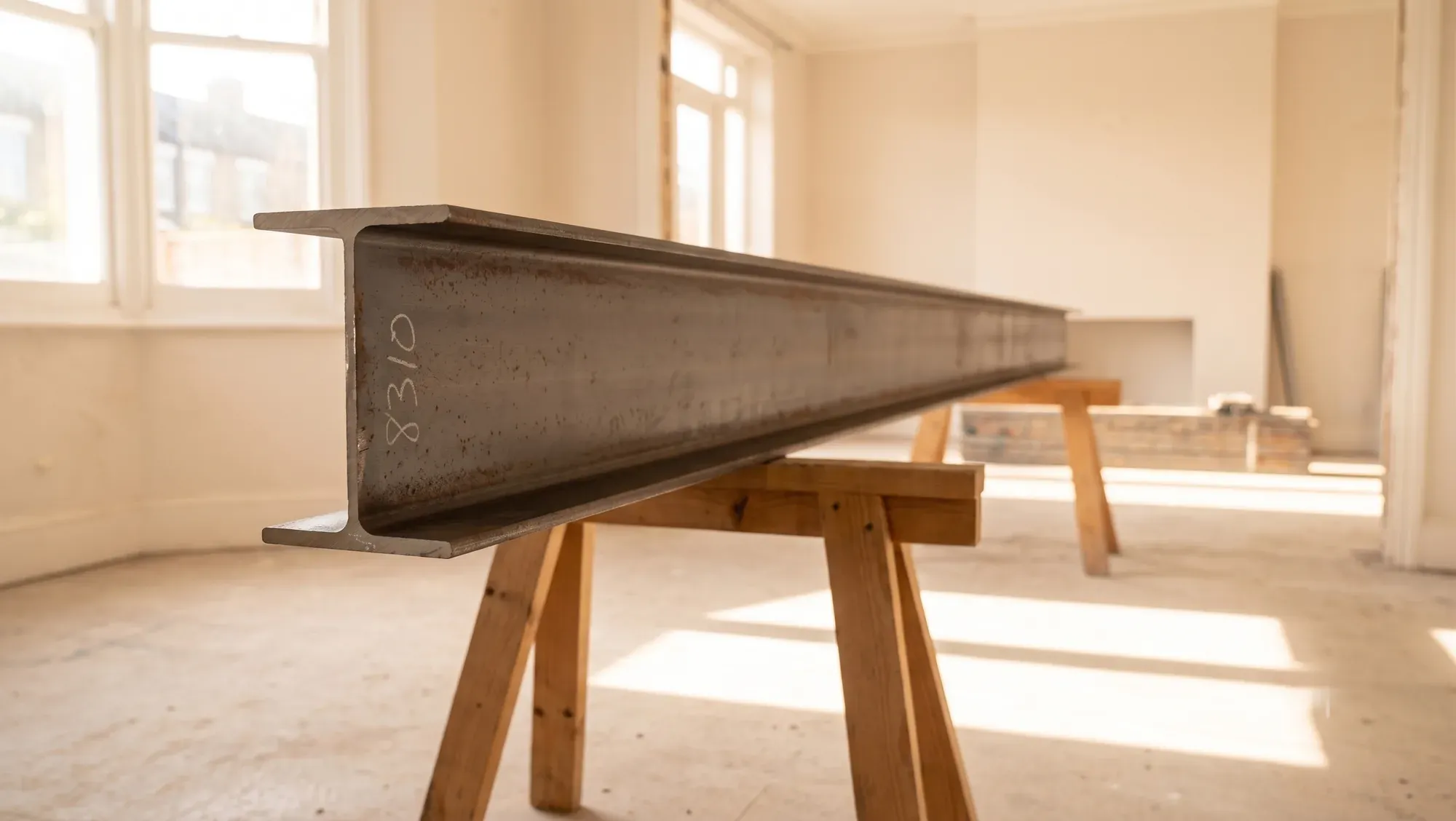
A domestic steel beam costs between about £49 and £103 per metre excluding VAT for the raw section, depending on size. A 203x133x25 universal beam, one of the most common domestic sections, is published at £82.95 per metre excluding VAT. The steel is rarely the expensive part: fabrication, padstones, fire protection, delivery and handling routinely cost more than the metal.
There is also a naming problem worth clearing up first, because it affects what you are being quoted.
An RSJ is not what most people are buying
RSJ stands for rolled steel joist, and it describes a specific section with tapered flanges. It is largely obsolete.
BS 4-1:2005, which listed joists and taper flange joists separately from universal beams, has been withdrawn. The current standard is BS EN 10365, whose 2026 edition is titled for channels, I and H sections and has no joist category at all. What your engineer will actually specify is a universal beam, a UB, or occasionally a universal column, a UC, where the load is high and the depth is limited.
Nine of nine pages we examined for this search treat "RSJ" as a straight synonym for a universal beam, and none cites either standard. One goes further and invents a price and capacity difference between "RSJs" and "I-beams".
None of this is pedantry. It matters because the designation is how you price the thing.
How to read a section size and work out the cost
A section is described by three numbers: depth in millimetres, width in millimetres, and mass in kilograms per metre. So a 203x133x25 UB is 203mm deep, 133mm wide, and weighs 25 kilograms per metre.
That third number is the one that prices the beam, because steel is sold by weight.
Section | Mass per metre | Published price per metre, ex VAT |
|---|---|---|
127x76x13 UB | 13.0 kg | £49.00 |
152x89x16 UB | 16.0 kg | £59.08 |
178x102x19 UB | 19.0 kg | £68.06 |
203x102x23 UB | 23.0 kg | £78.65 |
203x133x25 UB | 25.1 kg | £82.95 |
203x133x30 UB, primed | 30.0 kg | £102.00 |
Published section masses come from the manufacturer's own datasheet to BS EN 10365. The prices are retail cut-to-length from a stockholder, stated excluding VAT.
Divide one by the other and a 203x133x25 works out at about £3.30 per kilogram at retail. That is a useful sanity check, because page one for this search contains rates from £1.10 to £1.60 per kilogram alongside beam prices of £200 to £950, and the two cannot both describe the same buying channel. Trade buying by the tonne is cheaper than retail cut-to-length, which is cheaper again than a fabricated beam delivered to site. If a quote looks odd, the question is which channel it came from.
One dated movement worth knowing: fabricated structural steel rose 17.7% in the twelve months to June 2026, against 6.0% for construction work generally. Steel has been the outlier, so figures from 2024 will understate.
What sits on top of the steel
Six things, and together they usually exceed the cost of the section.
Fabrication. Cutting to length, drilling, welding end plates or cleats. A beam that arrives ready to install has had labour applied to it.
Padstones or spreader plates. The beam concentrates load at each end and something has to spread it. A standard 215x215x440 padstone is published at £40.88 each excluding VAT, with bulk rates from £28.62. Two per beam, usually.
Fire protection. Covered in its own section below, because it is the item most guides omit entirely.
Galvanising or paint. Rarely needed for an internal beam, but where it is, hot dip galvanising to BS EN ISO 1461 gives 85 microns minimum average and over 50 years of protection in UK conditions. On a large tendered frame, three-coat paint came out 35% more expensive than galvanising, so the cheap-looking option is not always cheaper.
Delivery and handling. A 4 metre 203x133x25 weighs about 100 kilograms. Getting it down a terrace hallway is manual handling; getting it over a house is a crane. Published crane rates on the SERP run to several hundred pounds for a half day, but the figures are unattributed and we would not rely on them.
Lead time, which costs money even though it is not a line item. A simple beam package runs from days to two weeks. A standard fabricated package is 6 to 8 weeks. Complex or coated work is 8 to 12 weeks or more. The clock starts at approved drawings, not at your phone call, and fabricated structural steel carries conformity marking under BS EN 1090-1.
Fire protection, which nobody prices
Not one of the pages we examined names Approved Document B. This is the largest gap on the SERP, and it is a cost.
A beam supporting a floor in a house needs 30 minutes of loadbearing fire resistance where the top floor is up to 5 metres. Only the loadbearing capacity criterion applies to a beam: integrity and insulation do not. The element supporting a floor has to match the period required of that floor.
In practice, boxing the beam in plasterboard is how compliance is achieved on almost every domestic job. That is why exposed steel is a specification decision and not just a look. If you want it visible, you need an intumescent coating, which expands above about 120°C and keeps the steel below roughly 550 to 620°C, tested to EN 13381-8 or BS 476-20 and 21.
Intumescent paint is not expensive as a product. Published prices run from around £42 excluding VAT for a 2.5 litre tin to £351 for 20 litres. What we could not source is a reliable applied cost per beam or per square metre, because coverage depends on the required period and the section's exposed area, so treat the tin price as an input and get it priced properly.
Two errors worth naming. One ranking page caps intumescent protection at 30 minutes, when the products themselves are tested to 30, 60, 90 and 120. Another says steel melts, which is not the failure mechanism: steel loses strength progressively as it heats, which is what the coating is managing.
When a steel beam is not the answer
Three alternatives, each with a reason.
Timber. Adequate for shorter spans and lighter loads, and cheaper to install because it needs no craneage and can be cut on site.
A flitch beam. A steel plate sandwiched between two timbers, analysed as a transformed section. Used where depth is limited or where existing timber needs reinforcing rather than replacing. It gets zero mentions across the pages ranking for this search.
A goalpost frame. Where there is no masonry capable of taking a bearing, a beam plus posts spreads the load to foundation level. This is common in a side return where one side of the opening is a party wall you cannot load.
Which one applies is a calculation, not a preference, and it starts with how to know if a wall is load-bearing. Worth knowing that the deflection limits engineers work to are given in the UK National Annex as examples rather than mandatory values, with serviceability criteria to be agreed for each project. So two engineers can size the same opening differently and both be right.
For what the calculations themselves cost, see our guide to the cost of a structural engineer.
Putting a realistic number together
For a 4 metre opening in a two-storey terrace, taking a 203x133x25 UB, the section itself is around £332 excluding VAT at retail. Add two padstones at roughly £82, and you are at about £414 of materials, or £497 including VAT.
That is the metal. It is not the job. The installation, propping, making good and fire protection are where the money goes, and our guide to knocking through walls and the steels it needs sets out the full picture including the party wall notice period that usually determines your start date.
We have deliberately not published a single all-in beam price, because the honest answer depends on the buying channel and the scope, and the ranges circulating online do not state either. Where a chimney breast is coming out too, chimney breast removal costs and regulations are worth reading alongside this.
How Beams helps
Steel is the part of a renovation where a cheap quote and an expensive quote can describe genuinely different products: a section dropped off on the pavement, or a fabricated beam delivered, craned, bedded on proper padstones and fire protected.
So on an extension design and build in London, we specify it properly from the engineer's calculations, price the fabrication, handling and fire protection as visible items rather than assumptions, and make sure the lead time sits in the programme instead of surprising everyone in week six.
That is the warranty behind a Beams project: one agreed price, payments released against milestones, and 12 months on the workmanship.
Common questions about steel beam costs
Is an RSJ cheaper than a universal beam?
They are not really alternatives. RSJ describes a largely obsolete tapered flange section, and the standard that listed it has been withdrawn. What you will be quoted is a universal beam, whatever the quote calls it.
How much does a steel beam weigh?
The third number in the designation is the mass in kilograms per metre. A 203x133x25 is 25.1 kg/m, so a 4 metre length is roughly 100kg. That number determines both the price and whether it can be carried in by hand.
Do I need to fireproof a steel beam in a house?
Yes, where it supports a floor. Thirty minutes of loadbearing fire resistance is the requirement for a typical two-storey house, and boxing in plasterboard is how it is normally achieved. Leaving steel exposed means specifying an intumescent coating instead.
Can I buy the steel myself and have a builder fit it?
You can, and people do. The risk is that you buy from a calculation you have not had checked, or a section that arrives unfabricated with no end plates where the design needs them. Any saving disappears if the beam has to go back.
Why do online prices vary so much?
Because they describe different things: steel by the tonne to trade, cut-to-length retail, or a fabricated beam delivered. Almost none of the published figures says which, and only one page in nine states a VAT basis anywhere.
Where these figures come from
Every figure on this page is a published third-party price or a manufacturer's published data, with its VAT basis stated. Where a figure is a calculation from two sources, that is flagged.
Section masses and designations: manufacturer's universal beam datasheet to BS EN 10365
Standards status: BS 4-1:2005 withdrawn, superseded by BS EN 10365:2017, with BS EN 10365:2026 current
Retail cut-to-length steel prices per metre: online steel stockholder, live August 2026, stated excluding VAT
Price per kilogram: calculated from the two sources above, not published as such
Steel price movement: Building Cost Information Service, quoting Department for Business and Trade materials price indices, published August 2026
Fire resistance periods: The Building Regulations 2010, Approved Document B, Volume 1
Intumescent product prices and tested performance: specialist passive fire supplier, live pricing
Padstone prices: online builders merchant, live pricing, excluding VAT
Galvanising performance and relative cost: Galvanizers Association, May 2026
Lead times and conformity marking: UK structural steel fabricator, June 2026
Deflection limits as examples rather than mandatory values: Steel Construction Institute
We could not source reliable per-tonne UK section prices, applied intumescent cost per square metre, or priced goalpost and flitch beam figures, so none appears above.
Find out what your project will cost
Tell us about the opening and we will get you up to three comparable quotes from vetted London builders, with the steel, fabrication and fire protection priced as visible items.