
Barnet housing statistics 2026
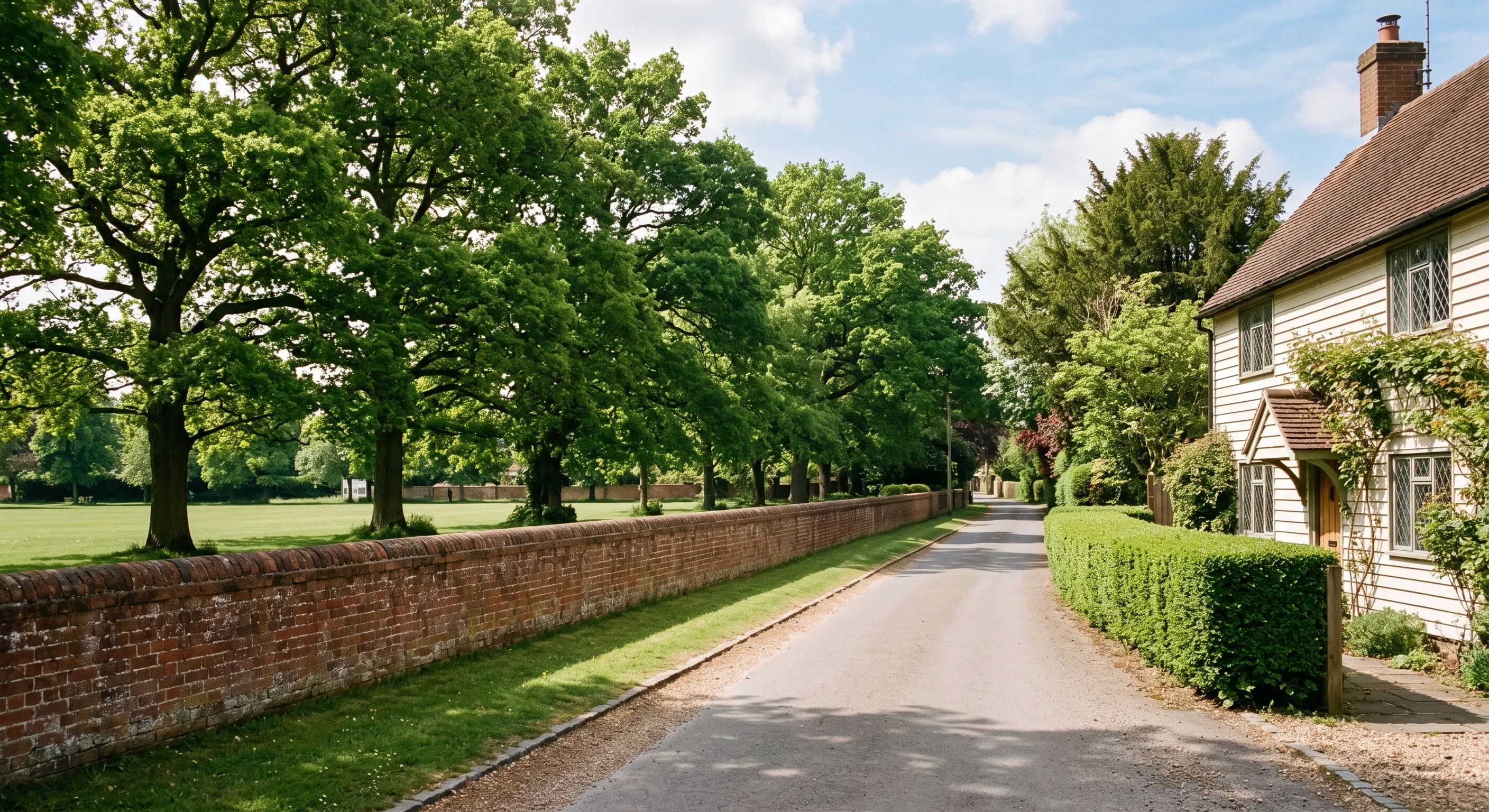
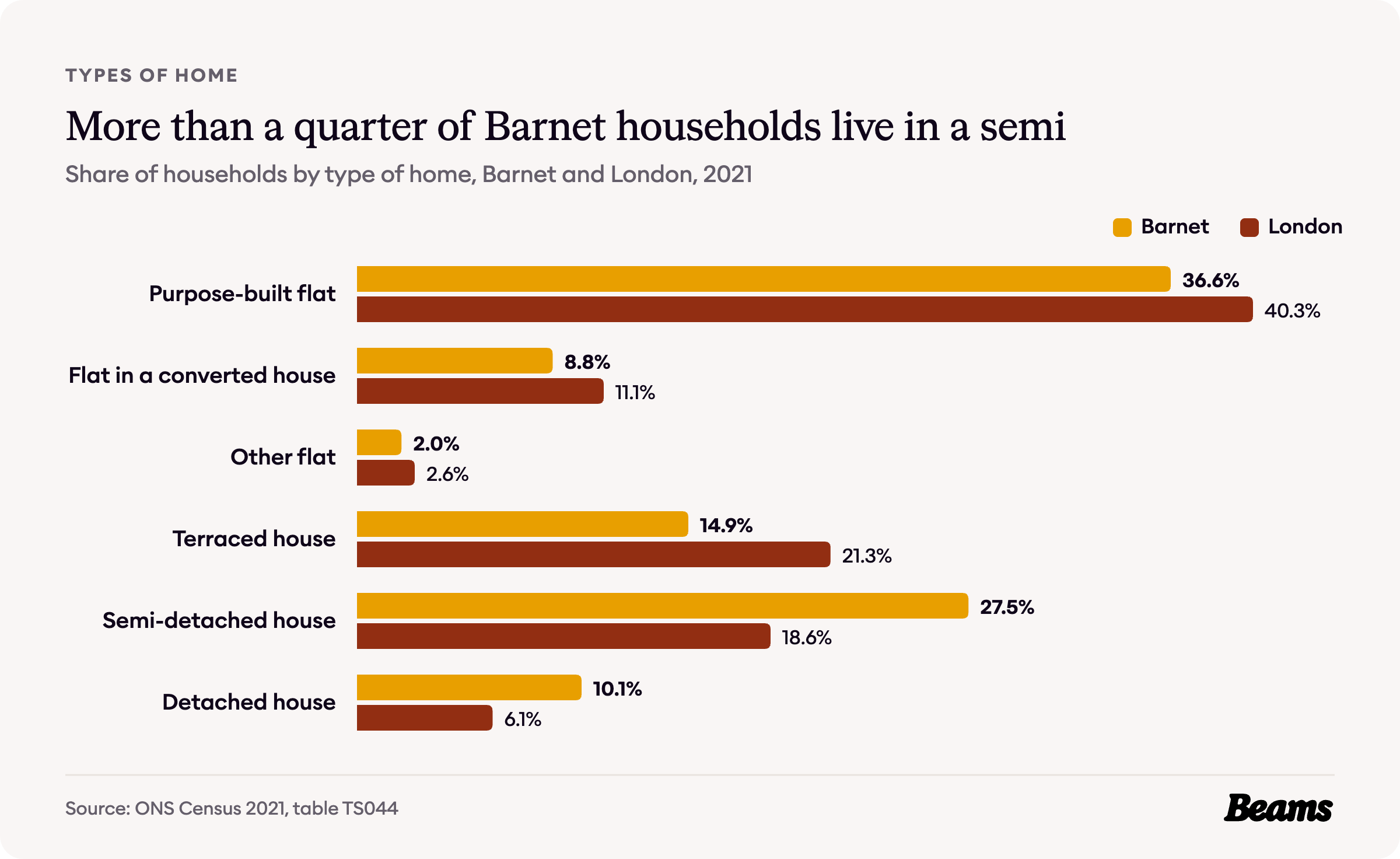
Barnet is a borough of interwar suburbs. A third of its homes went up between 1919 and 1939, many of them semi-detached houses along the new Underground line, and more than half of its households still live in a house. These are the numbers behind that story, from the 1930s semi to today's £592,892 average home.
Every figure comes from an official source and is dated, so you can see exactly what you are working with before you plan a home renovation in Barnet. The sources are numbered in brackets and listed in full at the end of the page.
When Barnet's homes were built
Hendon, now part of Barnet, changed little until the Hampstead tube reached Golders Green in 1907 and Edgware in 1924. Then it filled up fast. Between 1921 and 1931 its population nearly doubled, from 56,013 to 110,331 [1].
Much of that growth was the London County Council's Watling estate at Burnt Oak. The first residents arrived in 1927, and by 1931 the estate had 4,021 houses and flats. North and west of it, the remaining farmland was covered by private semi-detached houses in the 1920s and 1930s [1].
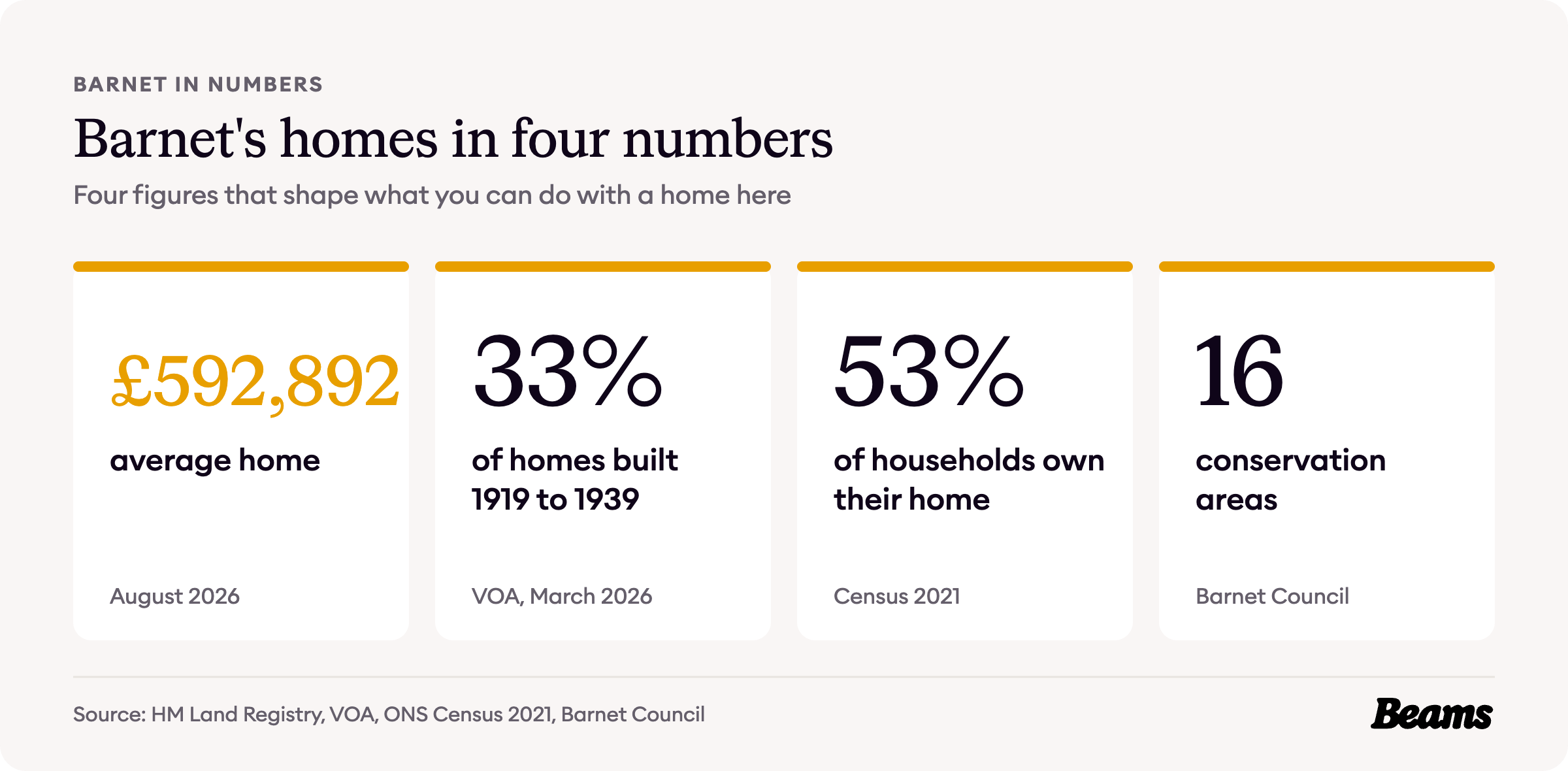
The Valuation Office Agency figures show how much of that era survives. Of Barnet's 162,740 homes, 33.3% were built between 1919 and 1939, against 22.0% across London. Only 6.4% date from before 1900, less than a third of London's 20.8% [2].
Barnet has kept building since. 20.0% of its homes date from 2000 onwards, a little more than London's 18.5% [2]. Houses from the 1920s and 1930s usually have a pitched roof with space inside it, which makes a loft conversion in Barnet the obvious way to gain a bedroom without giving up any garden.
How Barnet households live
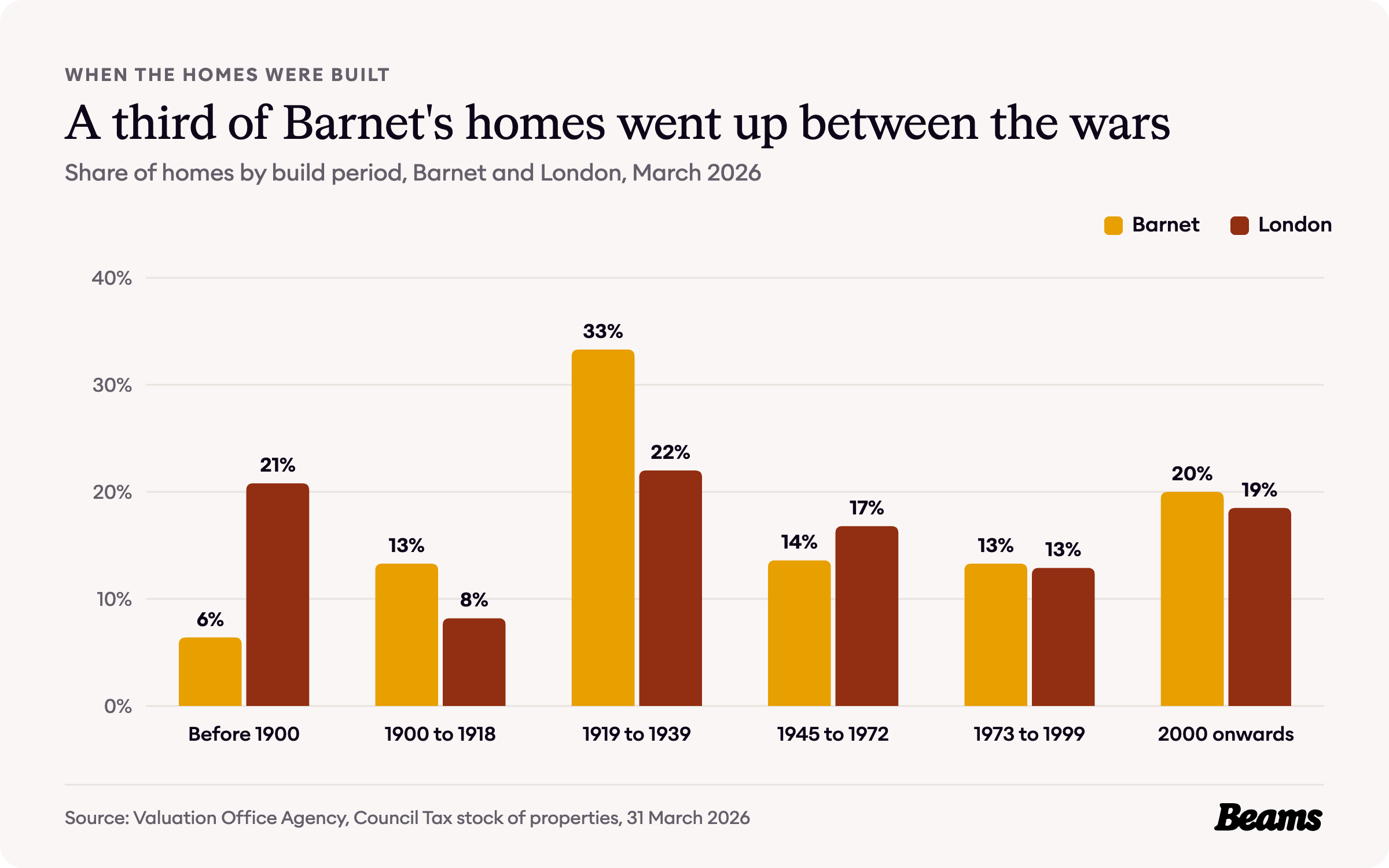
In Barnet, more households live in a house than in a flat. The 2021 Census found 52.5% of households in a house of some kind, against 46.0% across London [3].
The semi-detached house is the borough's signature home. 27.5% of households live in one, against 18.6% for London, and another 10.1% live in a detached house [3]. Flats still house 47.4% of households, most of them in purpose-built blocks.
With so many families living in houses laid out a century ago, a kitchen renovation in Barnet is often about opening up rooms that were designed for the way people lived in the 1930s.
Who owns Barnet's homes
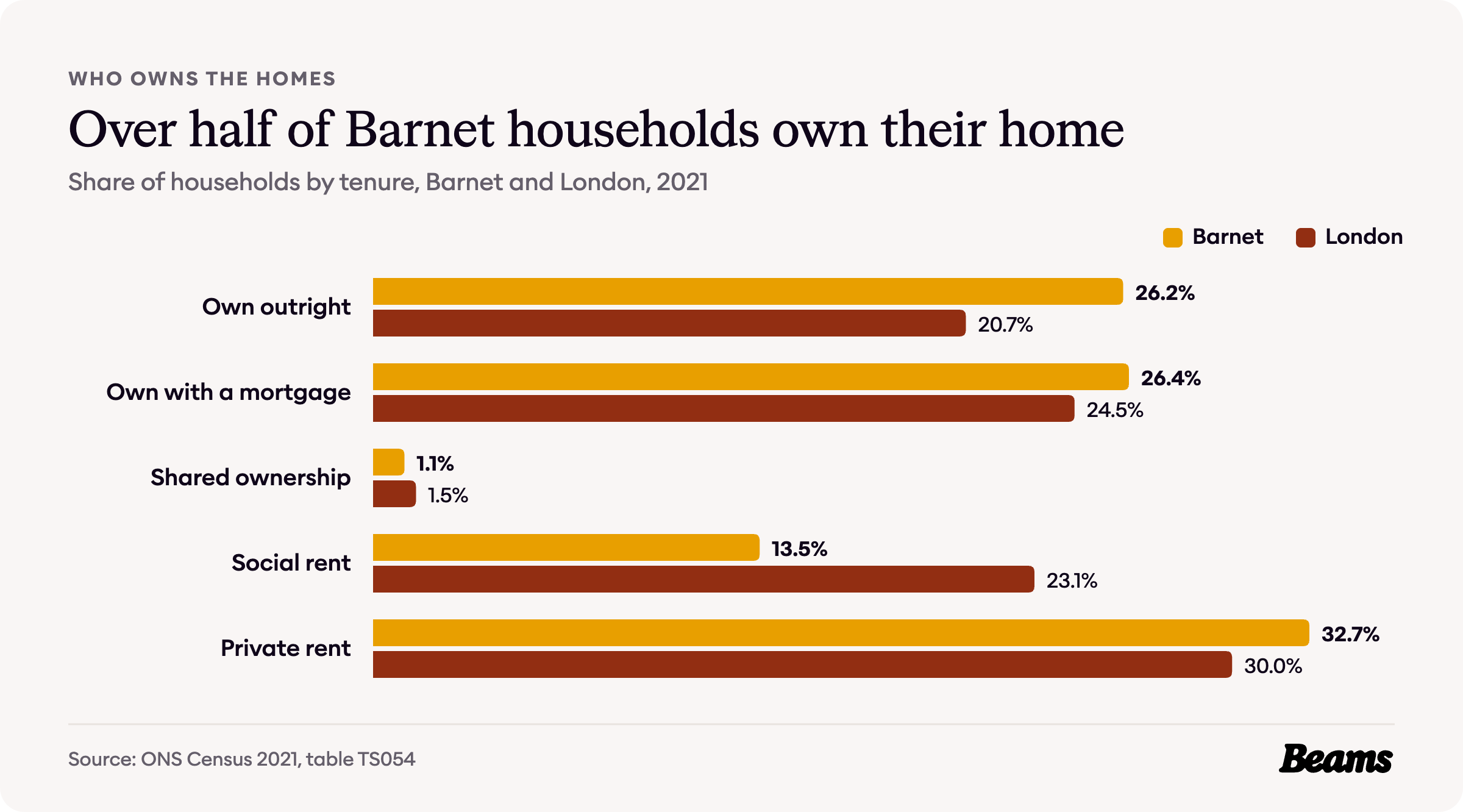
More than half of Barnet households own their home. 26.2% own outright and 26.4% with a mortgage, 52.6% in all, against 45.2% across London [4].
Social renting is far less common than across London as a whole, at 13.5% of households against 23.1%. A further 32.7% rent privately, a little above London's 30.0% [4].
What a Barnet home costs
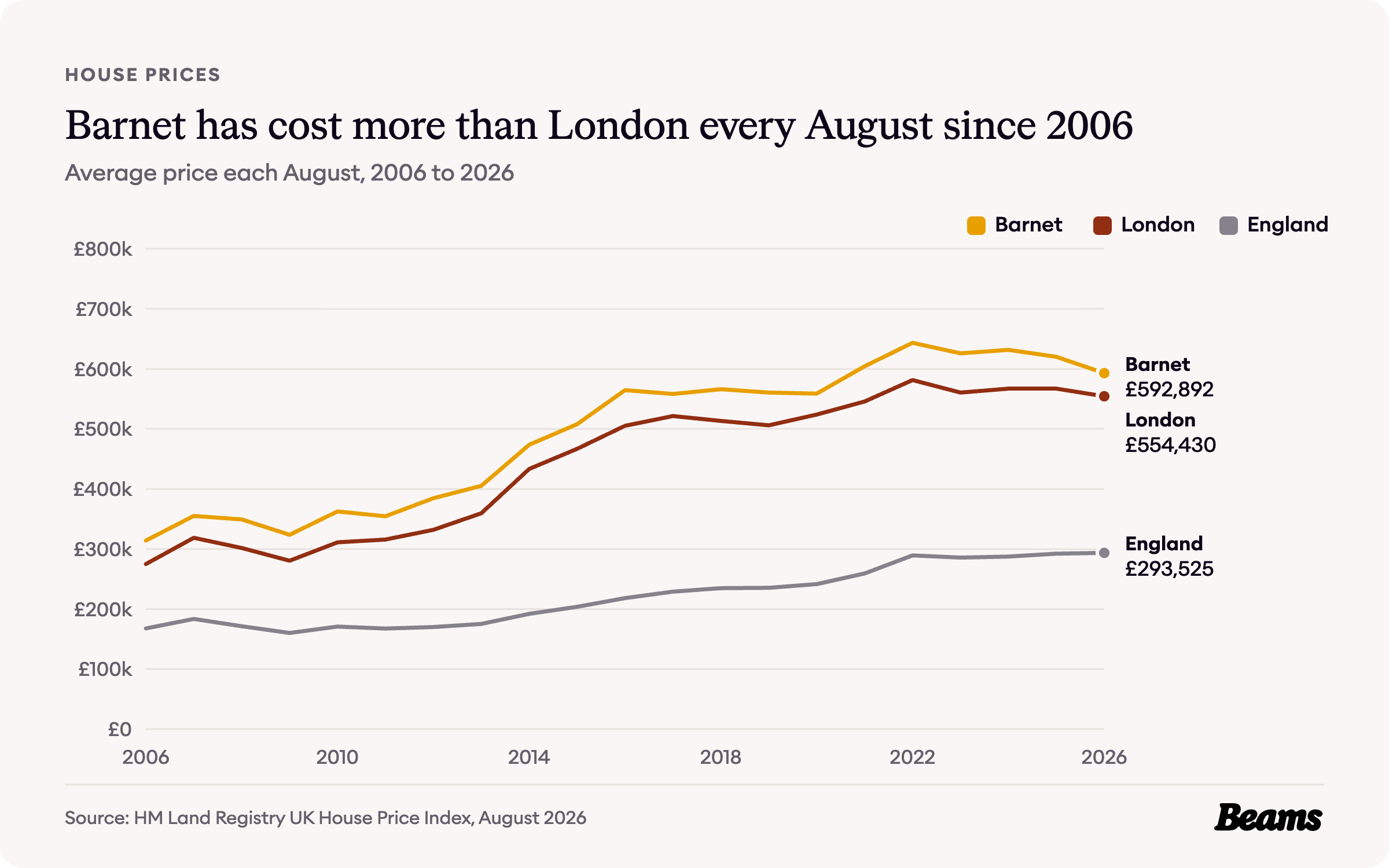
The average Barnet home cost £592,892 in August 2026, 4.4% less than a year earlier [5]. That is about 7% above the London average of £554,430, and about twice the England average of £293,525. London prices fell by 2.2% over the same year [6].
Barnet has been above the London average for the whole of the last twenty years. In August 2006 the average home here cost £314,080, against London's £274,815. The biggest rise came between 2013 and 2014, when the average went from £405,225 to £473,545, and prices peaked at £643,459 in August 2022 before easing back [6].
Flats, semis and the gap between them
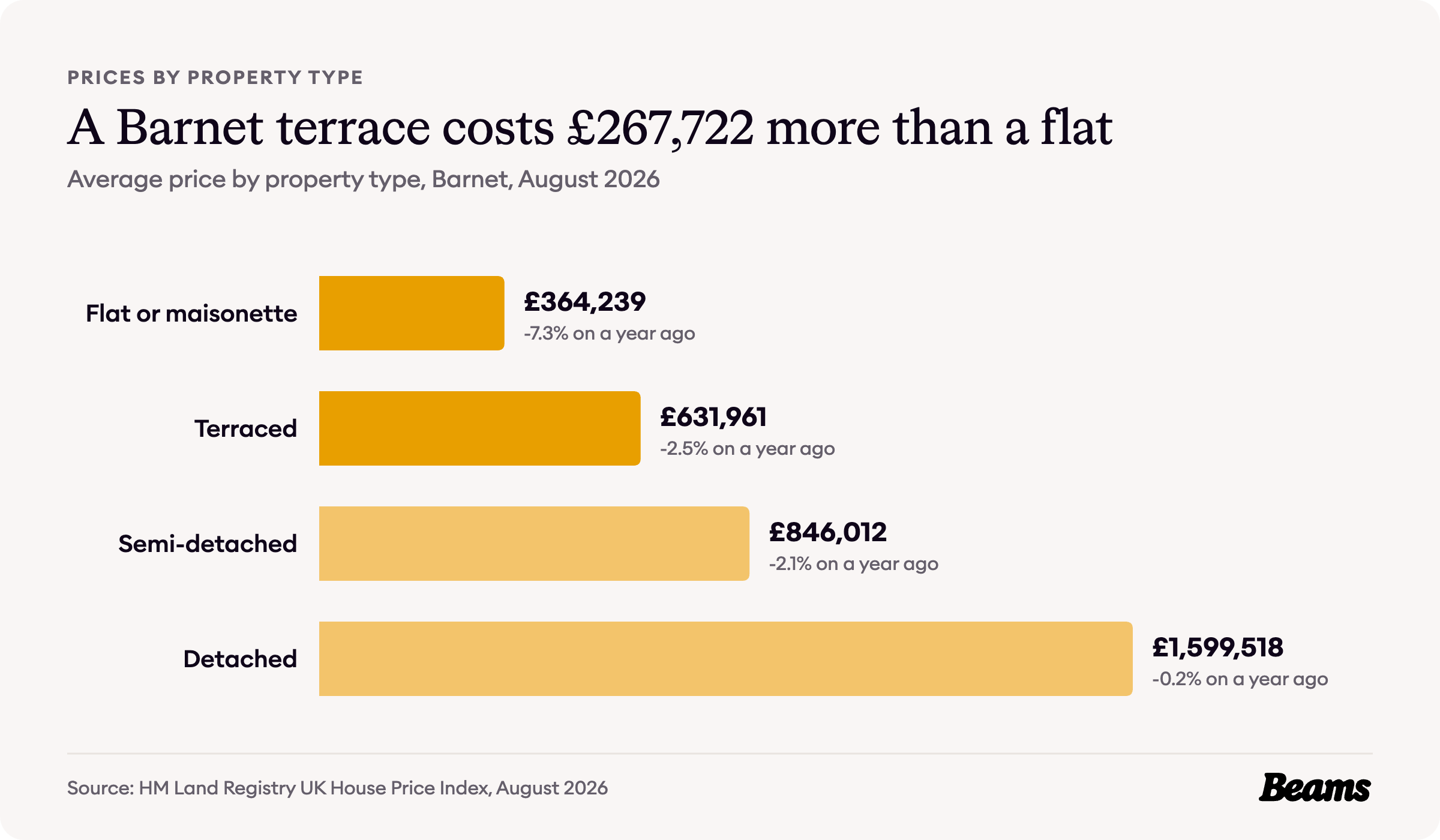
A flat or maisonette in Barnet averaged £364,239 in August 2026 and a terraced house £631,961, a gap of £267,722. Semi-detached homes averaged £846,012 and detached homes £1,599,518 [5].
Barnet's flats and terraces both cost less than the London averages of £427,310 and £648,650 [5] [6]. The borough's overall average is higher than London's because so many of its homes are semi-detached or detached.
First-time buyers paid an average of £463,079 in August 2026, while owners moving home paid £777,932 [5]. That difference is what most owners weigh up before they move. For a family already in a semi with a garden, a house extension in Barnet adds room without paying for the next rung of the ladder.
What it costs to rent in Barnet
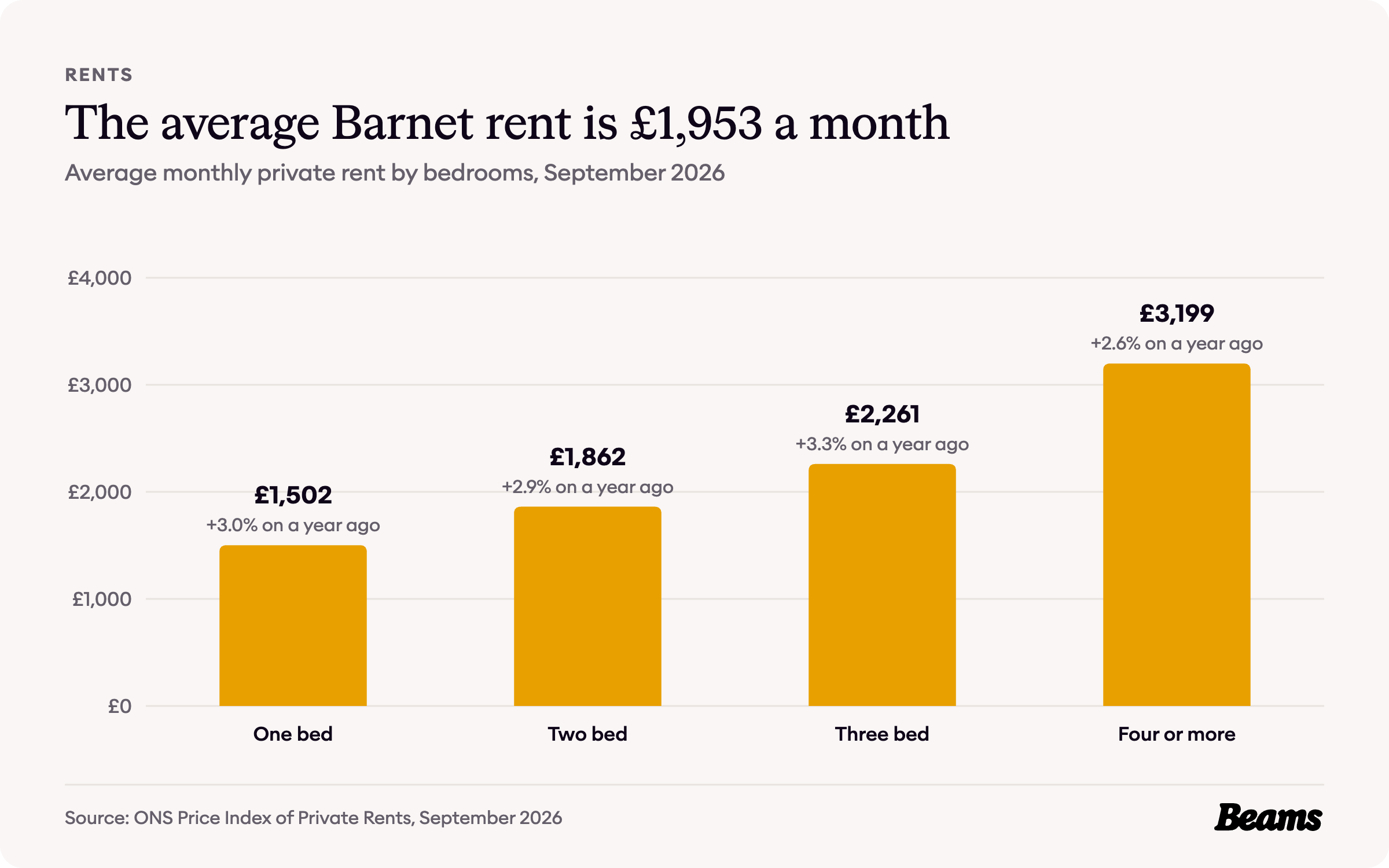
The average private rent in Barnet was £1,953 a month in September 2026, up 2.9% on a year earlier [5]. A one-bedroom home averaged £1,502 a month, a three-bedroom home £2,261 and a home with four or more bedrooms £3,199.
With a third of households renting privately, a dated bathroom is often the first thing a bathroom renovation in Barnet puts right between tenancies.
Council Tax bands in Barnet
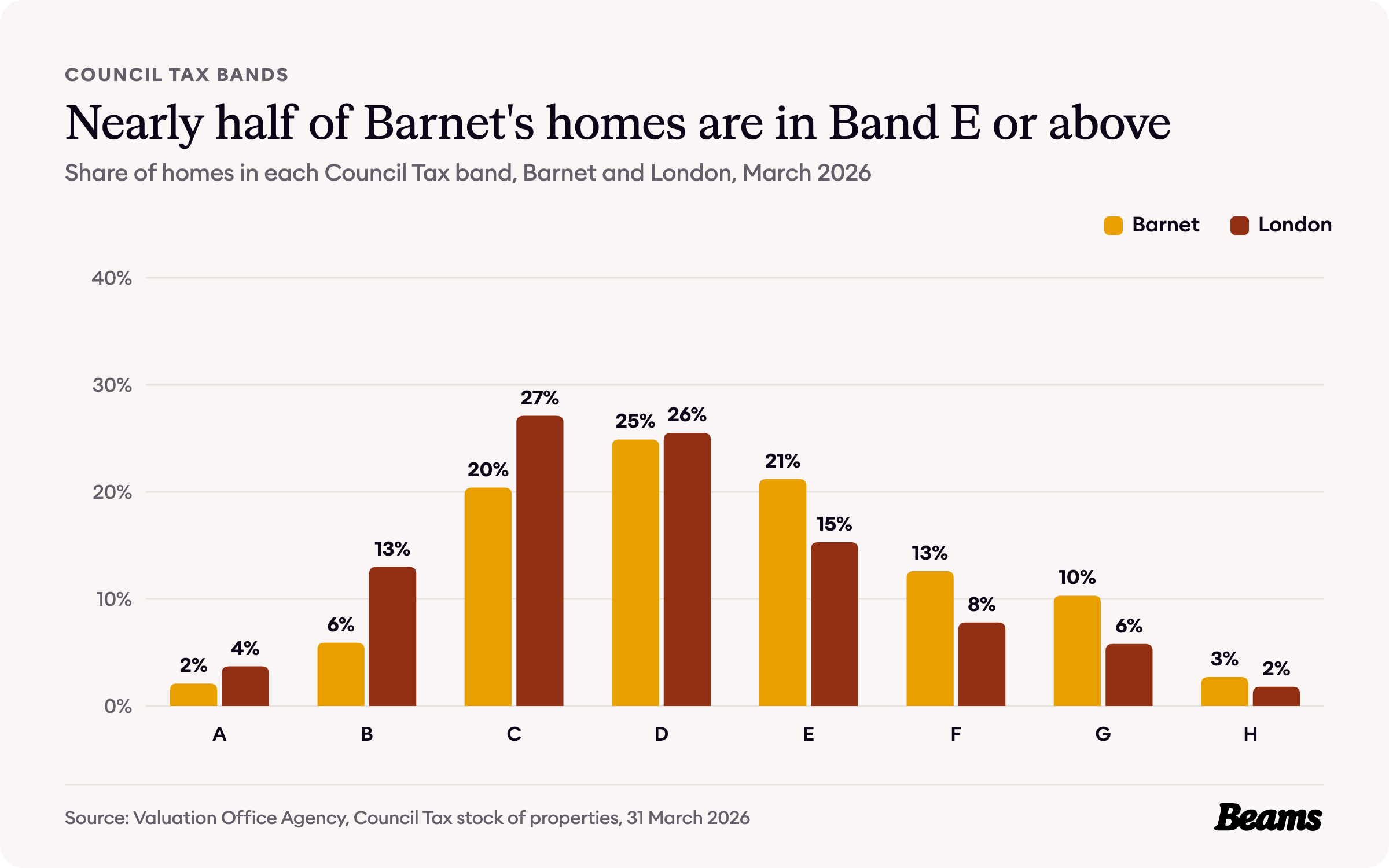
Council Tax bands are based on what a home would have sold for on the open market on 1 April 1991 [7]. In Barnet, 46.8% of homes are in Band E or above, against 30.7% across London, and 13.0% are in Bands G and H, against 7.6% for London [2].
Band D is the largest single band, with 24.9% of homes. Only 28.4% of Barnet homes sit in Bands A to C, compared with 43.8% across London [2].
The rules on your street
Barnet has 16 conservation areas, including Hampstead Garden Suburb, Golders Green, Mill Hill, Totteridge, Monken Hadley and the Watling Estate itself [8].
The council says special controls apply to buildings in conservation areas, and that it is an offence to demolish, alter or extend a building in one without consent. Ten of the 16 are covered by, or have, Article 4 directions in force, which means some works you could usually do without planning permission need consent [8]. Digging down is one of the jobs where those rules matter most, so a basement conversion in Barnet starts with a check of the address.
The council's planning guide does not give a decision time, so the national rule applies: councils have 8 weeks to decide most applications and 13 weeks for major development [9]. It is worth checking your street on the council's map before anyone starts drawing, then asking up to three vetted builders in Barnet to quote against the same plans.
Barnet housing statistics at a glance
- Average house price, August 2026: £592,892 (London £554,430) [5] [6]
- Change on a year earlier: -4.4% (London -2.2%) [5] [6]
- Average flat or maisonette: £364,239 (London £427,310) [5] [6]
- Average terraced house: £631,961 (London £648,650) [5] [6]
- Average private rent, September 2026: £1,953 a month [5]
- Homes built 1919 to 1939: 33.3% (London 22.0%) [2]
- Households living in a house: 52.5% (London 46.0%) [3]
- Households who own their home: 52.6% (London 45.2%) [4]
- Homes in Council Tax Band E or above: 46.8% (London 30.7%) [2]
- Conservation areas: 16 [8]
Frequently asked questions
References
- British History Online, Hendon: Growth after 1850. Victoria County History of Middlesex, volume 5.
- Valuation Office Agency, Council Tax: stock of properties 2026. Table CTSOP4.1, properties by build period and Council Tax band at 31 March 2026.
- ONS, Census 2021 table TS044: Accommodation type. Households by type of home, Barnet and London.
- ONS, Census 2021 table TS054: Tenure. Households by tenure, Barnet and London.
- ONS, Housing prices in Barnet. UK House Price Index for August 2026 and Price Index of Private Rents for September 2026, published 21 October 2026.
- HM Land Registry, UK House Price Index. Average prices for Barnet, London and England, August 2006 to August 2026.
- GOV.UK, How domestic properties are assessed for Council Tax bands. Accessed 29 October 2026.
- Barnet Council, Conservation areas. Accessed 29 October 2026.
- GOV.UK, Determining a planning application. Statutory time limits for deciding applications. Accessed 29 October 2026.
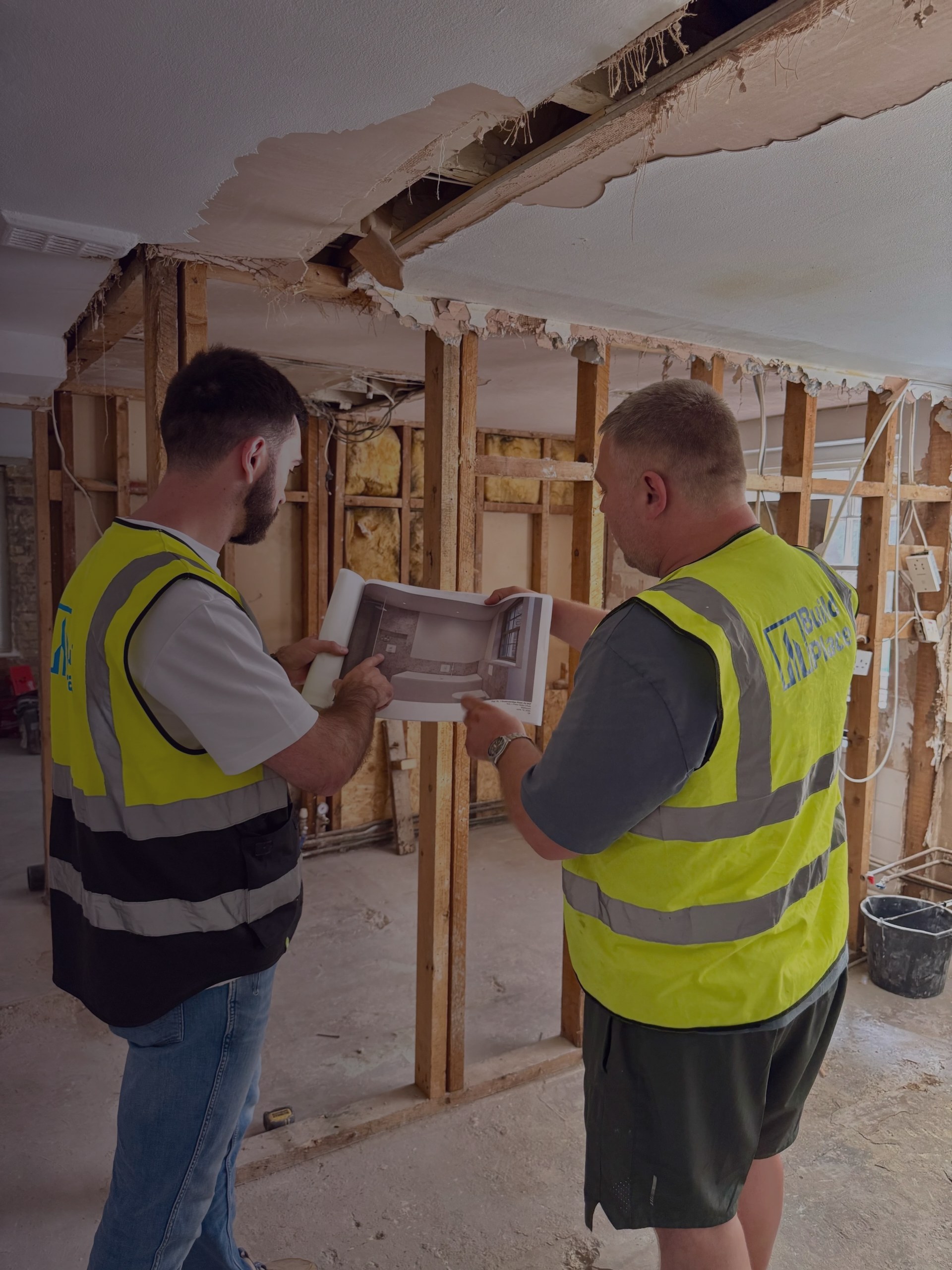
Thinking of improving rather than moving?
Tell us about your Barnet home and what you want to change. We'll give you a free estimate, then up to three vetted builders quote against the same specification.