
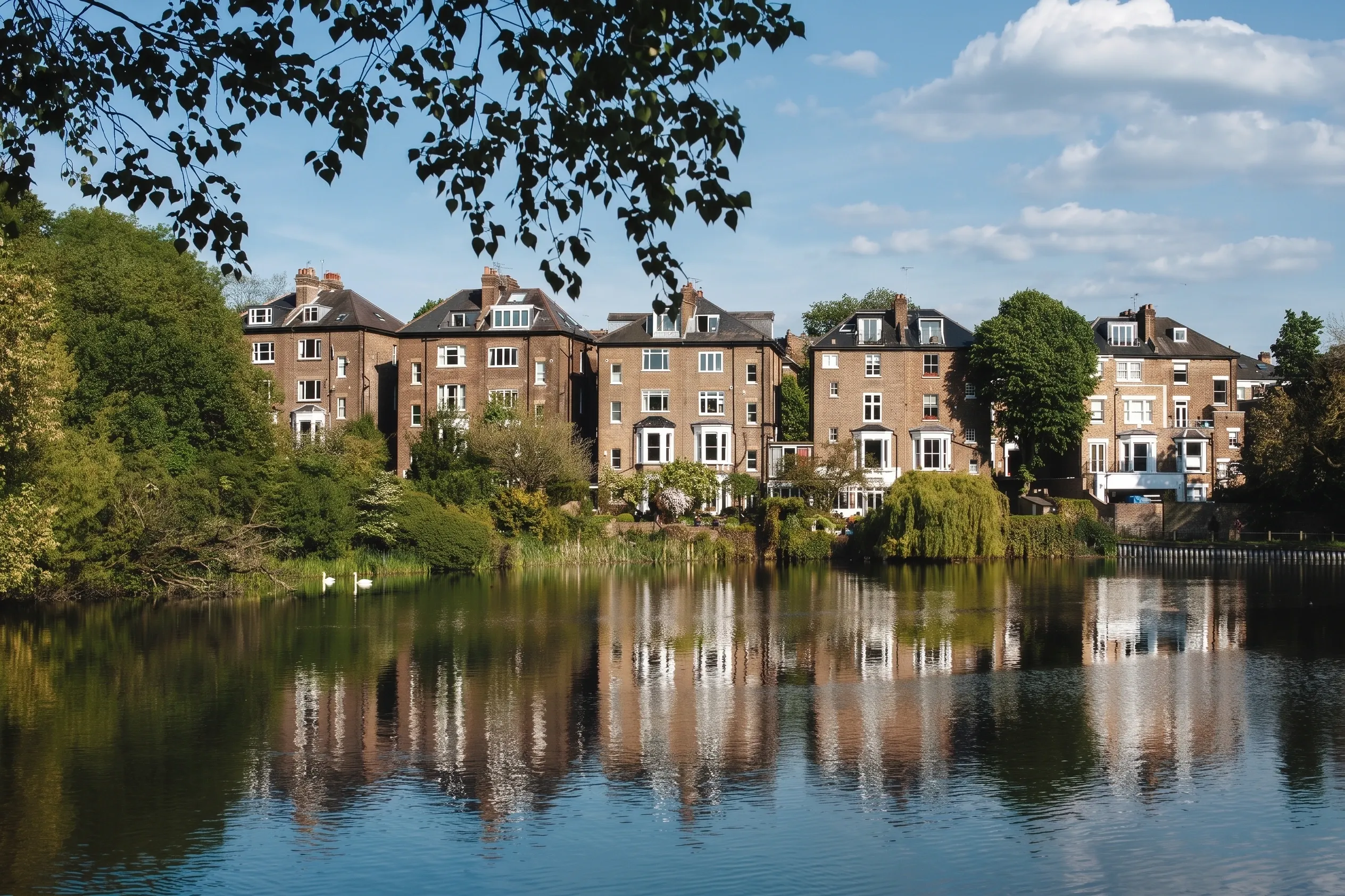
Hampstead housing statistics 2026
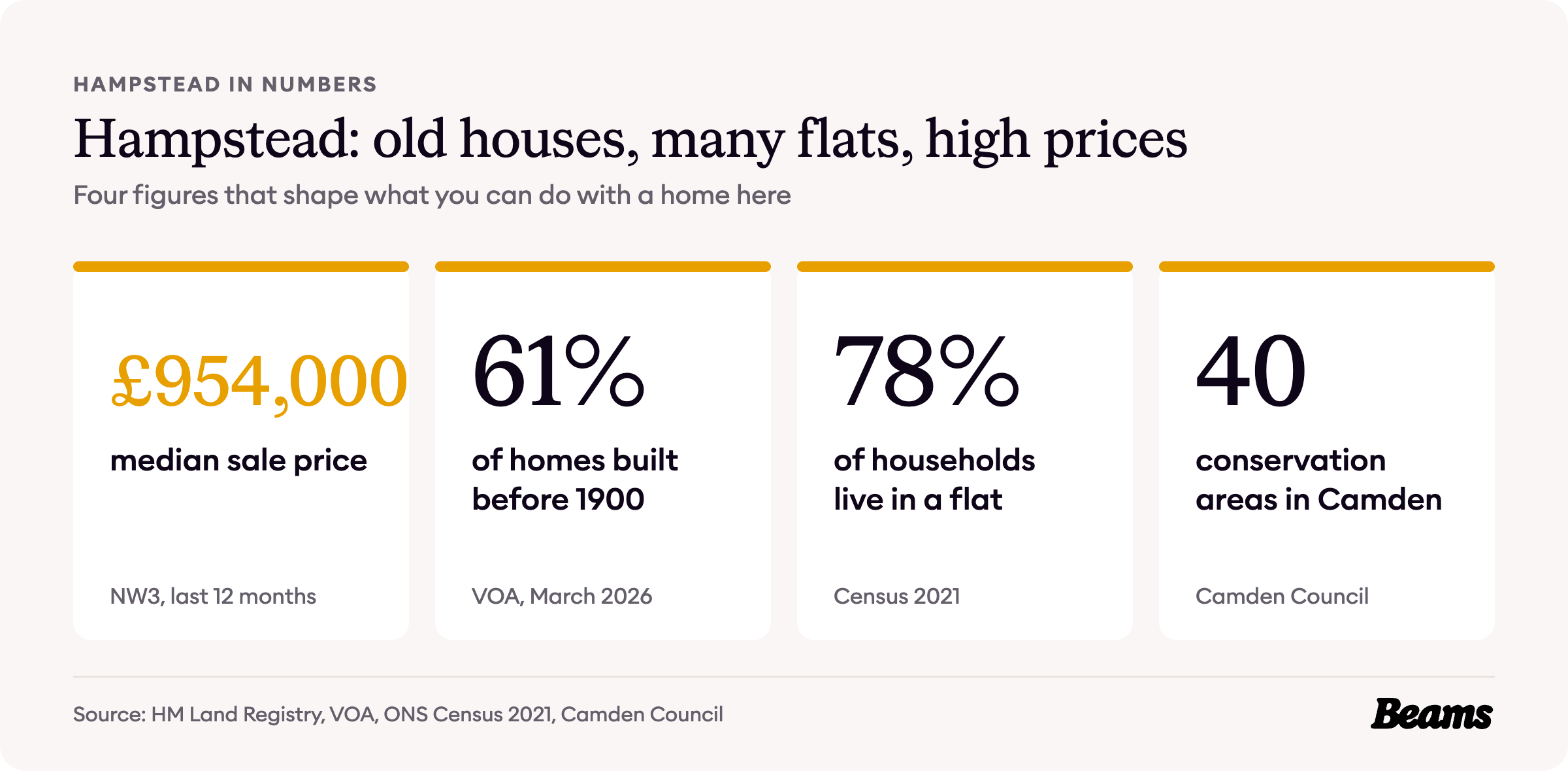
Hampstead is old, tall and divided. Six in ten of its homes were built before 1900, and two in five households now live in a flat carved out of a house. These are the numbers behind that story, from the villas of Fitzjohn's Avenue to the £954,000 median sale price in NW3 today.
Each figure below comes from an official source and carries its date, so you know what you are working with before you plan a home renovation in Hampstead. The sources are numbered in brackets and listed in full at the end of the page.
How Hampstead was built
Hampstead turned from a country parish into a London suburb in the 19th century. The parish had 686 houses in 1795. Its population doubled from 4,343 in 1801 to 8,588 in 1831 and reached 82,329 by 1901, and the rate of building quickened from the 1860s, partly because new railway stations opened [1]. The parish had 1,411 houses in 1841 and 4,348 in 1871, and by 1891 it had 9,517 dwellings [1].
Much of the land at the centre of the parish had to wait. The restrictions in Sir Thomas Maryon Wilson's will held back building there until they were lifted after his son's death in 1869, and the central demesne was then opened up for development [1]. In 1875 Spencer Maryon Wilson contracted for Fitzjohn's Avenue to be made, from College Crescent to Greenhill Road. Applications to build 70 houses on it followed between 1877 and 1879, and by 1883 it was being called one of the noblest streets in the world [2].
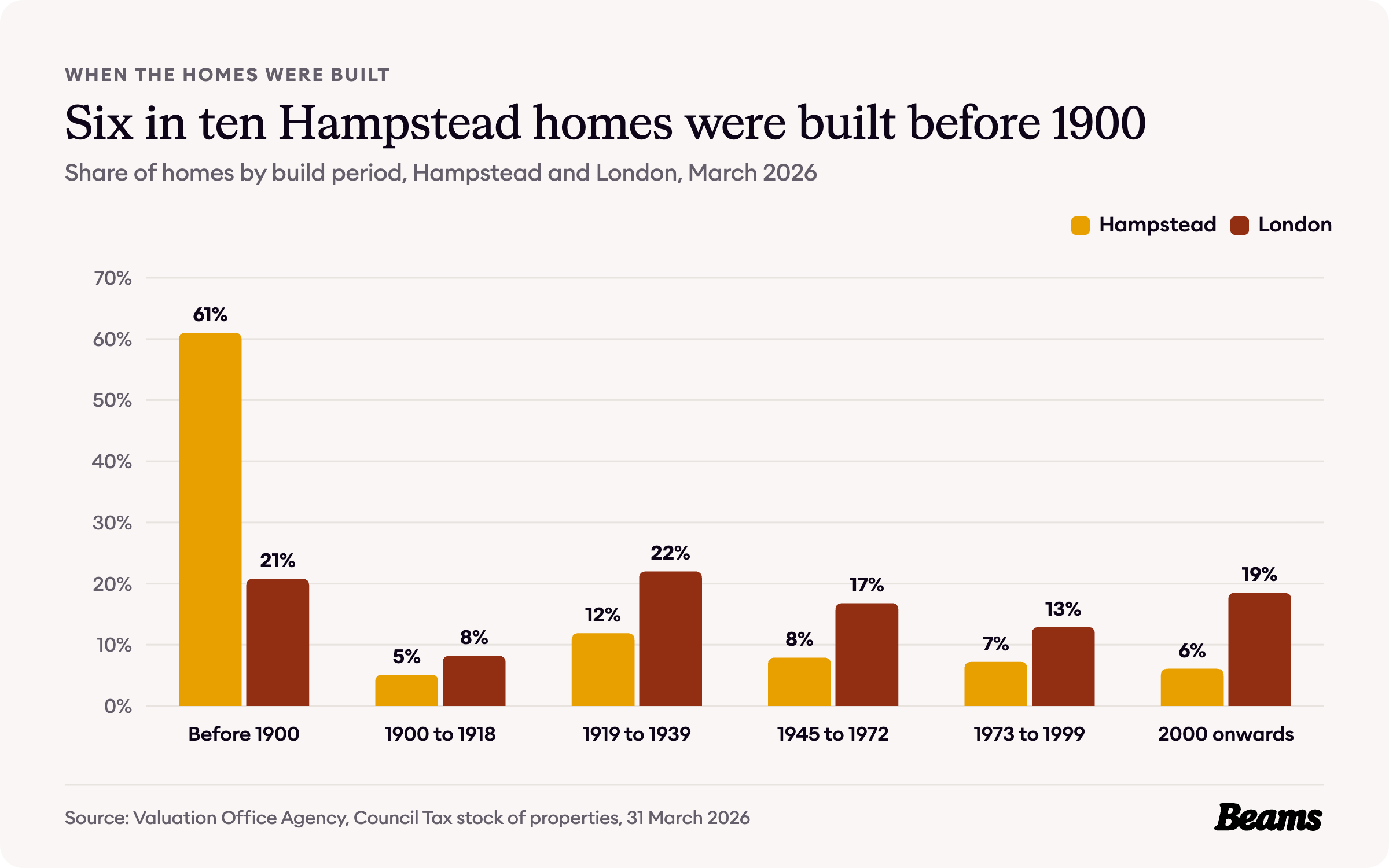
That Victorian building still defines the neighbourhood. The Valuation Office Agency counts 61.0% of the 10,930 homes in the Hampstead Town, Frognal and Belsize Park areas as built before 1900, against 20.8% across London. Very little came later: 11.9% between the wars, against 22.0% for London, and only 6.1% since 2000, against 18.5% [3].
With six in ten homes built before 1900, a loft conversion in Hampstead that puts an old roof space to use is often the most direct way to add a room, within the conservation area rules covered further down.
How Hampstead households live
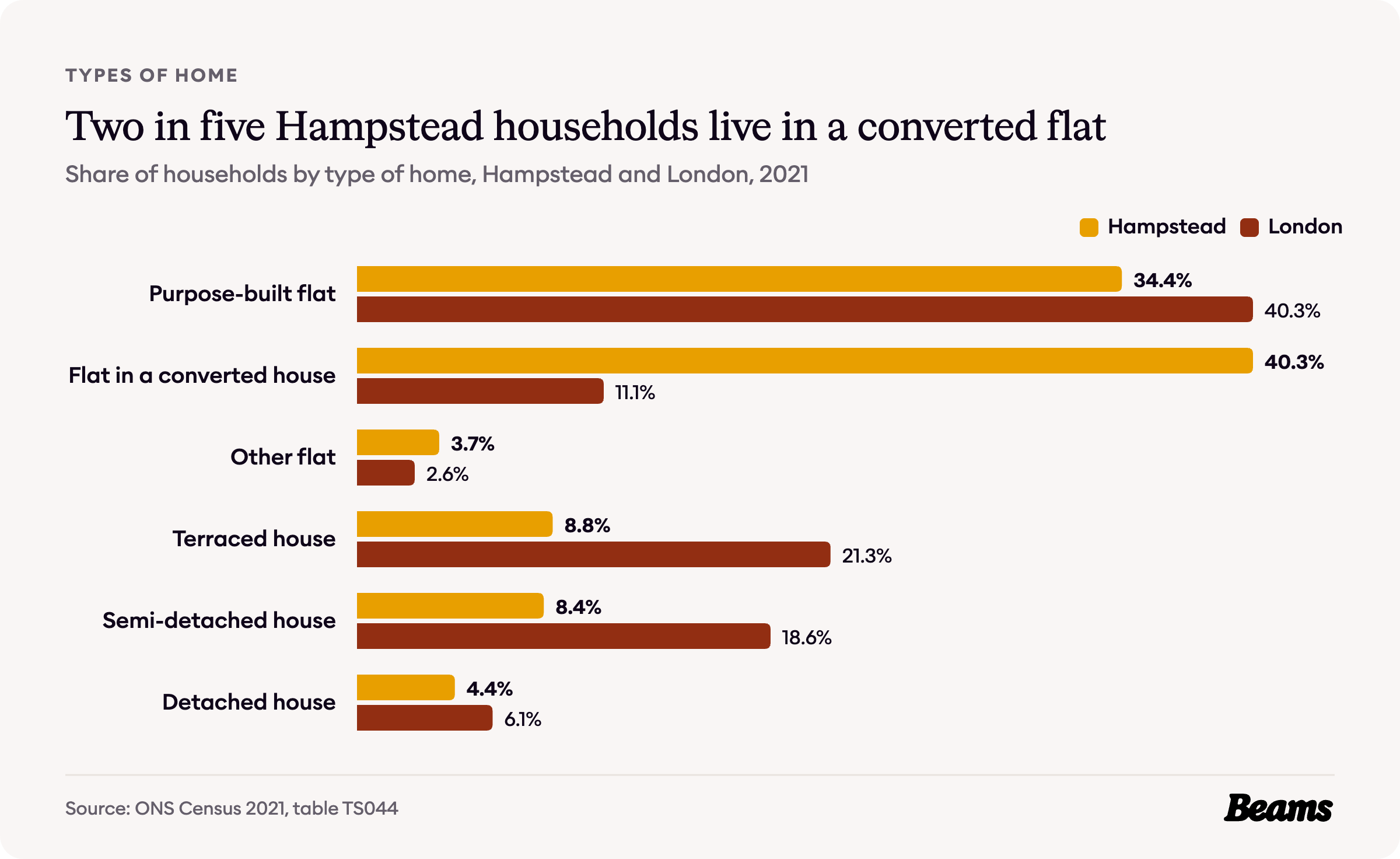
The 2021 Census counted 9,397 households in the Hampstead Town, Frognal and Belsize Park areas. The largest group, 40.3%, live in a flat inside a converted house, more than three and a half times the London share of 11.1%. Another 34.4% live in a purpose-built flat [4].
Add the other flats and 78.4% of households live in a flat, against 54.0% for London. Only 21.6% live in a house of any kind: 8.8% in a terrace, 8.4% in a semi-detached house and 4.4% in a detached one [4].
Those converted flats are what became of many of the big Victorian houses. The Victoria County History records the division of houses spreading to the large, middle-class houses of Belsize [1], and the council converting a few large houses in Fitzjohn's Avenue into flats in the 1950s and 1960s [2]. In a flat cut from a house, the kitchen often sits in a room that was never designed for one, so a kitchen renovation in Hampstead is usually about making that space work harder.
Who owns Hampstead's homes
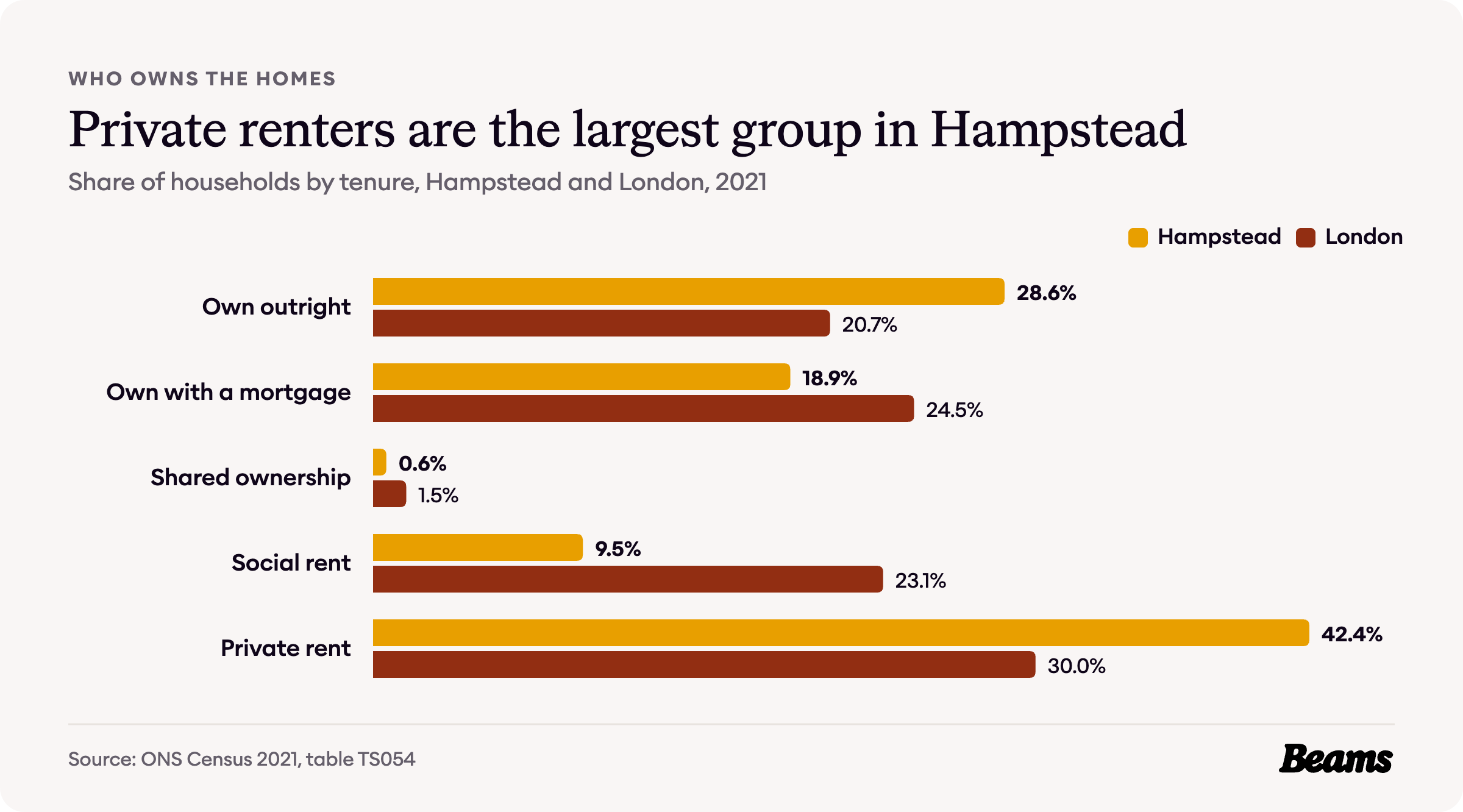
Hampstead splits almost evenly between owners and renters. 47.5% of households own their home, 28.6% outright and 18.9% with a mortgage, a little above London's 45.2% [5].
The difference is in who rents. Private renting is the largest single tenure, at 42.4% of households against 30.0% for London, while social renting is 9.5%, well under London's 23.1% [5]. Outright owners stand out too, at 28.6% against 20.7% across London.
What a Hampstead home costs
The figures on this page cover three different areas, so it helps to know which is which. The UK House Price Index and the rent figures cover the whole London Borough of Camden. The census and Valuation Office figures on this page cover the Hampstead Town, Frognal and Belsize Park small areas, and the sale prices cover the NW3 postcode district.
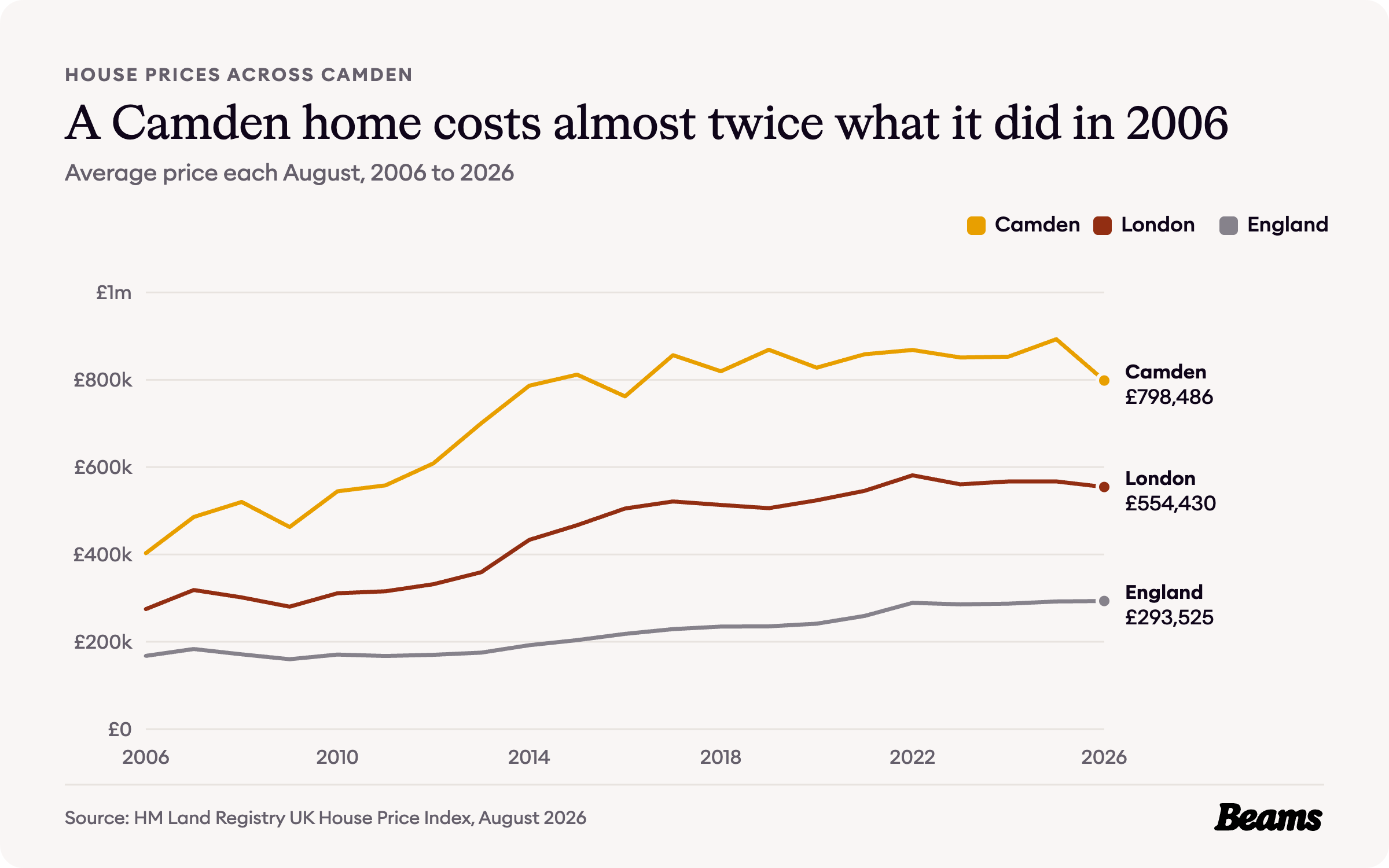
The average Camden home cost £798,486 in August 2026, 10.6% less than a year earlier [6]. That is about 44% above the London average of £554,430, and 2.7 times the England average of £293,525 [7].
Twenty years ago the average Camden home cost £402,772, against £274,815 for London. Camden has stayed above the London average every August since, and by August 2025 its average had more than doubled to £893,099. This year's fall took it back to £798,486, still almost twice the 2006 figure [7].
Flats, terraces and the price of moving up
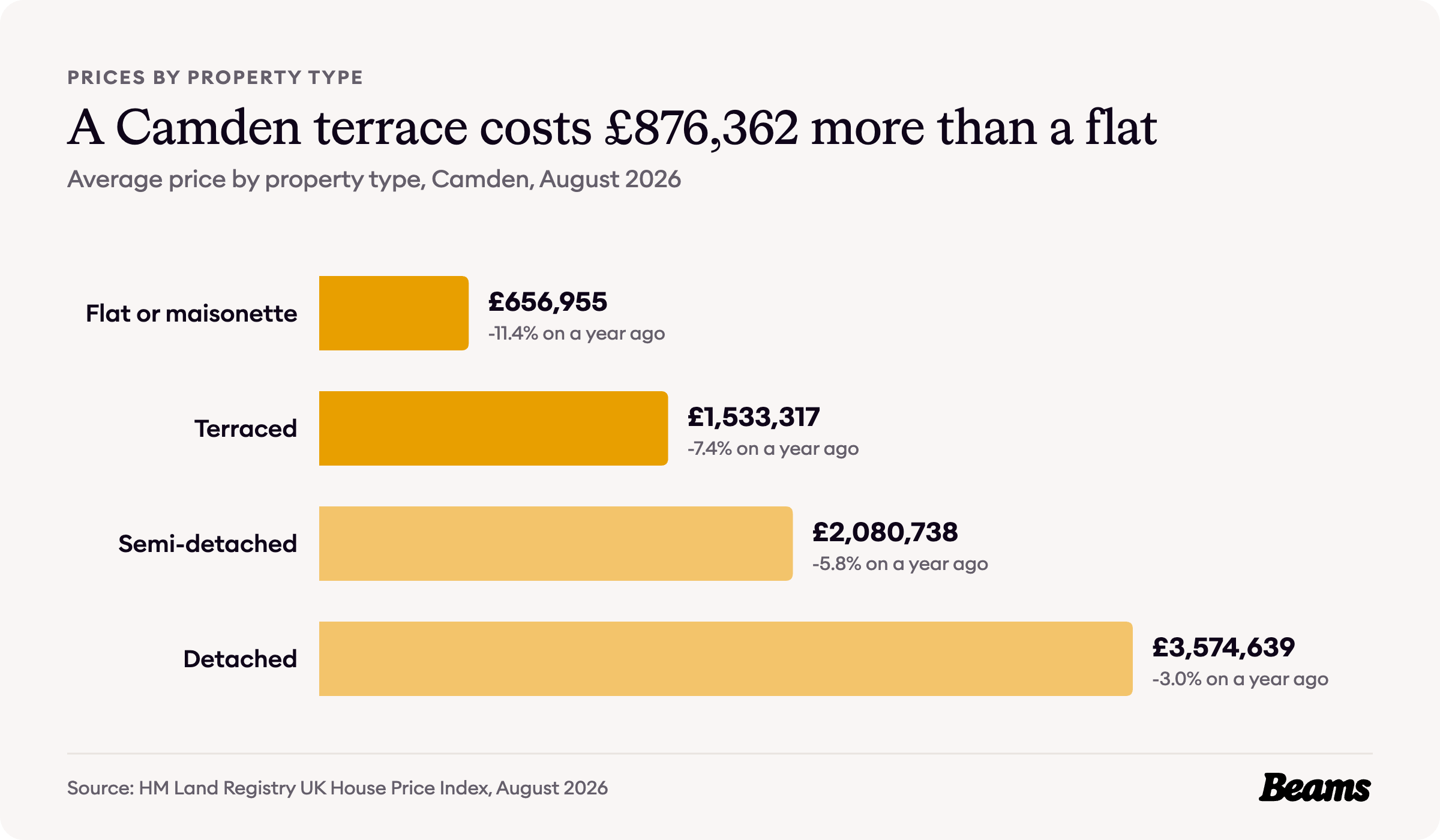
Across Camden, a flat or maisonette averaged £656,955 in August 2026 and a terraced house £1,533,317, a gap of £876,362 [6]. Semi-detached homes averaged £2,080,738 and detached homes £3,574,639. First-time buyers paid an average of £696,585, while owners moving home paid £999,539 [6].
For a family already in a terrace, the next rung, a semi-detached house, costs more than half a million pounds on top of that on average. Sums like that are the case for staying put, and a house extension in Hampstead adds room without paying for the next rung of the ladder.
What homes sell for in NW3
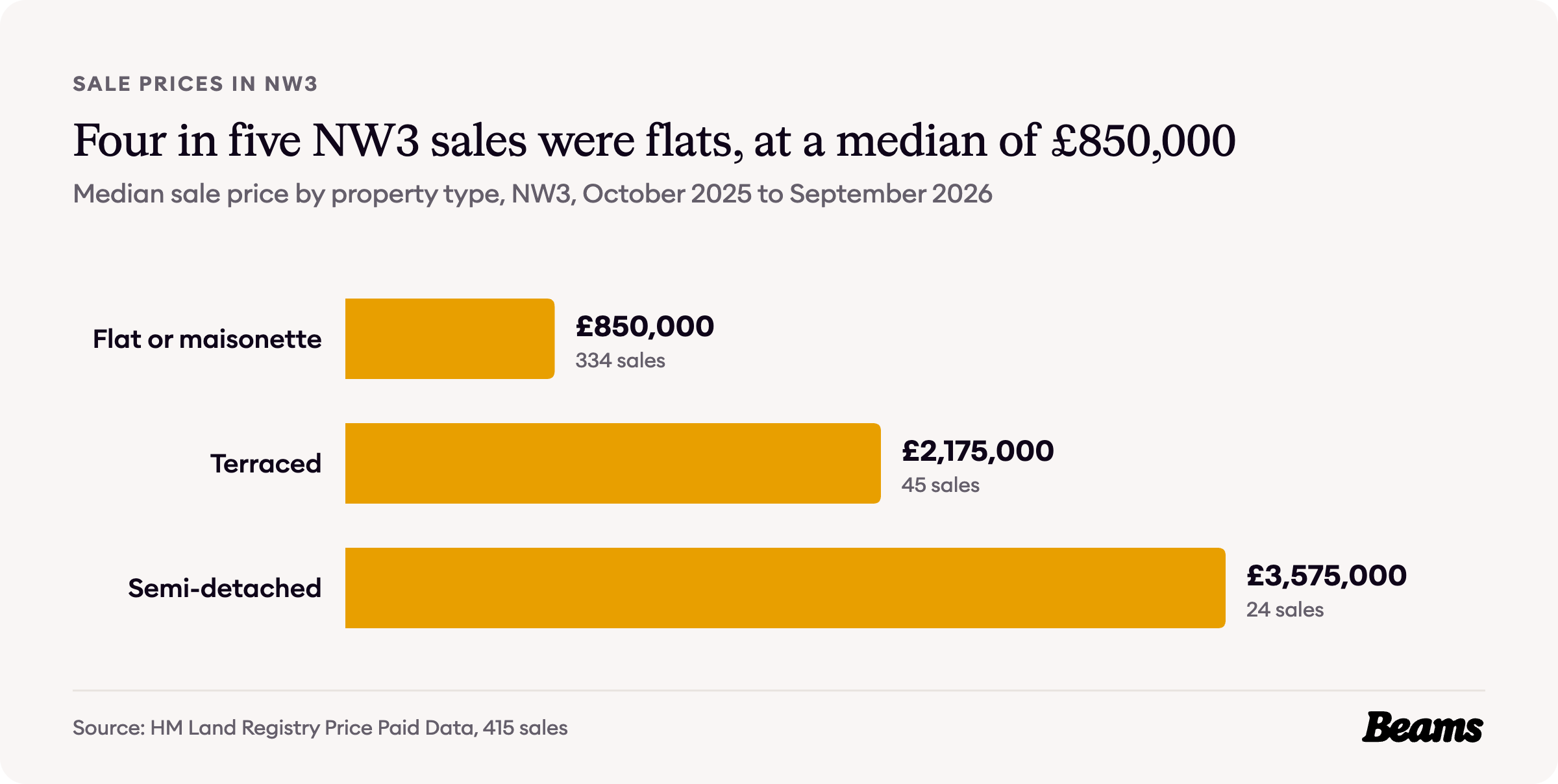
HM Land Registry records 415 sales in the NW3 postcode district between October 2025 and September 2026, at a median price of £954,000 [8]. Flats made up 334 of those sales, four in five, at a median of £850,000. The 45 terraced houses sold had a median of £2,175,000 and the 24 semi-detached houses £3,575,000 [8].
A median is the middle sale in each group, so it is not directly comparable with the index averages above, but both tell the same story. In NW3 the median terrace sold for 2.6 times the median flat, and across Camden the average terrace costs 2.3 times the average flat.
Renting in Hampstead
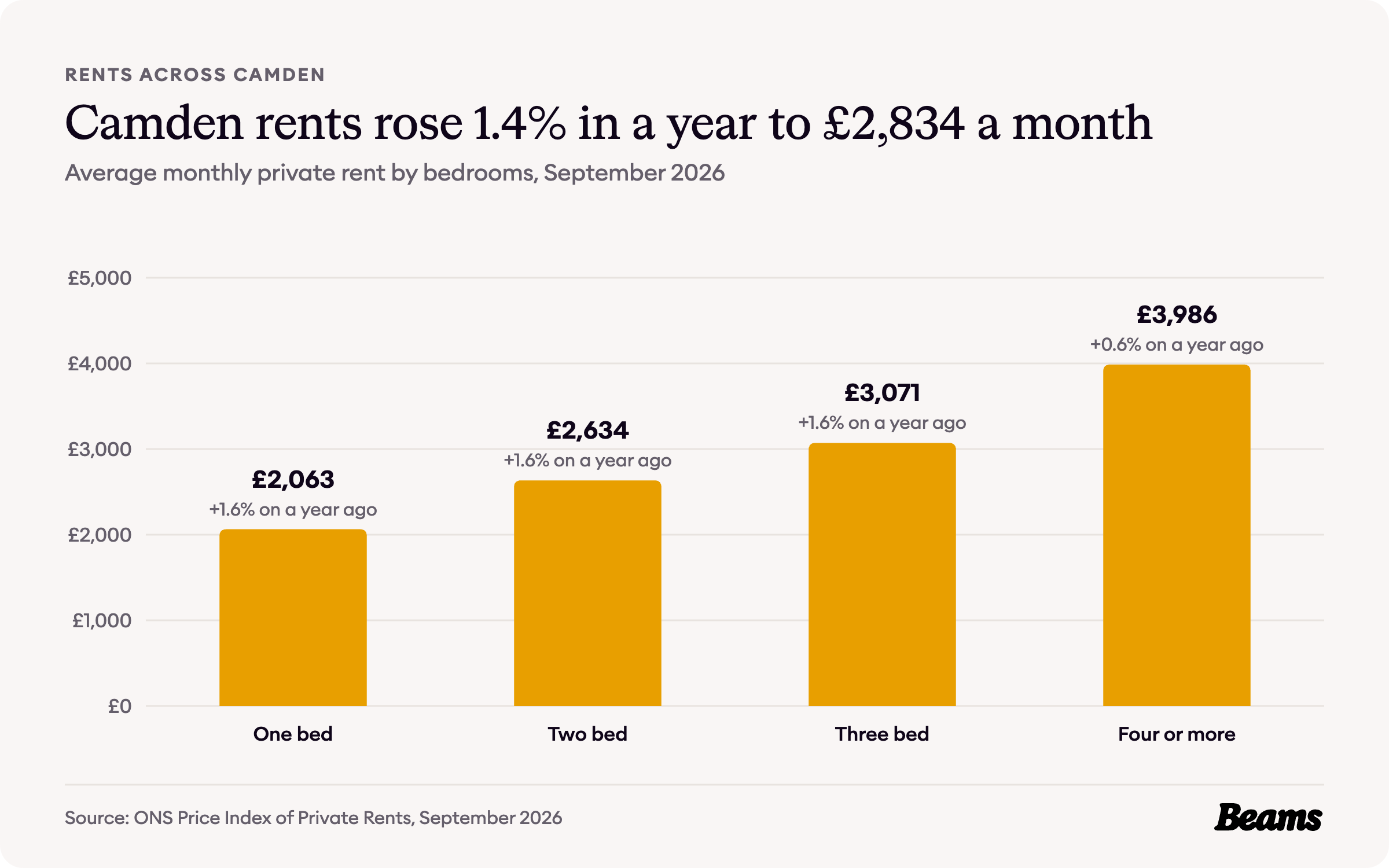
The rent figures are published for Camden as a whole. The average private rent across the borough was £2,834 a month in September 2026, up 1.4% on a year earlier [6]. A one-bedroom home averaged £2,063 a month, a two-bedroom home £2,634 and a home with four or more bedrooms £3,986 [6].
Rents rose 1.4% in the same year that the average Camden home fell 10.6% in price [6]. With 42.4% of Hampstead households renting privately [5], the rental market is a large part of how the neighbourhood's housing is used.
Council Tax bands in Hampstead
Council Tax bands in England are based on what a home would have sold for on the open market on 1 April 1991 [9], so they are a rough guide to the size and value of the housing.
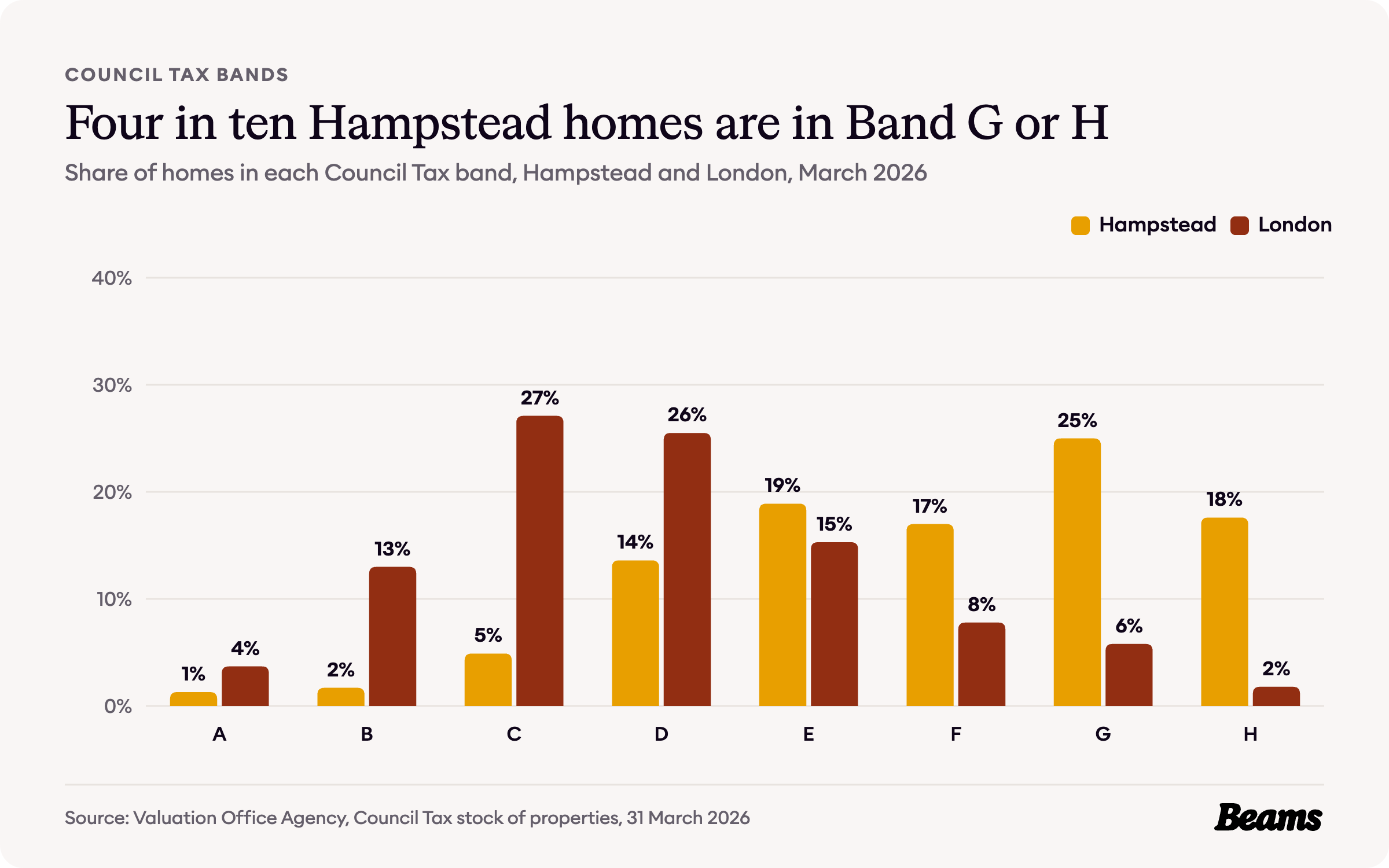
In the Hampstead Town, Frognal and Belsize Park areas, 25.0% of homes are in Band G and 17.6% in Band H, the top band. That puts 42.6% in the top two bands, against 7.6% across London. Only 7.9% are in Bands A to C, against 43.8% for London [3].
Homes at that end of the banding are often period properties, and interior design in Hampstead can plan a room around its original features rather than strip them out.
The rules on your street
Camden has 40 conservation areas, which together cover about half of the borough, and each has its own appraisal and management strategy [10]. Several take in this neighbourhood, among them Hampstead, Redington and Frognal, Fitzjohns/Netherhall and Belsize. In a conservation area you will usually need planning permission to alter a property, your application must include a heritage statement, and you must give the council six weeks' notice before working on most trees [10].
Article 4 directions go further. They remove certain permitted development rights from houses and flats in the Belsize, Fitzjohns/Netherhall, Hampstead and Redington and Frognal conservation areas, so some work that would not normally need planning permission does. Several of these directions were adopted as recently as 9 June 2026, and the council says they also aim to keep historic features repaired rather than replaced where possible [11]. Digging down is one of the jobs where these rules matter most, so a basement conversion in Hampstead should start with a check of the address.
The national time limit for deciding an ordinary planning application is eight weeks once it has been validated, or 13 weeks for major development, unless the applicant agrees to a longer period [12]. Camden decides 90% of applications by delegated powers, meaning by planning officers, and from 31 October 2026 national rules mean householder applications must be decided by officers rather than the planning committee [13]. Check your street on the council's maps before you ask builders in Hampstead for a fixed price.
Hampstead housing statistics at a glance
- Median sale price, NW3, October 2025 to September 2026: £954,000 (415 sales) [8]
- Average house price, Camden, August 2026: £798,486 (London £554,430) [6] [7]
- Change on a year earlier, Camden: -10.6% (London -2.2%) [6] [7]
- Average terraced house, Camden: £1,533,317 (London £648,650) [6] [7]
- Average private rent, Camden, September 2026: £2,834 a month [6]
- Homes built before 1900: 61.0% (London 20.8%) [3]
- Households living in a flat: 78.4% (London 54.0%) [4]
- Households who own their home: 47.5% (London 45.2%) [5]
- Homes in Council Tax Band G or H: 42.6% (London 7.6%) [3]
- Conservation areas in Camden: 40 [10]
Frequently asked questions
References
- British History Online, Hampstead: Settlement and Growth. Victoria County History of Middlesex, volume 9.
- British History Online, Hampstead: Frognal and the Central Demesne. Victoria County History of Middlesex, volume 9.
- Valuation Office Agency, Council Tax: stock of properties 2026. Table CTSOP4.1, properties by build period and Council Tax band at 31 March 2026, Hampstead Town, Frognal and Belsize Park areas and London.
- ONS, Census 2021 table TS044: Accommodation type. Households by type of home, Hampstead Town, Frognal and Belsize Park areas and London.
- ONS, Census 2021 table TS054: Tenure. Households by tenure, Hampstead Town, Frognal and Belsize Park areas and London.
- ONS, Housing prices in Camden. UK House Price Index for August 2026 and Price Index of Private Rents for September 2026, updated 21 October 2026.
- HM Land Registry, UK House Price Index. Average prices for Camden, London and England, August 2006 to August 2026.
- HM Land Registry, Price Paid Data. Sales in the NW3 postcode district, October 2025 to September 2026.
- GOV.UK, How domestic properties are assessed for Council Tax bands. Accessed 29 October 2026.
- Camden Council, Conservation areas. Accessed 29 October 2026.
- Camden Council, Article 4 Directions: heritage and conservation. Accessed 29 October 2026.
- GOV.UK, Determining a planning application. Planning practice guidance on statutory time limits. Accessed 29 October 2026.
- Camden Council, Deciding the outcome of a planning application. Accessed 29 October 2026.
Thinking of improving rather than moving?
Tell us about your Hampstead home and what you want to change. We'll give you a free estimate, then up to three vetted builders quote against the same specification.