
Who is responsible for a collapsed or leaning boundary wall?

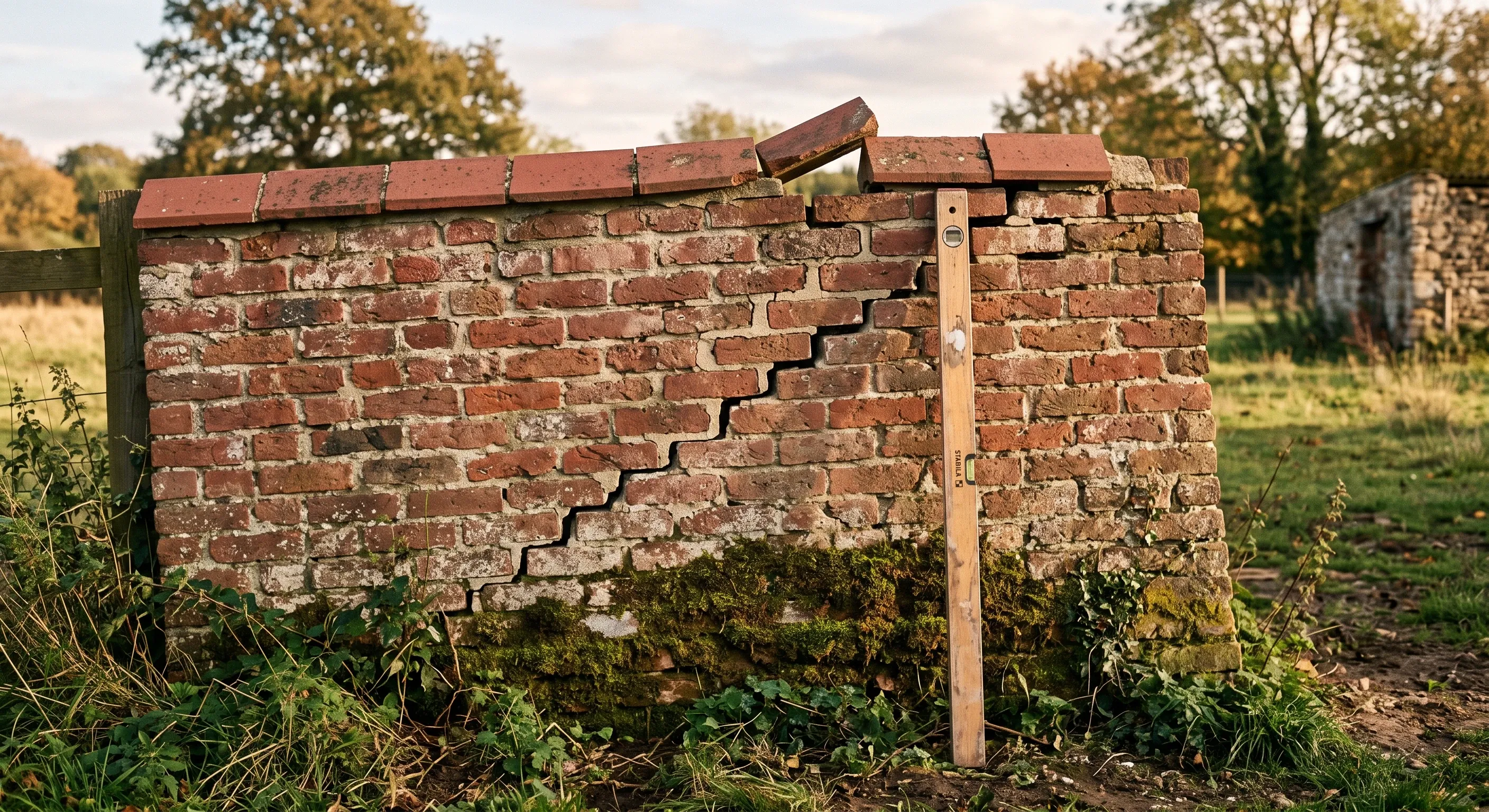
Responsibility usually falls on whoever owns the wall, and ownership is decided by the title deeds rather than by which side the piers face. Ownership is not the whole answer. A neighbour whose trees, raised ground or building work caused the failure can be liable for the repair even when the wall is not theirs.
There are three separate questions tangled together here, and answering them in the wrong order is how neighbours end up in a two year argument over twenty metres of brickwork. Who owns it. Whether anyone is under a duty to repair it. And who pays. English law gives different answers to each, and on the second one the answer surprises almost everybody. This article is general information about how the law and the practicalities usually work, not legal advice on your wall. If money or safety is genuinely at stake, get a solicitor and a structural engineer.
What do title deeds and T-marks actually prove?
A T-mark is a small letter T drawn against a boundary line, wholly inside the land of the owner responsible for maintaining that boundary feature, with the stem meeting the line at a right angle. Two T-marks back to back form an H and indicate shared responsibility. That is a genuine piece of evidence and it is worth finding.
What it does not do is settle ownership. T and H marks usually appear on the conveyance plan rather than the registered title plan, and they only reach the title plan where the deeds expressly refer to them. HM Land Registry title plans show general boundaries only, because section 60 of the Land Registration Act 2002 requires it: the plan indicates the general position of a boundary and leaves the exact legal line undetermined. So the title plan will not tell you whether the wall is yours, your neighbour's, or straddling the line. Order the title register and title plan from HM Land Registry and then order the conveyance the register refers to, because that is where the covenant and the T-marks live. Be prepared for the deeds to say nothing at all, which is extremely common on Victorian and Edwardian London stock.
There is a further trap. Even where the original conveyance imposed a positive obligation to maintain a boundary wall, positive covenants do not automatically bind later freehold owners in English law. A repairing obligation that looked watertight in 1908 may be unenforceable against the person who owns the house today. Boundary "ownership" on a title plan is a weaker thing than most homeowners assume.
Is anyone actually under a duty to repair a boundary wall?
Generally, no. There is no free-standing duty in English law to keep your boundary wall in good repair, and you cannot usually compel a neighbour to rebuild a wall they have let decay. That is the single most useful fact in this article and the one solicitors' pages tend to bury.
Liability comes from somewhere else: what happens when the wall causes damage. The line of cases running through Sedleigh-Denfield v O'Callaghan, Goldman v Hargrave and Leakey v National Trust established what is now called the measured duty of care. An occupier who knows, or ought to know, of a hazard on their land that puts a neighbour's land at risk must take such steps as are reasonable in all the circumstances to prevent or minimise the damage. The duty is measured, so it takes account of the resources of the person who owes it, and it only arises once the risk is patent rather than latent.
That last point drives what you should do this week. A wall that has quietly leaned for fifteen years is a latent risk to the owner who has never looked at it. A wall the owner has been told about in writing, with photographs and a date, is a known hazard. If your neighbour's wall is leaning towards your greenhouse, your children or your car, write to them, attach dated photographs, and keep a copy. You are not being difficult. You are converting their problem from a latent one into a known one.
When does the Party Wall etc. Act 1996 bite, and when does it not?
Only when the wall is a party fence wall. Section 20 of the Act defines that as a wall, not being part of a building, which stands on lands of different owners and is used or constructed to be used to separate those lands. The critical words are "stands on lands of different owners". The wall has to sit astride the legal boundary.
A masonry wall built wholly on one side of the line is a boundary wall, not a party fence wall, and the rights in section 2 of the Act do not attach to it. Timber fences, panels, posts and hedges are never party fence walls whatever their position. Get this wrong and you serve notices that are void, or you miss notices you needed to serve.
Where it is a party fence wall, section 2(2)(b) gives a building owner the right to "make good, repair, or demolish and rebuild" it where the work is necessary on account of defect or want of repair. Section 11(5) then apportions the expense between the building owner and the adjoining owner in proportions that have regard to the use each owner makes or may make of the wall, and to responsibility for the defect or want of repair where more than one owner uses it. In plain terms: on a shared, decayed boundary wall that both sides use, a contribution from the neighbour is the statutory expectation rather than a favour.
The Act's limits matter as much as its reach. It does not oblige your neighbour to repair anything. It gives the person who wants to do the work a mechanism to do it and to seek a contribution, and it gives the other side a process to dispute the scope and the cost. Nobody can be forced to serve a notice. We cover the notice and surveyor process under the Party Wall Act separately, and it is worth reading before you write to anyone, because the sequence of notice, consent or dissent, and appointment of surveyors is easy to get out of order.
How bad does a lean have to be before you get expert advice?
There is no statutory lean threshold, and anyone quoting one as law is wrong. What surveyors and engineers use are rules of thumb, and these are the ones that come up repeatedly:
- Lean approaching half the wall's thickness. A 215mm one-brick wall that is out of plumb by roughly 100mm from base to top is at the point where a structural opinion is sensible.
- Roughly 25mm of lean per 300mm of height. An inch per foot, in the older language, on any masonry wall.
- Movement that is changing. Crack widths increasing over a season, mortar dropping out of the bed joints, coping stones displaced, or the wall visibly moving when pushed at the top.
- Bulging rather than tilting. A uniform lean is often old foundation settlement. A belly in the middle course usually means the wall is being pushed, and that is more urgent.
- Height and what is underneath it. Any wall over about 1.8m leaning towards a pavement, a road, a play area or somewhere people sit should be assessed now, not in spring.
A wall being pushed is almost always retaining soil it was never designed to retain. Free-standing garden walls are built to resist wind, not lateral earth pressure, and a neighbour who has raised their ground level, built a raised bed against the back of the wall or imported topsoil has converted it into a retaining structure overnight. The remedy is a properly designed retaining wall with the right thickness, reinforcement and drainage behind it, not repointing. If the wall overhangs a public highway, the council has powers over dangerous structures under sections 77 and 78 of the Building Act 1984, and in inner London under Part VII of the London Building Acts (Amendment) Act 1939. Those are powers rather than duties, so do not assume the council will step in.
For an inspection, use a structural engineer or a RICS chartered building surveyor and ask for a written opinion on cause, not just condition. Cause is what decides who pays.
Whose insurance pays for a collapsed boundary wall?
Check the policy wording before you check anything else. Buildings insurance commonly excludes storm damage to gates and fences outright, and guides from insurers and comparison sites including Lemonade UK and Compare the Market are consistent that solid boundary walls are sometimes treated more favourably than fence panels on the same policy. Sometimes is doing a lot of work in that sentence.
Three things decide most claims. First, the definition of storm: insurers commonly set a wind gust threshold around 55mph, and the Financial Ombudsman Service publishes its approach to storm damage complaints, which is worth reading if you are refused. Second, wear and tear and gradual deterioration, which are excluded on every policy and which is exactly what a hundred-year-old lime mortar wall has. Third, ownership, because you cannot claim on your own policy for a wall that belongs to your neighbour. Impact by a vehicle, fire and vandalism are usually covered where storm is not. Where a neighbour's tree brought the wall down, the route is a claim against them in negligence or nuisance and their liability insurer, and it will turn on whether they knew or ought to have known the tree was unsafe.
Repair or rebuild, and who typically pays?
The distinction decides the bill, and it is the thing most quotes leave vague. Here is how the common failures usually break down.
What you are seeing | Usual cause | Repair or rebuild | Who typically pays |
|---|---|---|---|
Loose mortar, spalled bricks, no movement | Weathering, failed pointing | Repair: rake out and repoint, replace bricks | The wall's owner |
Coping loose, top two or three courses moving | Water ingress, failed or missing coping | Repair: rebuild the top courses, new coping and DPC | The wall's owner |
Uniform lean, no bulge, stable for years | Original foundation too shallow | Usually rebuild the leaning section on new foundations | The wall's owner, shared if a party fence wall |
Belly in the middle, lean towards one side | Soil or surcharge loading from one side | Rebuild as a retaining structure | Whoever created the loading |
Sudden collapse after a dry summer | Clay shrinkage, often tree related | Rebuild on deeper foundations | Owner, or the tree's owner if negligence is shown |
Collapse during or after adjacent works | Excavation, vibration, removed support | Rebuild | The party who carried out the works |
Two rules follow from that table. Get the cause established before you get the price, because "repair" and "rebuild" are different jobs at different money and a builder who has not been told which one you want will quote the cheaper one. And when you price a garden wall repair or rebuild, insist the written scope says which it is, states the foundation depth, and states whether the wall is being rebuilt on the same line.
What to do in the first week
Make it safe first. Fence off the fall zone, especially on a pavement side, and do not let anyone work next to a leaning wall.
Then, in order: photograph everything with a date and a scale object in shot. Order the title register, title plan and the conveyance from HM Land Registry for both properties if you can. Write to your neighbour, factually, attaching the photographs. Get a structural engineer or RICS surveyor to report on cause. Notify your insurer even if you doubt cover, because late notification is itself a reason for refusal. Only then get prices.
If the wall straddles the boundary, that report also tells you whether the Party Wall etc. Act applies and whether notices are needed before anyone touches it. In terraced London streets the boundary geometry is rarely as tidy as the title plan suggests, and the same evidence problems that come up with party walls in London terraces apply to the garden wall running back from the rear elevation.
Frequently asked questions
Can I force my neighbour to repair their leaning wall?
Generally no. There is no general duty to repair. What you have instead is the measured duty of care, which bites once they know the wall is a hazard, and a claim in nuisance or negligence if it damages your property.
Who owns the wall if the piers or posts are on my side?
That convention has no legal force. It is a useful hint about who built it, nothing more. The deeds decide.
Can I rebuild the wall higher than it was?
Not automatically. Permitted development caps a new garden wall at two metres, or one metre next to a highway used by vehicles, and there is a separate rule about rebuilding to a former height. See our guide to the height limits on a rebuilt garden wall.
What if the wall is on the boundary and both deeds are silent?
A wall standing on the lands of both owners and separating them is a party fence wall under section 20 of the Party Wall etc. Act 1996, whatever the deeds say. Evidence of who built it and who has maintained it becomes important.
Do I need a party wall surveyor for a repair?
Only where the work is notifiable under the Act and the adjoining owner dissents or does not respond. Straightforward repointing of a wall wholly on your own land is not notifiable.
Is any of this legal advice?
No. It is general information on how these disputes usually work. Boundary and liability questions turn on the specific deeds, the specific facts and the specific damage, and they need a solicitor.
Find out what your project will cost
A leaning wall turns into an argument the moment two builders price two different jobs. Get up to three comparable quotes from vetted London builders, all worked from the same written scope, so the repair and rebuild options are priced on the same basis.
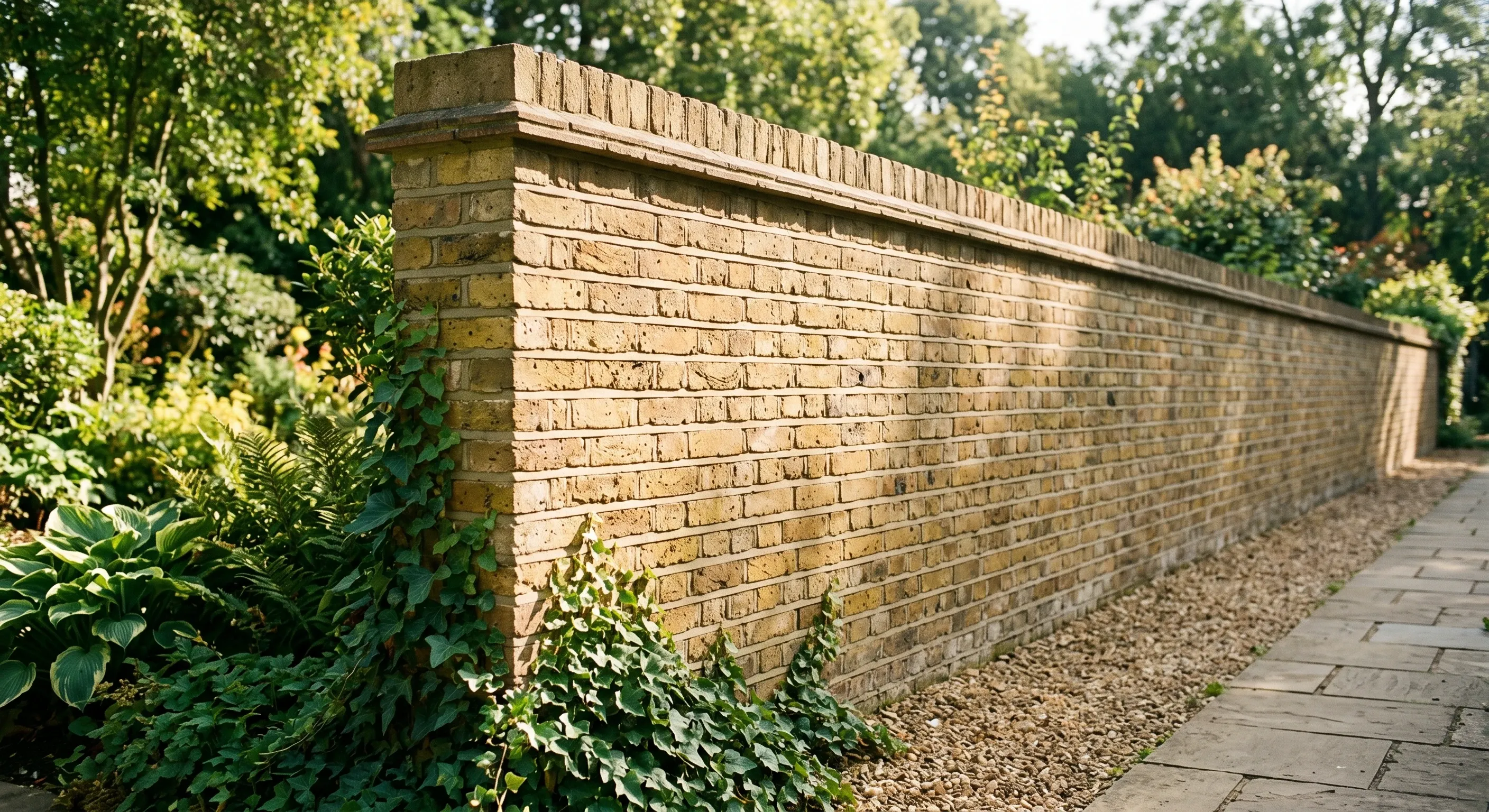
Garden walls can be 2m high, or 1m next to a road. The GPDO 2015 rules, the rebuild exemption nobody mentions, and how height is measured on a slope.
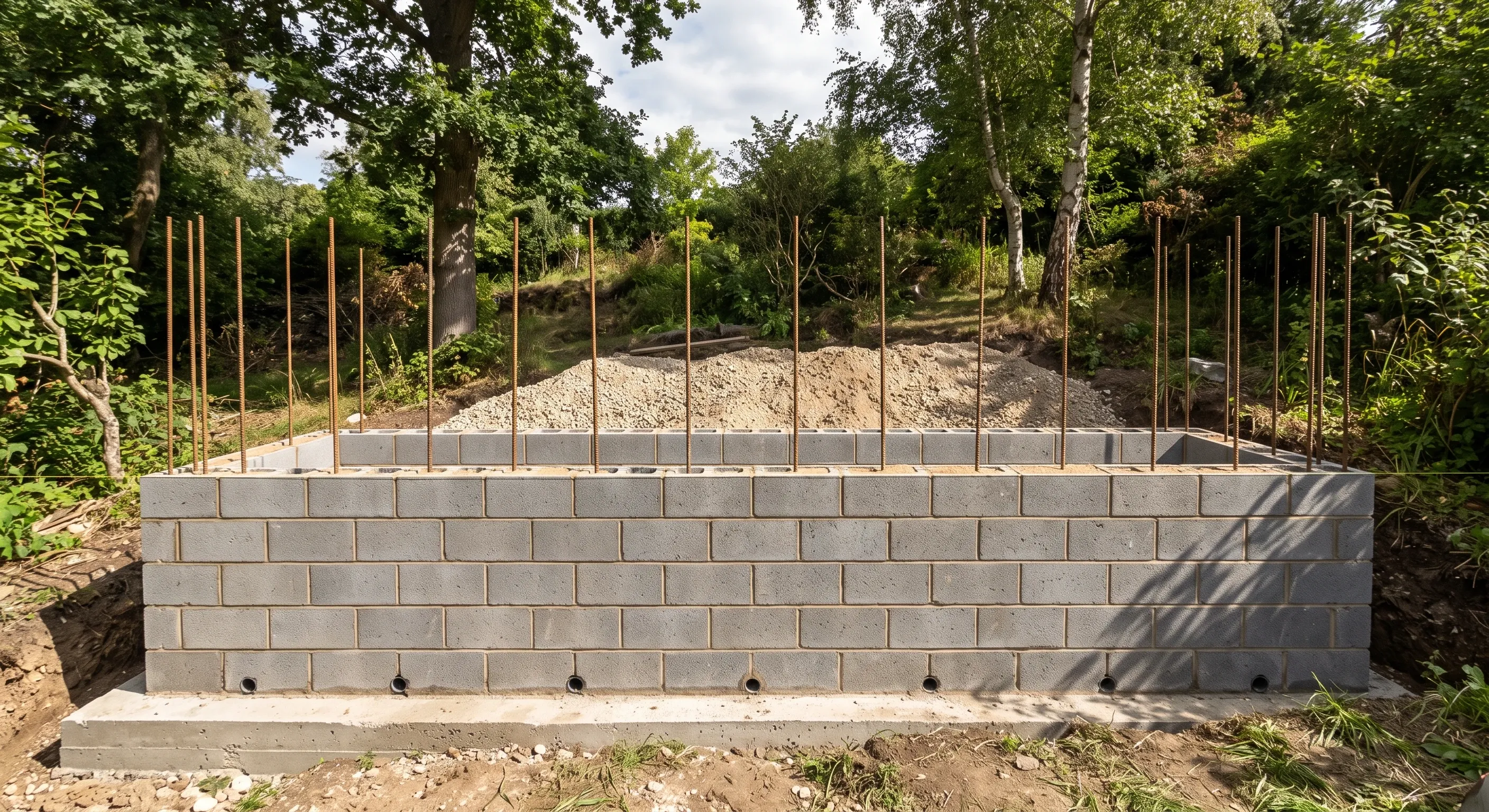
Retaining walls under 1m by a road or 2m elsewhere are permitted development. The 600mm building control rule is a myth. What actually applies.
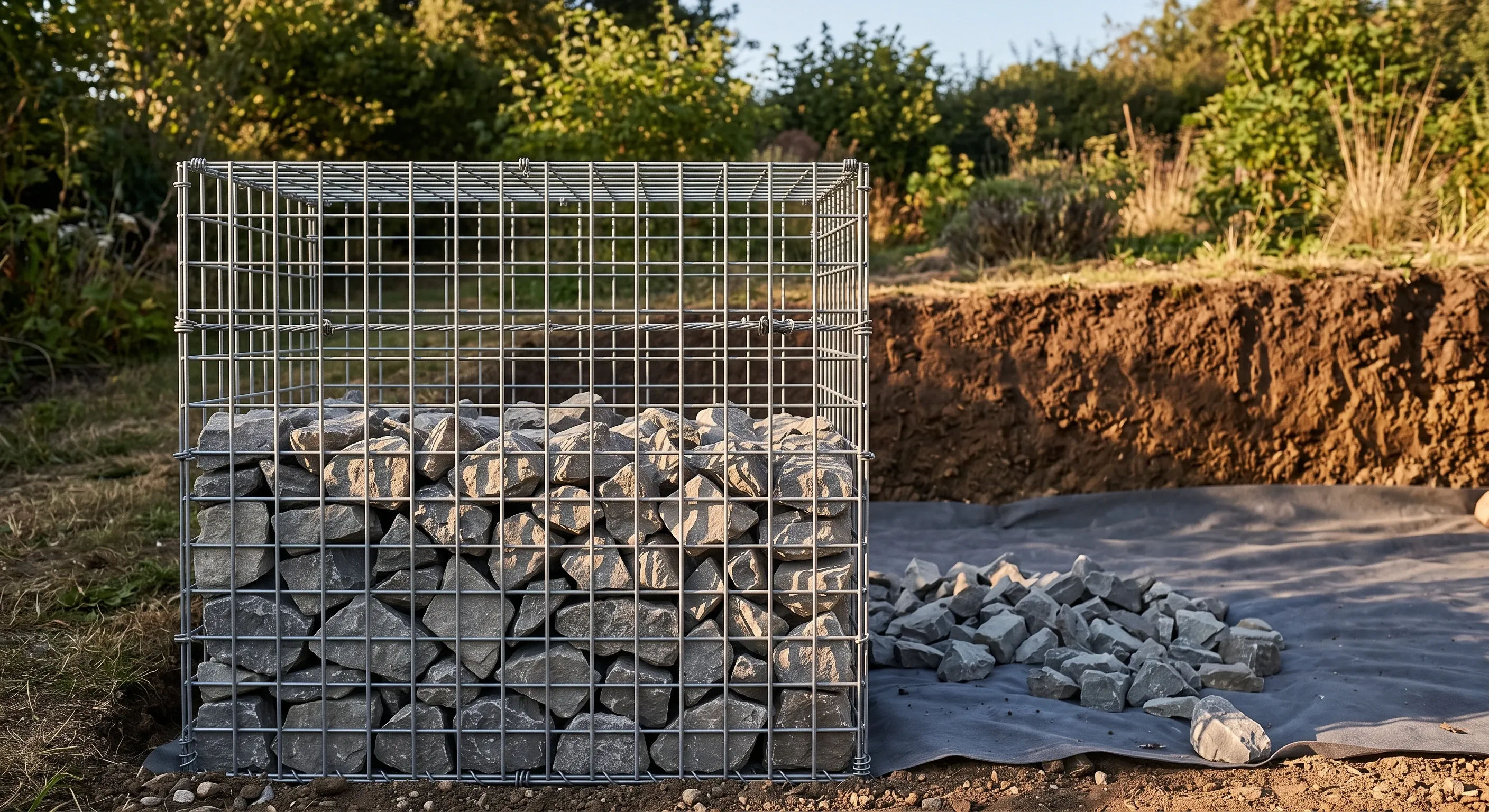
Retaining wall materials compared by realistic retained height, foundation, drainage detail and service life. Plus why the drainage fails first.