
Do you need a party wall agreement for an extension?

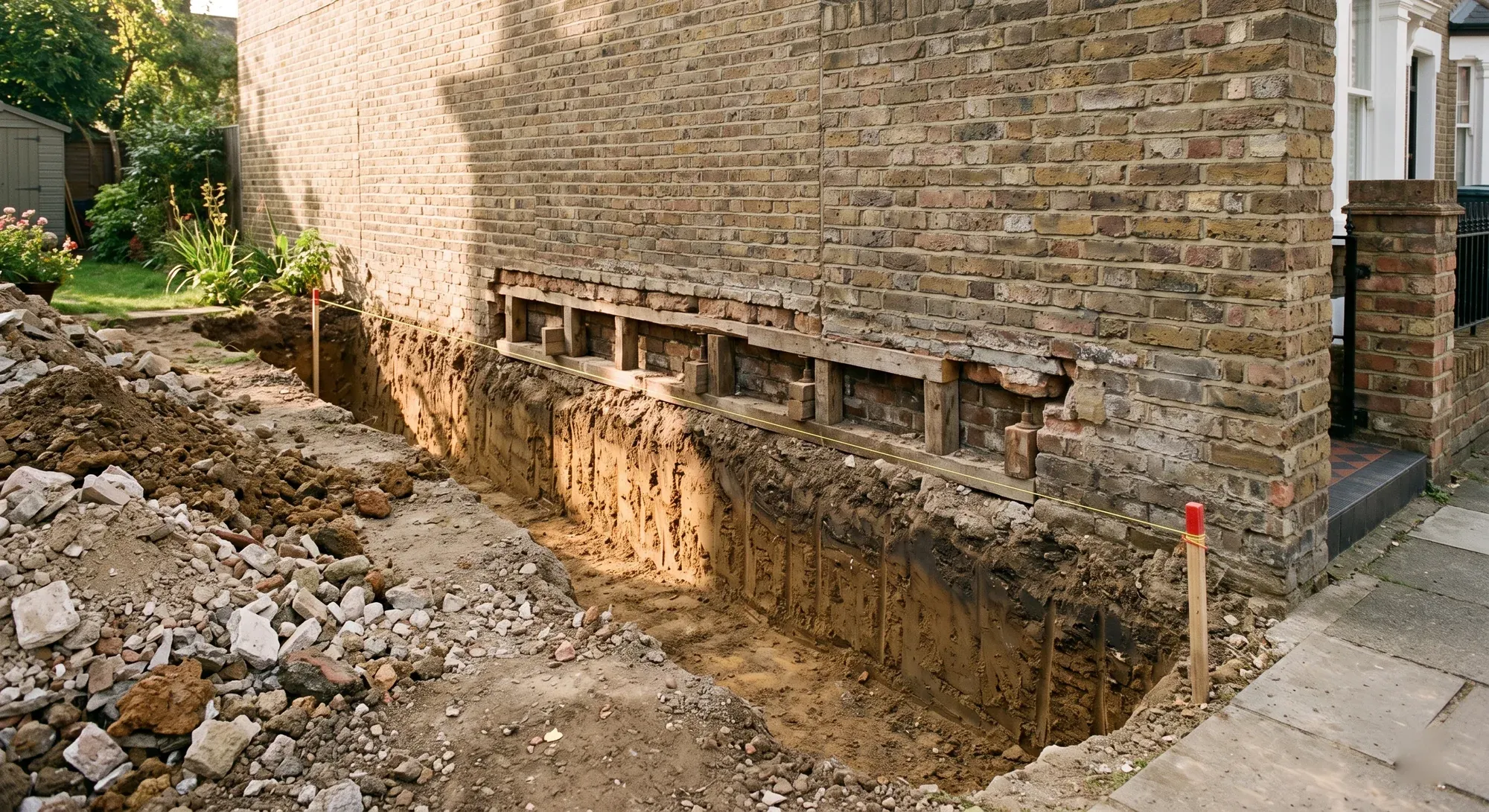
Almost certainly yes, and usually under section 6 rather than the section everyone talks about. If your extension has new foundations within 3 metres of a neighbouring building and digs deeper than their footings, you must serve notice at least one month before you start. If it also cuts a beam into the party wall, that is section 2 and the period becomes two months.
The one-month figure surprises people, because most guidance quotes two months flat. Two months is the section 2 period. Foundations are section 6, and section 6 has its own rules.
Work out which section applies to your extension
A typical rear or side extension can trigger two sections at once, and our complete guide to the Party Wall Act runs through all of them. Take them separately.
Section 6, excavation. This is the one that catches nearly every extension with proper foundations.
Section 6(1) applies where you excavate within 3 metres horizontally of a neighbour's building or structure and the work goes deeper than the bottom of their foundations. Both conditions have to be met. If your footings stay shallower than theirs, you are outside it.
Section 6(2) extends to 6 metres, where the excavation would meet a plane drawn downwards at 45 degrees from the bottom outer corner of their foundation. The deeper you dig, the further out this reaches.
Section 2, work to the party wall. Triggered separately, if your extension involves any of: cutting into the party wall to take the bearing of a steel beam, raising the party wall, cutting away a projecting chimney breast, inserting a damp-proof course, or exposing a previously enclosed party wall.
Section 1, building on the line of junction. If the new wall sits on the boundary itself rather than inside it, this applies, at one month's notice.
Where more than one applies, the longest period governs your start date. Two sections do not run in parallel to your advantage.
The section 6 details that catch extensions out
Four things make section 6 more demanding than most guidance suggests.
Plans and sections are mandatory. Section 6(6) requires you to serve drawings showing the site and depth of the proposed excavation alongside the notice. A letter on its own is not a valid section 6 notice, and an invalid notice does not start the clock.
Your neighbour can require underpinning at your expense. Section 6(3) entitles them to ask you to strengthen or safeguard their foundations. That is a real cost, and it is yours. It is also the reason a neighbour who dissents is not necessarily being difficult.
It has its own 14-day dissent clock. Section 6(7) deems a dispute to have arisen if they do not consent within 14 days. You never need section 5 for excavation.
Your rear neighbour may count. Section 6(4) deems people adjoining owners for these purposes even where nothing is shared. The house whose garden backs onto your extension can be within 3 or 6 metres of your new foundations. Almost nobody serves notice on them, and the Act does not care whether you thought of it.
That last point is the most commonly missed item in an extension project. If your foundations are close to a boundary, work out who is on the other side of every boundary, not just the party wall.
Which extensions do not need a notice
Not every extension triggers the Act, and it is worth knowing where the line sits rather than assuming.
Foundations shallower than your neighbour's, and more than 3 metres away. No section 6 trigger.
Anything beyond 6 metres horizontally. Outside both rules.
A detached house with generous space on both sides. Genuinely possible to build an extension with no notifiable work at all.
An extension that does not touch the party wall, with foundations that do not engage section 6. No notice.
The duty in section 3(1) is tied to exercising a right under section 2. If you are not exercising one and section 6 is not engaged, there is nothing to serve. Replastering, rewiring, fitting units and decorating are never notifiable.
The honest caveat: where party walls in London terraces are involved, an extension that triggers nothing is rare. Party walls on one or both sides and neighbours within 3 metres are the normal condition.
What it costs and how long it takes
Published prices from London surveying practices put an agreed surveyor for a rear or side extension at £1,300 to £1,500 plus VAT. A schedule of condition is around £450 plus VAT where it is not already included. Where each side appoints its own surveyor, expect roughly double.
There is no statutory fee scale. Section 10(13) leaves the cost of the award to the surveyors, and government guidance confirms there are no set charges, which is why quotes vary so much.
On timing, budget three months from serving notice to being clear to start. The notice period is one or two months depending on the sections, and the surveyor process adds to that rather than running inside it.
One trap specific to extensions: a section 6 notice lapses if you have not begun within 12 months, under section 6(8). Serve it the moment planning is granted and you may be serving it again.
Our guide to party wall notices and agreements, costs and process sets out the full fee table with the VAT basis on each figure.
Where this sits in your extension budget
Party wall is one of the professional and statutory fees that sit outside the build cost, alongside planning, building control and the structural engineer. Together those can add anything from around 5% to as much as 25% on top of a build, and they are a common reason two builders' quotes appear to differ when they do not.
For the full picture, including where the party wall line sits against the build itself, see our guide to house extension costs in the UK.
What your neighbour can and cannot do
Your neighbour cannot stop the extension. The government's guidance says so directly: an adjoining owner cannot prevent someone exercising the rights the Act gives them.
What they can do is dissent, which moves you into the surveyor process and produces an award governing how the work happens. Dissent changes the process, not the outcome. It is also the normal course of events rather than a sign of conflict.
Under section 6(3) they can require underpinning or safeguarding of their foundations at your cost, which is the one place where their response genuinely changes your budget.
If they ignore the notice entirely, section 6(7) treats that as a dispute after 14 days, and section 10(4) lets you appoint a surveyor on their behalf after ten days. Silence delays you, it does not block you.
One thing to be careful about: silence does not always work in your favour. If you also served a section 1 notice to build on the boundary line, section 1(4) means their silence costs you the right to build astride it, and the wall must then sit wholly on your own land. That is also why it matters who is responsible for a boundary wall that is already leaning before you build anything against it.
What happens if you skip it
The Act contains no enforcement procedure for failing to serve notice. No penalty, no regulator, no council department.
The risk is your neighbour going to court, and the remedy that matters is an injunction, because an injunction can stop a live site. On a fixed-price extension with trades booked and a steel on order, that is expensive in a way a surveyor's fee never is.
You also lose the Act's protection. Without it you are exposed to ordinary trespass and nuisance claims, and without a schedule of condition you have no evidence when a crack that was there before is attributed to your groundworks. Groundworks next to an older property is exactly the scenario where that argument happens.
And it follows you to resale, where a buyer's solicitor asks for the award.
How Beams helps
Extensions are where party wall most often bites, because they combine foundations near a boundary with structural work into the wall, so two sections engage and the longer clock wins.
So on a managed extension project we work out which sections apply while the design is still moving, get notices served early enough that they never sit on the critical path, identify every neighbour who needs one including the rear one people forget, and make sure the schedule of condition exists before a spade goes in. Your builder then prices the work knowing what the award requires.
That is part of the commitments behind a Beams project: one agreed price, payments released against milestones, and 12 months on the workmanship.
Common questions
How close to the boundary can I build without a party wall notice?
Distance alone does not settle it, depth matters too. Within 3 metres you need notice only if you dig deeper than your neighbour's foundations. Within 6 metres, only if the excavation would cross a 45 degree plane from the bottom of their foundation. Beyond 6 metres horizontally, section 6 does not apply.
Do I need a party wall agreement if my extension is on my own land?
Possibly. Section 6 is about proximity and depth, not ownership, so foundations wholly on your land can still be notifiable. And section 2 applies to work to the shared wall regardless of which side you stand on.
Can I start work while waiting for the award?
No. You cannot begin notifiable work until the notice period has run and, where there is a dispute, the award is in place. Starting early is the fastest route to an injunction.
What if my neighbour wants their own surveyor?
That is their right, and it roughly doubles the surveyor cost, which you will usually be paying. It is worth asking early whether they would consider an agreed surveyor acting for both, which is faster and cheaper, before positions settle.
Does an extension need a party wall notice if it is single storey?
Height is irrelevant. What matters is whether the foundations engage section 6 and whether the work touches the party wall. A single-storey extension with proper footings next to a terrace almost always needs a notice.
Where this information comes from
Excavation triggers, plans, underpinning, deemed dissent and the 12-month lapse: Party Wall etc. Act 1996, sections 6(1), 6(2), 6(3), 6(4), 6(6), 6(7) and 6(8)
Notice periods: sections 1(2), 3(2) and 6(5)
Rights to work to a party wall: section 2, in particular 2(2)(f) and 2(2)(g)
Silence under a line of junction notice: section 1(4)
Surveyors, costs and appeals: sections 10(4), 10(13) and 10(17)
That a neighbour cannot prevent the work, and that the Act has no enforcement procedure for failure to serve notice: Ministry of Housing, Communities and Local Government explanatory booklet
Surveyor fees: published price lists from named UK surveying practices, checked August 2026, each stating its own VAT basis. No statutory fee scale exists
Find out what your project will cost
Tell us what you are planning and we will get you up to three comparable quotes from vetted London builders, with the foundations and the notices worked out before a spade goes in.