
What is snagging and how does a snagging list work?

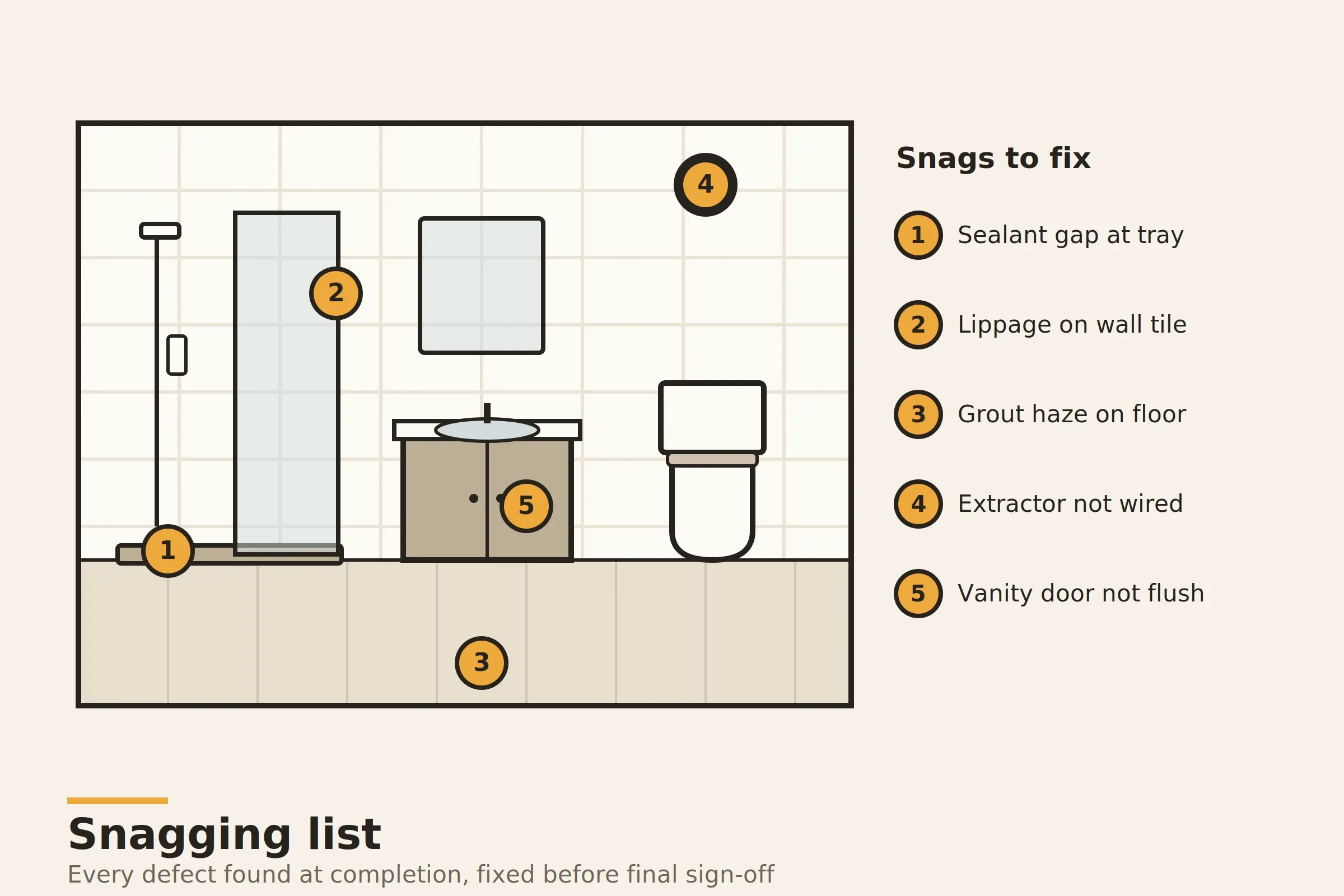
Snagging is the process of finding and fixing the small defects left at the end of building work: paint misses, misaligned doors, cracked tiles, wobbly sealant lines. A snagging list (also called a punch list) is the written record of those defects, signed off as each one is put right.
Snags are normal. Even good builders leave them.
For scale: research on brand-new homes shows new builds often carry over 150 snags, and in one 2025 survey 93.7% of new build buyers reported problems to their builder after moving in [1]. Professionally built, professionally inspected, still imperfect. On a renovation, a list running to a few dozen items on a big project is completely ordinary and no reflection on the builder.
So the question isn't whether your renovation will have snags. It's whether they get found, listed and fixed while you still have leverage, or discovered one by one over the next six months.
Is snagging different on a renovation compared with a new build?
Yes, and the difference is the mechanism sitting behind it. A new build carries a two-year developer warranty for defects, wrapped inside a ten-year structural policy from NHBC or a similar provider, plus an established culture of paying a surveyor to snag the house before completion. A renovation has none of that machinery. Your position rests on the contract you signed, the money you have not yet paid, and the workmanship warranty your builder offers, usually twelve months.
Different mechanism, different leverage.
On a new build you are making a claim against a developer and a warranty provider, through a process with a portal, a reference number and a complaints route. On a renovation you are having a conversation with the person who did the work, and the strength of your hand comes almost entirely from what the contract says and how much of the price is still in your account.
That cuts both ways. New build buyers get a formal route and then often wait months inside it. Renovation clients usually get their builder back on site within a fortnight, because the alternative is not being paid.
The snags themselves also differ. On a renovation you are inspecting new work where it meets old: a fresh plaster line running into an original wall, floor levels between an extension and the existing house, tiling set onto a wall that was never quite square. Those junctions produce most renovation snags, and no new-build snagging checklist covers them.
What counts as a snag, and what doesn't?
A snag is a minor defect or unfinished detail in otherwise completed work: cosmetic marks, alignment issues, missing sealant, a socket that was never fitted. It is not major defective work, incomplete stages, or anything structural, which are contract issues rather than snagging items.
The distinction matters because the remedies differ.
Snags get fixed inside the normal completion process. Defective or incomplete work is a milestone you shouldn't be approving in the first place. Putting a genuinely unfinished bathroom on a snagging list politely reclassifies a big problem as a small one, and you lose the leverage that goes with naming it properly.
If you're in that territory, our guide on handling a dispute with your builder is the right read, not this one.
How does a snagging list work?
A snagging list works in four steps: inspect the finished work room by room, record every defect specifically (location, issue, photo), agree the list and a fix window with your builder, then re-inspect and sign off each item as it's completed.
Specificity is what makes the list work.
"Bathroom needs finishing" starts an argument. "Sealant gap at the left edge of the shower tray, grout haze on the floor tiles by the door, extractor fan not wired" starts a schedule. Every item should be checkable by someone who wasn't in the room when you wrote it.
Six fields per entry is enough, and a spreadsheet or a shared note does the job as well as any app:
Field | What to record | Example |
|---|---|---|
Item | The defect in plain words, numbered so it can be referred to later | 14. Sealant gap along shower tray edge |
Location | Room plus a fixed reference point, so nobody has to guess | Family bathroom, enclosure, wall side |
Photo reference | The file name of a dated photo taken on the walkaround | IMG_0412, 14 Oct |
Agreed fix | What the builder has agreed to do, in their words if possible | Strip and reapply sealant, full length |
Deadline | A date, not a phrase like as soon as we can | 21 Oct |
Status | Open, fixed, or signed off, with sign-off coming from you rather than the builder | Signed off 22 Oct |
Photograph everything as you go. Not because you expect a fight, but because a dated photo ends most of them before they start.
When should you do the snagging inspection?
Do the snagging inspection at practical completion, before the final payment is released. That ordering is the entire game: a builder with money still to collect fixes snags quickly, and a builder paid in full fixes them somewhere between eventually and never.
Come equipped. The kit is almost comically simple: low-tack masking tape to mark each item on the spot, a torch for raking light across walls and worktops, your phone for photos, and a spirit level app if you're feeling thorough.
Then take your time. Daylight, every door opened, every tap run, every socket tested. Check finishes at worktop height and skirting height, because paint looks different when you crouch. View walls along the surface, not straight on, and imperfections announce themselves.
One more pass most people skip: come back in the evening and do the lights-on check. Downlights raking across a ceiling reveal what noon hid.
What should you check, room by room?
Work each room in the same sweep: surfaces, then joinery, then services. Then repeat the whole thing after dark with every light on.
Every room
- Paint coverage and plaster lines seen from two metres in daylight, then again along the surface rather than straight on
- Skirtings and architraves neatly mitred, filled and painted, including down at floor level
- Doors that open, close and stay where you leave them, with even gaps and no binding on the frame
- Every socket, switch and light tested rather than admired, two-way switching included
- Windows locked, unlocked, opened and closed, with handles aligned and trickle vents fitted
- Radiators level, valves turning, no weeping at the tails
- Floor finishes flat underfoot, no lipping at thresholds, no hollow-sounding boards
- Sealant and mastic lines continuous and straight, with no gaps or voids that will trap dirt
Kitchens
Kitchens earn a slower lap.
- Cupboard doors aligned along the whole run, not only against their neighbour
- Drawers on their stops, soft-close working, handles all set the same way
- Worktop joints tight, flush and sealed, with clean edges at cut-outs
- Upstands and splashbacks sealed to both the worktop and the wall
- Every appliance switched on and run, including the extractor on boost
- Tap flow and waste tested, then the cupboard under the sink checked again an hour later
- Plinths clipped in and end panels scribed to the wall and floor
Bathrooms
Bathrooms deserve the most patience of all. Between waterproofing, tiling, sealant and flow, a bathroom renovation packs more snag opportunities per square metre than any other room in the house, and the wet ones are the expensive ones to find late.
- Shower run for a full five minutes, not five seconds, then tray edges, wall junctions and the ceiling below all checked
- Water finding the waste with no pooling in a corner, which is how you know the falls are right
- Grout even in colour and depth, tiles flat to the eye across the full wall, cut tiles kept off the main sightlines
- Sealant at tray, bath and basin continuous and properly tooled
- Extractor wired, running and genuinely pulling air, which a sheet of tissue will tell you in a second
- Toilet fixed solidly, cistern filling and stopping, nothing seeping at the pan connector
- Heated towel rail and underfloor heating both turned on and confirmed warm before you sign anything
Outside
Extensions and loft conversions make exterior snags common, and this is the part of the list most homeowners never write. Walk the outside of the house twice, once dry and once in heavy rain if you get the chance.
- Roof coverings and ridge lines even, no slipped or cracked tiles, no daylight showing in the loft
- Flashings and lead work properly dressed at abutments, chimneys and roof lights
- Gutters running to the outlets instead of ponding, downpipes clipped, joints dry when it rains
- Brickwork courses level and pointing consistent in colour and profile, with no smeared or missing mortar
- Render even in texture and colour, beads finished cleanly, no hairline cracking where new meets old
- External doors and thresholds weathertight and closing onto the full length of the seal
- Drainage gullies clear, inspection chamber covers seated and accessible, new runs falling the right way
- Ground levels and paving falling away from the new wall, with the damp proof course still visible above them
Expect a second, smaller wave of snags over the first months too, especially the first heating season, when new plaster dries and timber settles and hairline cracks appear. Normal, predictable, and exactly what a warranty window is for.
What does a professional snagging survey cost, and is it worth it?
A professional snagging survey costs roughly £300 to £600 for an average house, more on larger properties, and produces a written report with numbered items, photographs and a location reference for every defect found.
What you are buying is a trained eye and a document. Surveyors look at the things homeowners tend to skip: roof coverings and flashings, loft insulation depth and coverage, render cracking, external levels and drainage falls, window and door operation against manufacturer tolerances, extract ventilation rates, and whether smoke alarms and trickle vents are where Building Regulations require them.
On a renovation, the honest answer is that most people do not need one.
A survey earns its fee on large or high-value projects, on extensions and loft conversions where the new fabric is hard to assess from the ground, and in the case where you know you are not going to enjoy judging finish quality yourself. There is a second reason to buy one on a big job: an independent report carries weight in a disagreement in a way that a list written on your phone does not.
For a kitchen, a bathroom or a redecoration, your own checklist and a torch will find nearly everything a surveyor would.
What is retention, and how does the defects liability period work?
Retention is a percentage of the contract price held back at practical completion and released once the snag list is clear. On standard building contracts it runs at 2.5% to 5%, released three to twelve months after practical completion, and the gap in between is the defects liability period.
The logic is straightforward. The builder has finished, you have moved back in, and a defined sum stays unpaid until the defects that only show up in normal use have been put right.
JCT contracts, including the Home Owner forms written for domestic work, build this in as standard. Plenty of small renovation contracts do not, which is how homeowners end up with nothing held back and no formal window in which to raise the cracks that appear once the heating goes on.
If you are still agreeing terms, retention belongs in the same conversation as the deposit, and our guide to how much deposit you should pay a builder sets out where the money should sit at each stage of the job.
Beams does the same job more bluntly. Instead of a 2.5% retention released next summer, the final milestone is 30% of the construction cost, held until you approve sign-off. Bigger number, shorter window, and it concentrates attention on the list in a way a small retention never quite manages.
What if the builder won't fix the snags?
If a builder won't fix agreed snags, put the list in writing with a reasonable deadline, tie any remaining payment to completion of the list, and escalate through a formal complaint if the deadline passes. Under the Consumer Rights Act 2015 you're entitled to work carried out with reasonable care and skill, and snags are part of that standard.
This is also where you learn why the payment structure mattered all along.
Withheld final payment resolves snagging standoffs quietly and quickly. Chasing a fully paid builder relies on goodwill, and goodwill has a shorter warranty than workmanship. Most snagging problems are really payment-sequencing problems wearing a disguise, which is one of the main reasons why renovation projects go wrong.
How does snagging work on a Beams project?
Beams builds snagging into the payment structure. You inspect at practical completion, and the final milestone, 30% of the construction cost, is only released when you approve sign-off, once the snags are cleared to the agreed standard. The money is the leverage, and it stays in your account until the list is done.
Then the safety net keeps going: every project carries a 12-month workmanship warranty from the builder, so the snag you find in February is still covered even though sign-off happened in October. First-winter cracks included.
The mechanics of that final approval are worth two minutes of your time now: our guide to approving milestones and releasing builder payments shows exactly how the last stage works, including the window you have to raise issues before anything moves.
Snagging isn't the annoying bit at the end. It's the bit where a good project becomes a finished one.
Get your free estimate and run your project on a structure where the last 30% keeps everyone honest.
Snagging FAQs
Do builders have to fix snags?
Yes. Under the Consumer Rights Act 2015 building work must be carried out with reasonable care and skill, and a builder who leaves defective or unfinished detailing has not met that standard. Your contract will usually say much the same thing in its own words. The builder is entitled to put the work right themselves before you bring anyone else in, so give them the chance in writing first.
How long does a builder have to fix them?
There is no statutory deadline, so the contract sets it. Two to four weeks from the day the list is agreed is reasonable for a normal snag list, longer where a part has to be ordered or a trade brought back. Record a date against each item rather than accepting a vague promise to get to it when they can.
How many snags is normal?
A handful of items in a single room, and a few dozen across a whole-house renovation, are both ordinary. New builds run far higher, often over 150. Type matters more than volume: twenty paint touch-ups is a routine list, while three items involving water, gas or electrics is a serious one.
Should you snag before or after final payment?
Before, always. Inspect at practical completion and hold the final payment or retention until the agreed list is cleared. Once the money has gone, all you have left is goodwill and the warranty, and both move slower than a builder with an invoice still outstanding.
Do you need a professional snagging survey?
Not on most renovations. A survey earns its £300 to £600 on large or high-value projects, on extensions where roof, render and drainage work is hard to judge from the ground, or where you would rather someone else assessed finish quality. On a single kitchen or bathroom, a careful checklist and a torch will do it.
What is the difference between a snag and a defect?
A snag is minor and usually cosmetic, fixable in an hour or an afternoon. A defect is a failure in the work itself: leaking pipework, damp coming through a new wall, a floor that flexes. Snags belong on the completion list. Defects belong in a written complaint and, once you are past sign-off, in a warranty claim.
Sources
[1] HomeOwners Alliance, Snagging List for New Builds guide (updated October 2025). New build properties often have over 150 snags, and a 2025 survey found 93.7% of new build buyers reported problems to their builder since moving in. Figures relate to new builds, cited here for scale. https://hoa.org.uk/advice/guides-for-homeowners/i-am-buying/need-snagging-list-new-build-home/
Ready to start your renovation?
Tell us about your project and get a free estimate. A Beams planner will talk you through what's realistic for your home, with no obligation and no sales pressure.

The full escalation path for a builder dispute: formal complaint, ADR, Trading Standards, small claims. Plus how to recover money via Section 75 or chargeback.

Learn how construction payments work with Beams. See how funds are held safely, released by milestone, and tracked in your dashboard so your renovation stays clear, secure and predictable from day one.

Day rate vs fixed price – who carries the risk, what a day rate includes, when each makes sense, and how to stop an open-ended job doubling your labour bill.
20 questions to ask a builder before you hire them, covering track record, insurance, quotes, payment, timeline and snagging, with the benchmarks to expect.