
How much does a planning application cost?

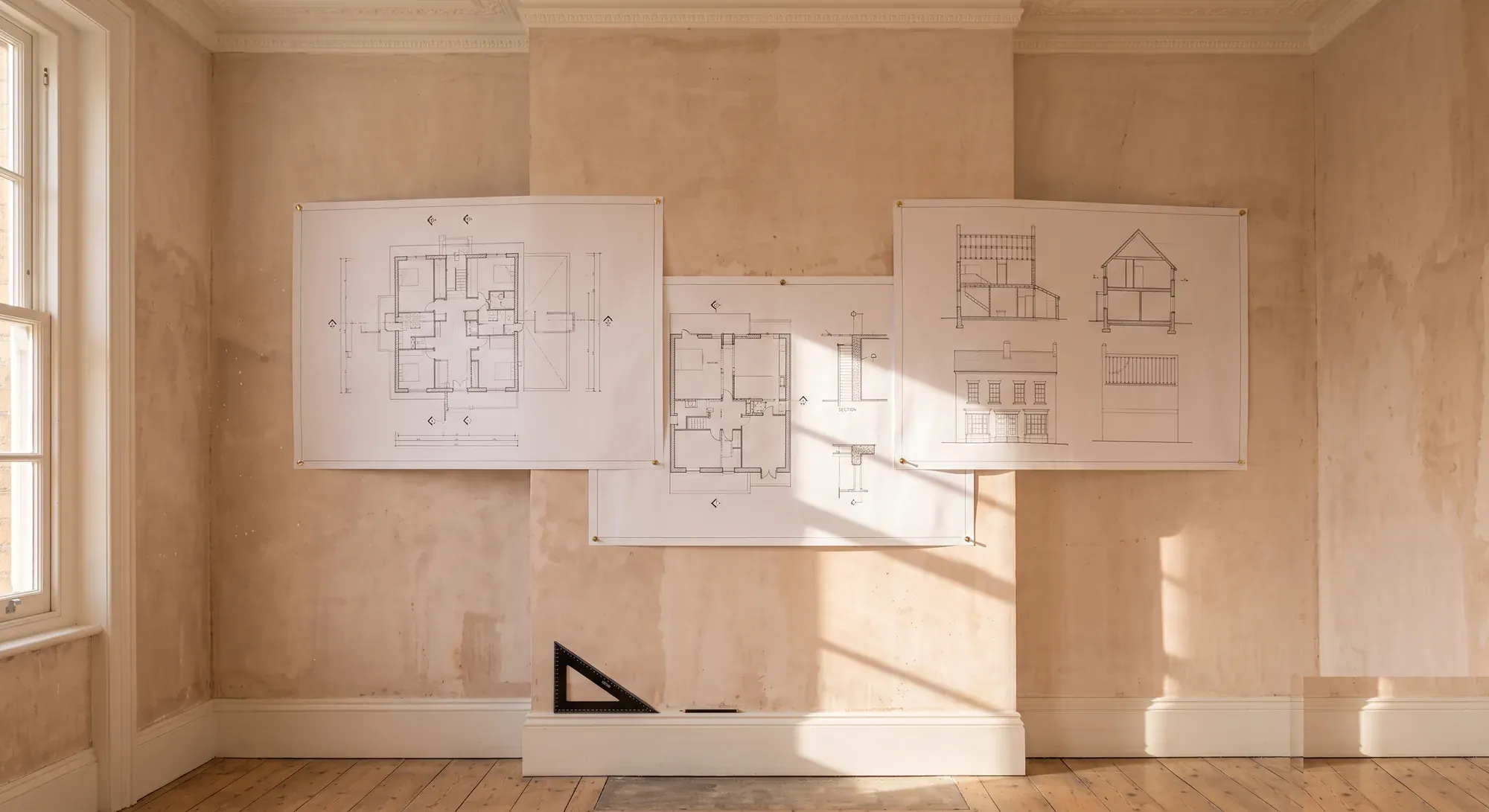
A householder planning application in England costs £548 from 1 April 2026. That is the fee to the council and it is not the cost of getting permission. Drawings, and a designer to produce them, are usually the larger number, and there are cheaper routes worth knowing about: a Lawful Development Certificate for a proposed use is £274, prior approval for a larger home extension is £249, and a non-material amendment after approval is £46.
Planning fees carry no VAT, because determining an application is treated as a non-business activity.
The fee schedule
Fees in England are set nationally and uprated each April. These apply from 1 April 2026, following indexation at the September 2025 CPI figure of 3.8%.
Application | Fee |
|---|---|
Householder: alterations or extensions to one house | £548 |
Two or more dwellings | £1,083 |
New single dwelling | £610 |
Works within the curtilage: outbuilding, boundary wall, hard surface | £272 |
Prior approval: larger home extension, or additional storeys | £249 |
Lawful Development Certificate, proposed use | Half the equivalent fee, so £274 for one house |
Lawful Development Certificate, existing use | Full fee, so £548 for one house |
Discharge of conditions, householder | £89 |
Minor material amendment under section 73, householder | £89 |
Non-material amendment | £46 |
Note the Lawful Development Certificate line, because the pricing is a formula rather than a fixed sum. The proposed-use certificate is half the fee for the equivalent application, which for a single house works out at £274. The existing-use certificate is the full fee.
The cheaper routes, and when each applies
Three of those rows can save you money and time, and they are underused.
A Lawful Development Certificate for a proposed use, £274. If you believe your work already falls within permitted development, you do not need permission, you need proof. This certificate is a formal determination that the work is lawful, at half the price of an application. It is the cheapest certainty in the planning system, and it produces a document you can hand a buyer's solicitor years later.
Prior approval for a larger home extension, £249. The route to the 8 metre allowance on a detached house or 6 metres on anything else. Adjoining owners get 21 days to make representations, prior approval is only required if one of them objects, and consent is deemed on the expiry of 42 days if the authority has not notified you, disregarding public holidays. Cheaper and faster than a full application, and unavailable on article 2(3) land such as a conservation area.
A non-material amendment, £46. If a small change is needed after approval, this is the route rather than reapplying at £548. Whether a change qualifies is the authority's judgement, so ask before assuming.
See permitted development rights explained to work out which of these applies to your situation.
The costs that are not the fee
For most renovations the application fee is the smallest line in getting permission, as our complete guide to planning permission explains. Three others are larger, and only one of them has a published range.
Drawings and a designer. You cannot submit without measured existing and proposed drawings at the right scale, and in practice you are paying someone to produce them. Published guidance puts architect and designer fees at between 3% and 15% of build cost, with a drawings-only package at the bottom of that range and a full service at the top. That is the widest and most consequential variable in the whole process.
Pre-application advice. Most authorities offer it and most charge for it. Charges are set locally and are not published centrally, so we are not going to quote a figure. It is worth asking your borough what it costs and what you get, because on a marginal scheme an officer's early view is often worth more than an appeal.
Discharging conditions. A conditional approval is not something you can build from until the conditions are discharged, and that is a separate application at £89 for a householder, with its own determination period.
Then there is everything that is not planning at all. Building control on an extension up to 40 square metres runs £700 to £1,300 including VAT, higher in inner London. A structural engineer, and a party wall surveyor where one is needed, sit outside both. Our guide to the hidden renovation costs that catch homeowners off guard covers the rest.
Getting your fee back
Worth knowing before you resign yourself to a slow application.
If the authority does not decide within the statutory period, you gain a right of appeal against non-determination. And if you do not appeal, the fee is refunded at 16 weeks from validation for a non-major application. On a householder application that is £548 returned.
Almost no homeowner knows this and fewer claim it. If your application has run well past eight weeks, ask the authority about the refund position directly.
There is also a free-go provision worth asking about: where an application has been refused, a resubmission of substantially the same scheme within twelve months can be exempt from a further fee. Confirm with your authority before paying twice.
Our guide to how long a planning permission decision takes sets out the periods those refunds hang off.
Where the money actually goes wrong
Three patterns, all avoidable.
Paying twice through an invalid submission. An incomplete application is not validated, so the clock never starts, and the design iterates while you wait. Every authority publishes a local validation list. Reading it is free.
Applying when you did not need to. Plenty of single-storey rear extensions fall within permitted development. Spending £548 and eight weeks on an application for work that was already lawful is a common and entirely avoidable cost, and £274 for a certificate would have proved it.
Designing past the limits by a small margin. A rear extension at 3.2 metres on a semi is an application. At 3 metres it is not. The value of the extra 200 millimetres is rarely £548 plus eight weeks plus a designer's revision fee, and that trade is worth making explicitly rather than by accident.
What planning does not cover
A planning decision notice says you may build it. It says nothing about how it must be built.
Building regulations are a separate consent, with a separate body, separate fees and separate consequences. You can have permitted development rights, meaning no planning application at all, and still need full building control approval. Our guide to how building regulations and planning permission differ covers this in full, including the fact that building regulations enforcement no longer has a time limit while planning enforcement does.
How Beams helps
The expensive version of planning is the one where the design is drawn, submitted, queried, revised and resubmitted, and each loop costs weeks.
So on a managed house extension we work out first whether an application is needed at all, use a certificate or prior approval where either is cheaper, get the submission complete rather than fast, and hold structural design until the planning outcome is known, because a condition on materials or height changes what you are building.
That is part of what a Beams project commits to: one agreed price, payments released against milestones, and 12 months on the workmanship.
Common questions
Is there VAT on planning fees?
No. Determining a planning application is treated as a non-business activity, so the fee carries no VAT. The professional fees around it, such as a designer, generally do.
Why is a Lawful Development Certificate cheaper than an application?
Because the fee is set as half the equivalent application fee for a proposed use, which comes to £274 for a single house. For an existing use it is the full fee.
Can I get my planning fee refunded?
Yes, in one situation. If the authority misses the statutory determination period and you do not appeal against non-determination, the fee is refunded at 16 weeks for a non-major application.
Do I pay again if I am refused?
Not necessarily. A resubmission of substantially the same scheme within twelve months of a refusal can be exempt from a further fee. Ask the authority to confirm before paying.
What is the total cost of getting planning permission?
The fee is £548 for a householder application. The drawings and designer are usually larger, at between 3% and 15% of build cost depending on the level of service, and pre-application advice is charged locally at rates that are not centrally published.
Where these figures come from
All application fees, applying from 1 April 2026 and indexed at the September 2025 CPI figure of 3.8%, and the treatment of fees as a non-business activity outside VAT: Ministry of Housing, Communities and Local Government planning fees indexation document
Fee refunds at 16 weeks for non-major and 26 weeks for major applications, and the right of appeal against non-determination: GOV.UK planning practice guidance on determining a planning application, updated 8 April 2026
Prior approval, the 21-day representation period and deemed consent after 42 days: Town and Country Planning (General Permitted Development) (England) Order 2015, Schedule 2, Part 1, Class A, paragraph A.4
Architect and designer fee range: HomeOwners Alliance, January and March 2026. No professional body publishes a fee scale
Building control charges: Building (Local Authority Charges) Regulations 2010 and published council fee schedules
Pre-application advice charges and planning appeal costs are set locally or are not centrally published, so no figure for either appears here. Fees change each April, so check the current schedule before applying. Planning differs in Wales, Scotland and Northern Ireland, and this page describes England.
Find out what your project will cost
Tell us about your project and we will get you up to three comparable quotes from vetted London builders, with the statutory fees identified rather than discovered.